Want to lower your chances for a cesarean?
The International Cesarean Awareness Network (ICAN) is pleased to announce a new online webinar! The ICAN Birth Class: Cesarean Prevention is scheduled for Tuesday, June 23rd at 10 p.m. EDT (7 p.m. PDT).
This webinar is perfect for the mom expecting her first baby, or for the mom who is planning a VBAC.
The $20 fee for the class goes directly to support ICAN's mission of promoting maternal-child health, providing emotional and physical support for women who have had cesareans, preventing unnecessary cesareans, and promoting Vaginal Birth After Cesarean (VBAC). ICAN has 110 chapters in North America and Europe, which hold educational and support meetings for people interested in cesarean prevention and recovery. It is also active in advocacy for childbirth issues nationally and internationally.
Remember, women in the USA have about a 1 in 3 chance in having their childbirth end surgically; for "obese" women, in many places, the chances are more like 1 in 2.....or higher.
Taking a webinar can't guarantee you won't have a cesarean, but it can certainly help raise your awareness of the factors that commonly lead to unnecessary cesareans.
That way, hopefully we can keep cesareans reserved for the cases in which they are truly necessary, and avoid exposing women and babies to the risks of surgery when it's not really needed.
[Potential risks to babies from cesareans include: low birth weight, prematurity, respiratory problems, and lacerations. Potential risks to women include: hemorrhage, infection, hysterectomy, surgical mistakes, re-hospitalization, dangerous placental abnormalities in future pregnancies, unexplained stillbirth in future pregnancies and increased percentage of maternal death.]
You can find out more about the ICAN Birth Class: Cesarean Prevention here:
http://ican-online.org/none/ican-birth-class-cesarean-prevention
Attendees may register here:
https://www2.gotomeeting.com/register/999201490
*Don't worry, I'm still working on my post about prenatal weight gain and women of size! Almost there! Just wanted to get the word out on this cesarean prevention class so interested folk have plenty of time to register.
Wednesday, June 17, 2009

Friday, May 29, 2009
Yes, I've seen the new Institute of Medicine guidelines on how much weight "obese" women are supposed to gain (or more accurately, not gain) during pregnancy. (See Yahoo "health" news.) Wanted to reassure you all that I will be commenting on it soon.
But first I have to put top priority on some mom stuff, some end-of-the-school-year activities and big events that need my more immediate attention, and then I'll get to this. Sometimes blogging has to take a back seat to real life, but wanted to reassure you that I'm aware of this story and have plans to discuss it.
In the meantime, feel free to talk among yourselves about the new guidelines. What do you think of them, how do they make you feel, what are your concerns, are they realistic, what do you think the practical application of the guidelines will be in clinical practice?
I'll publish comments frequently until I have time to blog more fully about this, but in the meantime, let's start some dialogue on the topic.
What do you think about the new IOM guidelines?
But first I have to put top priority on some mom stuff, some end-of-the-school-year activities and big events that need my more immediate attention, and then I'll get to this. Sometimes blogging has to take a back seat to real life, but wanted to reassure you that I'm aware of this story and have plans to discuss it.
In the meantime, feel free to talk among yourselves about the new guidelines. What do you think of them, how do they make you feel, what are your concerns, are they realistic, what do you think the practical application of the guidelines will be in clinical practice?
I'll publish comments frequently until I have time to blog more fully about this, but in the meantime, let's start some dialogue on the topic.
What do you think about the new IOM guidelines?
Monday, May 25, 2009
Holiday Fluff: No. 1 Ladies' Detective Agency
 Although I'm busy like crazy right now, trying to get through end-of-the-school-year activities, I did find time recently while I was doing laundry to watch a new TV series. Now I'm a big fan and I have to spread the word!
The series is called "The No. 1 Ladies' Detective Agency" and it's on HBO. They just finished the first run of the series but it will get repeated soon so if you haven't seen it yet, put it on your "record" list ASAP.
The series stars Jill Scott, an American singer and actress. She is a woman of size. Huzzah!
The thing that's most refreshing about the series is that this well-rounded woman is portrayed as a completely well-rounded human being too. How often is a woman of size allowed to be more than a one-note caricature on TV? Yet this character is. She's smart, she's sassy, she's vulnerable, she's assertive, she makes mistakes, she falls in love, she solves cases, and oh yeah, she's funny too.
I haven't yet seen the first couple of episodes in the series because I only heard about it partway through its run. I set my DVR to record the rest of the series, but I was so busy I didn't get to watch it for quite some time. In fact, I almost deleted it, thinking I'd never get around to it anyhow......but thank goodness I took a chance and peeked at it while folding some laundry one night! I quickly got hooked.
It's not a laugh-out-loud, smile-a-minute series. It's quirky and atmospheric, and the humor is more chuckle-y and character-driven. It also has some sad moments and a little romance thrown in for good measure too. It's just charming overall, and was definitely quite enjoyable. Even my husband got hooked after a while, despite initially thinking he wouldn't care for it.

Jill Scott, the star, was pregnant for the filming, so there's even a well-rounded mama connection!! How cool is that!
I was watching her in the series before I knew she was pregnant and just had a little inkling of something, that little intuition I get sometimes when people are pregnant. It was just the way her body was shaped and the way she moved, I think....kinda rang a memory bell for me. I shrugged it off at the time but now that I know she was pregnant during the filming, I get a little chuckle out of it. My "babydar" is still going strong!
The good news is that she had her baby last month. What a lovely gift for her after experiencing years of infertility, and what a note of hope to other women who have been through the infertility rollercoaster too. Congratulations to her on her new son!
I should note that the series is not perfectly fat-friendly. There are a few remarks here and there about "overeating" or vague insults about her shape from others, and they did pad her some for the role.........but the director and author were adamant about having a woman of size (what they call a "traditional build") in the role, and for the most part, she is treated with real respect and portrayed as a woman of beauty.

And she really is beautiful in the role, too. Look at her picture there. What a gorgeous woman.
There are also occasional people of size in other characters as well. Usually, on the rare occasion there is a fat person in a movie or series, he/she is the token fat person, rather than having a cast full of people of varying sizes to represent the diverse spectrum in most societies. So that diversity of size among multiple characters in this series was refreshing too.
The show is based on a book series by Alexander McCall Smith, and the action takes place in Botswana. Others have said that it stays very true to the culture of Botswana and is very respectful of its people. It is a fascinating and gentle introduction to this very inviting culture and definitely makes you want to learn more about it.
The series has quite a pedigree of famous people. The two-hour series pilot was directed by the late Anthony Minghella (Oscar winner for "The English Patient"); it was co-produced by the late Sydney Pollack ("Out of Africa") and co-written by Richard Curtis ("Four Weddings and A Funeral"). Famous guest stars in the show include CCH Pounder ("ER" and "The Shield") and Idris Elba ("The Wire" and "The Office").
The lead in the show is Jill Scott, a Grammy Award-winning singer, poet, and actress. She plays Precious Ramotswe, a woman who ends an abusive marriage, then takes an inheritance from her father and turns it into a detective agency, supposedly the first in Botswana. Although she is a detective and the show features some mysteries, they are refreshingly less graphic than the usual "CSI" style fare and feature some unique African twists to the stories.
The secondary lead in the show is Anika Noni Rose, from "Dreamgirls." She is a Tony-award winning actress who is set to become Disney's first black animated princess character later this year. She plays Grace Makutsi, the secretary and aspiring detective at the agency. Her character is more stiff; the actress seems to be playing it for laughs and it doesn't work at first glance. But as the series progresses on, the character begins to "click" and her mannerisms become more quirky and humorous and gives some genuine chuckles later on.
I've read reviews that say that the pilot drags a bit and that the series doesn't really hit its stride until about halfway through. Since that's about when I really started watching, I can't say. All I know is that the last several episodes were really charming and if you start from the beginning of the series, it may behoove you to stick with it for a few episodes if it doesn't "spark" for you at first.
I look forward to catching the rest of the episodes soon and I really hope that HBO will make more in the future. It's certainly a series worth continuing.
*According to the HBO website, it looks like the series is scheduled to repeat next weekend, starting on May 30th and 31st. Be sure to set it to record if you get HBO. Definitely worth catching.
Sunday, May 17, 2009
Going in the Wrong Direction
The Los Angeles Times actually had a pretty decent article recently about the strong rise in childbirth-related healthcare costs, and declining U.S. childbirth outcomes. You can read it here.
Even if you are not pregnant or will not ever have children, this is an important article to read because the topic affects your bottom line....your pocketbook.
The article makes the important point that our increasing use of interventions like induction and cesarean sections are driving up our healthcare costs enormously while not improving outcomes. Indeed, some outcomes are actually going downhill.
The article discusses how the rising cesarean rate in particular is driving up healthcare costs and resulting in poorer outcomes.
Or you can select a hospital care provider who follows the midwifery model of care, which emphasizes proactive prevention of problems, de-emphasizes use of interventions such as inductions, individualizes care based on each woman's needs, and sees labor and birth as a normal physiological process instead of a disaster waiting to happen.
Some doctors follow tenets of the midwifery model of care, and not all midwives follow the midwifery model. You can't always tell a provider's philosophy by their title or degree, so it's not simply a matter of choosing always choosing a midwife, and of course, some women have complications or special needs that necessitate seeing a doctor.
But if you ask careful questions and choose a provider that practices from the midwifery model, whatever their title, chances are much higher of you avoiding unneeded interventions and having a spontaneous vaginal birth.
Too Little Support For VBAC
The article also discusses how doctors frequently limit women's access to Vaginal Birth After Cesarean, or VBAC.
The International Cesarean Awareness Network (ICAN) did a telephone survey this year of virtually all the hospitals in the United States and found that nearly half did not permit VBACs, either by outright policy ban or because no doctors at the hospital would take a VBAC.
In fact, even in the hospitals that in theory "permitted" VBACs, few actually had many VBACs occur, which means that their "support" for VBACs was mostly theoretical and in reality, most mothers were talked out of a VBAC.
Based on the comments ICAN received in the survey, they estimated that only about 10% of hospitals contacted were truly VBAC-supportive, where women would actually have a reasonably good chance of having a VBAC. That's the apalling state of VBAC in this country today.
Consider the healthcare implications of this. If the rate of cesareans in first-time mothers is strongly increasing, and if most doctors do not support VBAC anymore, that means that nearly all those mothers will be having repeat cesareans for any subsequent children. It doesn't take long for that to really add up.....and for the related costs to add up too.
The lack of access to VBAC for most women means that a lot of unnecessary repeat cesareans are being performed all over the U.S., and that's another reason why our healthcare costs are spiraling completely out of control.
Even when there are no complications, the hospital stay for a cesarean is twice as long, and the costs for all the services needed are higher. Add in complications such as wound infections, blood clots, hemorrhage, and breathing issues for the baby (all of which are higher with a cesarean), and all these cesareans are really costing a lot. As the article notes:
Too Many Early Deliveries
Another important point the article made is the trend to deliver babies earlier and earlier.
The average pregnancy lasts between 38-42 weeks, with 40 weeks being considered the official "due date." But the length of the average pregnancy has declined, according to the article, and is now just 39 weeks.
Yet early delivery often creates problems with babies that just aren't quite ready to be out in the world yet. Babies born even just a little too early can have trouble with their breathing, with maintaining a stable blood sugar, with nursing effectively, and with neonatal jaundice. This means they often go to the Neonatal Intensive Care Unit (NICU), and that drives up healthcare costs. From the article:
The Burden of Rising Maternity Costs
Rising maternity costs are taking up an increasing proportion of the already over-bloated healthcare budget in the U.S., and will only continue to rise as the rates of interventions like cesareans go up. In an increasingly stressed economy, this makes no sense.
Even if you never plan to have children, pressing for childbirth reform is in your own best interest because of the ultimate impact of an out-of-control cesarean rate on healthcare costs that you will have to help shoulder.
It's time to press for institutional change, for policies that strongly discourage early delivery, for policies that discourage induction for convenience or for "soft" indications, for policies that strongly discourage unnecessary cesareans, and to demand that hospitals honor women's right to access VBACs.
And for those who plan to have children, we as consumers can drive this maternity care reform by voting with our feet.
We can demand that hospitals and doctors be required to report their cesarean rates to the public, we can boycott hospitals and doctors with high cesarean rates (and let them know why we are not choosing them), we can refuse to allow early and unnecessary interventions, and we can choose a provider that follows the midwifery model of care to lessen our risks of costly procedures like inductions and cesareans.
Childbirth care and outcomes are indeed going in the wrong direction in many ways, and it's up to all of us to help change that trend.
Even if you are not pregnant or will not ever have children, this is an important article to read because the topic affects your bottom line....your pocketbook.
The article makes the important point that our increasing use of interventions like induction and cesarean sections are driving up our healthcare costs enormously while not improving outcomes. Indeed, some outcomes are actually going downhill.
Too Many CesareansChildbirth often is held up in healthcare reform debates as an example of how the intensive and expensive U.S. brand of medicine has failed to deliver better results and may, in fact, be doing more harm than good.
"We're going in the wrong direction," said Dr. Roger A. Rosenblatt, a University of Washington professor of family medicine who has written about what he calls the "perinatal paradox," in which more intervention, such as cesareans, is linked with declining outcomes, such as neonatal intensive care admissions. Maternity care, he said, "is a microcosm of the entire medical enterprise."
The article discusses how the rising cesarean rate in particular is driving up healthcare costs and resulting in poorer outcomes.
One of the more interesting points the article made was how much depends on your choice of birthplace. You really shouldn't just choose the hospital closest to you. Your chances of interventions like a cesarean varies dramatically, depending on which hospital you go to.Once reserved for cases in which the life of the baby or mother was in danger, the cesarean is now routine. The most common operation in the U.S., it is performed in 31% of births, up from 4.5% in 1965.
With that surge has come an explosion in medical bills, an increase in complications -- and a reconsideration of the cesarean as a sometimes unnecessary risk.
Among California hospitals, cesareans range from 16% to 62% of births. Such variation means a lot of women are getting unnecessary cesareans, Main said. "There's no justification for that kind of variation." [emphasis mine]Of course, you can decrease your risk for cesareans even more by choosing an out-of-hospital birth, which more and more women are recognizing as a reasonable alternative (and which has been endorsed by the Royal College of Obstetricians and Gynaecologists in the U.K. as a reasonable choice for women with uncomplicated pregnancies).
Or you can select a hospital care provider who follows the midwifery model of care, which emphasizes proactive prevention of problems, de-emphasizes use of interventions such as inductions, individualizes care based on each woman's needs, and sees labor and birth as a normal physiological process instead of a disaster waiting to happen.
Some doctors follow tenets of the midwifery model of care, and not all midwives follow the midwifery model. You can't always tell a provider's philosophy by their title or degree, so it's not simply a matter of choosing always choosing a midwife, and of course, some women have complications or special needs that necessitate seeing a doctor.
But if you ask careful questions and choose a provider that practices from the midwifery model, whatever their title, chances are much higher of you avoiding unneeded interventions and having a spontaneous vaginal birth.
Too Little Support For VBAC
The article also discusses how doctors frequently limit women's access to Vaginal Birth After Cesarean, or VBAC.
The International Cesarean Awareness Network (ICAN) did a telephone survey this year of virtually all the hospitals in the United States and found that nearly half did not permit VBACs, either by outright policy ban or because no doctors at the hospital would take a VBAC.
In fact, even in the hospitals that in theory "permitted" VBACs, few actually had many VBACs occur, which means that their "support" for VBACs was mostly theoretical and in reality, most mothers were talked out of a VBAC.
Based on the comments ICAN received in the survey, they estimated that only about 10% of hospitals contacted were truly VBAC-supportive, where women would actually have a reasonably good chance of having a VBAC. That's the apalling state of VBAC in this country today.
Consider the healthcare implications of this. If the rate of cesareans in first-time mothers is strongly increasing, and if most doctors do not support VBAC anymore, that means that nearly all those mothers will be having repeat cesareans for any subsequent children. It doesn't take long for that to really add up.....and for the related costs to add up too.
The lack of access to VBAC for most women means that a lot of unnecessary repeat cesareans are being performed all over the U.S., and that's another reason why our healthcare costs are spiraling completely out of control.
Even when there are no complications, the hospital stay for a cesarean is twice as long, and the costs for all the services needed are higher. Add in complications such as wound infections, blood clots, hemorrhage, and breathing issues for the baby (all of which are higher with a cesarean), and all these cesareans are really costing a lot. As the article notes:
Because spending on the average uncomplicated cesarean for all patients runs about $4,500, nearly twice as much as a comparable vaginal birth, cesareans account for a disproportionate amount (45%) of delivery costs. (Among privately insured patients, uncomplicated cesareans run about $13,000.)So not only does the rising primary cesarean rate cost our healthcare system dearly, the fact that few hospitals currently support VBACs will continue to cause a rebound effect, driving the cesarean rate (and our healthcare costs) even higher in years to come.
Too Many Early Deliveries
Another important point the article made is the trend to deliver babies earlier and earlier.
The average pregnancy lasts between 38-42 weeks, with 40 weeks being considered the official "due date." But the length of the average pregnancy has declined, according to the article, and is now just 39 weeks.
Yet early delivery often creates problems with babies that just aren't quite ready to be out in the world yet. Babies born even just a little too early can have trouble with their breathing, with maintaining a stable blood sugar, with nursing effectively, and with neonatal jaundice. This means they often go to the Neonatal Intensive Care Unit (NICU), and that drives up healthcare costs. From the article:
In an analysis of its claims, United[Healthcare Services Inc.] found that 48% of newborns admitted to neonatal intensive care units were from scheduled deliveries, many of them before 39 weeks.One of the best ways to start reducing maternity costs is to decrease the rate of early inductions and cesareans. This should start from the top-down, from institutional policies, but until those institutions really start reforming their practices, it can start with mothers refusing early interventions that are not truly medically necessary. Even better, it can start with women refusing to choose a provider likely to order such early interventions.
The Burden of Rising Maternity Costs
Rising maternity costs are taking up an increasing proportion of the already over-bloated healthcare budget in the U.S., and will only continue to rise as the rates of interventions like cesareans go up. In an increasingly stressed economy, this makes no sense.
Pregnancy is the most expensive condition for both private insurers and Medicaid, according to a 2008 report by the Childbirth Connection, a New York think tank.It is time for some healthcare reform, and one of the first places to start is in the maternity care system and the skyrocketing rates of inductions and cesareans.
"The financial toll of maternity care on private [insurers]/employers and Medicaid/taxpayers is especially large," the report said. "Maternity care thus plays a considerable role in escalating healthcare costs, which increasingly threaten the financial stability of families, employers, and federal and state budgets."
Even if you never plan to have children, pressing for childbirth reform is in your own best interest because of the ultimate impact of an out-of-control cesarean rate on healthcare costs that you will have to help shoulder.
It's time to press for institutional change, for policies that strongly discourage early delivery, for policies that discourage induction for convenience or for "soft" indications, for policies that strongly discourage unnecessary cesareans, and to demand that hospitals honor women's right to access VBACs.
And for those who plan to have children, we as consumers can drive this maternity care reform by voting with our feet.
We can demand that hospitals and doctors be required to report their cesarean rates to the public, we can boycott hospitals and doctors with high cesarean rates (and let them know why we are not choosing them), we can refuse to allow early and unnecessary interventions, and we can choose a provider that follows the midwifery model of care to lessen our risks of costly procedures like inductions and cesareans.
Childbirth care and outcomes are indeed going in the wrong direction in many ways, and it's up to all of us to help change that trend.
Wednesday, May 13, 2009
Care Providers vs. "Scare" Providers
Far too many doctors and other healthcare professionals have decided to become "Scare Providers" instead of "Care Providers." This seems to be particularly true for fat women in the realm of pregnancy and childbirth.
I am hearing more and more stories lately about doctors telling fat women that they will never have a healthy pregnancy, that if they dare to become pregnant at their size they will probably die, that their baby will die, or that they will never have a healthy baby.
This kind of bullying is not the experience of all fat women, mind, but I am hearing this kind of story much more often than I used to. The risks around pregnancy in women of size has become SO hyped now that some doctors are totally distorting the actual risks way out of proportion, trying to scare fat women away from having babies at all.
The Newest Story for the "Scare Providers Hall of Shame"
A mother from a support group for women of size recently wrote about her experience going to a Reproductive Endocrinologist (RE). She gave me permission to share it here.
She is 29 years old, "overweight," and has been trying to get pregnant for 2 years without success. She saw an OB, who determined that she has a blocked tube and doesn't ovulate regularly. They did lab work and counseling to discuss her risk factors and to work out a healthy, sane proactive plan for having a healthy pregnancy. Then her OB sent her to her local RE for help in getting pregnant.
The RE took one look at her size and started interrogating her. In the end, he refused to help her, telling her it would be "unethical" to assist them with pregnancy because of her size.
He also told them that if they were to get pregnant somehow, "The baby would only have a 5% chance of survival." FIVE PERCENT.
Then he told them that he would be writing a letter to her doctors so they would quit wasting his time with cases such as hers anymore.
Now, I have no idea where that doctor got that "5% chance of survival" bullshit. I've read a LOT of medical studies on "obesity" and pregnancy, and I have NEVER seen any number like that in ANY study.
It was purely and totally a scare tactic number, pulled out of his behind and not based on any real research. Bottom line, it was designed to bully and frighten this woman out of having a baby.
Fortunately, she didn't buy into this bullshit at all, but how many fat women have been told crap like this (or read scary online "information" articles and media releases) and are intimidated out of having children?
Other Stories in the Hall of Shame
This is just the latest story of fat bias mistreatment. You'd think I'd get used to reading these by now, but my blood starts boiling every time I read these things.
I've documented other stories like this on my blog before, but it was early in the history of the blog and few people had found me then, so pardon me for a little repetition. Let me hit some of the "highlights" for you.
First, there's the story of the woman who emailed me last year about "Suicide By Pregnancy." An OB at a prestigious university medical school told her that if she chose to continue her pregnancy, she would almost surely die. Here's a quote:
Just before the cesarean, the OB pressured her to agree to tie her tubes so she wouldn't have any more pregnancies. When she would not agree, they implied she would not survive the surgery, asked if she was an organ donor, and wanted to know what funeral home to use.
Then they used a classical incision in the cesarean (a huge up-down incision, which is usually used only when a baby needs to come out as FAST as possible, which was not true here), and told her that if she dared have another pregnancy, her uterus would "explode."
In other words, they found a way to punish her and scare her out of another pregnancy, despite her not agreeing to let them tie her tubes.
After the surgery, they took turns coming into her room and yelling at her about losing weight:
As one woman recounted:
A New Form of Medical Bullying
Medical bullying has been around for "obese" people for a long, long time, but it only seems to be getting worse now with all the hype about obesity.
Fat women have been having babies for years too, but the risks of obesity and pregnancy are so hyped nowadays in the media and the medical literature that doctors have a hugely exaggerated sense of risk with it.
Because of this, they feel justified in a nearly 50% cesarean rate for "morbidly obese" women (or more; that study was only on first-time mothers); in preventing fat women from having access to reproductive technology (as is happening in the UK); in pressuring women of size to not get pregnant unless they get to a "normal" BMI first (which, given the long-term failure rate of dieting, basically means that very few will ever have babies); or in scaring fat women out of trying to conceive at all or into terminating their pregnancies.
Basically, they are trying to emotionally manipulate fat women out of pregnancy (or further pregnancies) by any means they can.
I've said it before but it bears repeating.....this kind of over-the-top BULLYING is a total exaggeration of the risks, and basically amounts to trying to scare women of size out of having babies rather than giving them reasonable counseling about possible risks and ways to mitigate those risks.
It is a unique and insidious form of eugenics and IT MUST STOP.
*If you have a story of fat-biased treatment that you encountered during pregnancy or birth, please feel free to email it to me at kmom at plus-size-pregnancy dot org. It's very important that we document these kinds of incidents.
I am hearing more and more stories lately about doctors telling fat women that they will never have a healthy pregnancy, that if they dare to become pregnant at their size they will probably die, that their baby will die, or that they will never have a healthy baby.
This kind of bullying is not the experience of all fat women, mind, but I am hearing this kind of story much more often than I used to. The risks around pregnancy in women of size has become SO hyped now that some doctors are totally distorting the actual risks way out of proportion, trying to scare fat women away from having babies at all.
The Newest Story for the "Scare Providers Hall of Shame"
A mother from a support group for women of size recently wrote about her experience going to a Reproductive Endocrinologist (RE). She gave me permission to share it here.
She is 29 years old, "overweight," and has been trying to get pregnant for 2 years without success. She saw an OB, who determined that she has a blocked tube and doesn't ovulate regularly. They did lab work and counseling to discuss her risk factors and to work out a healthy, sane proactive plan for having a healthy pregnancy. Then her OB sent her to her local RE for help in getting pregnant.
The RE took one look at her size and started interrogating her. In the end, he refused to help her, telling her it would be "unethical" to assist them with pregnancy because of her size.
He also told them that if they were to get pregnant somehow, "The baby would only have a 5% chance of survival." FIVE PERCENT.
Then he told them that he would be writing a letter to her doctors so they would quit wasting his time with cases such as hers anymore.
Now, I have no idea where that doctor got that "5% chance of survival" bullshit. I've read a LOT of medical studies on "obesity" and pregnancy, and I have NEVER seen any number like that in ANY study.
It was purely and totally a scare tactic number, pulled out of his behind and not based on any real research. Bottom line, it was designed to bully and frighten this woman out of having a baby.
Fortunately, she didn't buy into this bullshit at all, but how many fat women have been told crap like this (or read scary online "information" articles and media releases) and are intimidated out of having children?
Other Stories in the Hall of Shame
This is just the latest story of fat bias mistreatment. You'd think I'd get used to reading these by now, but my blood starts boiling every time I read these things.
I've documented other stories like this on my blog before, but it was early in the history of the blog and few people had found me then, so pardon me for a little repetition. Let me hit some of the "highlights" for you.
First, there's the story of the woman who emailed me last year about "Suicide By Pregnancy." An OB at a prestigious university medical school told her that if she chose to continue her pregnancy, she would almost surely die. Here's a quote:
He told me that I wasn't going to make it alive through my pregnancy and that they would "have to take drastic measures to try save me before they would even attempt to save my baby" etc.Or there's Gina Marie's story, where she was induced early because of a suspected big baby, which resulted in a cesarean, as inducing early for a big baby often does. (Of course, they blamed the c-section on her obesity instead of on inducing for macrosomia, naturally.)
He kept saying I shouldn't have gotten pregnant, that I had in a sense, committed suicide! He told me that my heart was going to give out, or that I was going to stroke out while attempting to push my LARGE baby out, therefore I was going to have a c-section. He told me that I was going to have massive blood clots in my legs and severe pre-eclampsia.
I left his office completely panicked and in tears. I was shaking so bad I could hardly walk and all he did was look at me and said in a cold voice with no emotion at all, "It's really scary, isn't it."
Just before the cesarean, the OB pressured her to agree to tie her tubes so she wouldn't have any more pregnancies. When she would not agree, they implied she would not survive the surgery, asked if she was an organ donor, and wanted to know what funeral home to use.
Then they used a classical incision in the cesarean (a huge up-down incision, which is usually used only when a baby needs to come out as FAST as possible, which was not true here), and told her that if she dared have another pregnancy, her uterus would "explode."
In other words, they found a way to punish her and scare her out of another pregnancy, despite her not agreeing to let them tie her tubes.
After the surgery, they took turns coming into her room and yelling at her about losing weight:
Not only did I need to diet, but if I did not do so, I would be dead before ten years, because women my size don't live past 40. My child would never love me because he would be so ashamed to have a fat mama. Fat women are bad mothers who can't keep up with their children, and their children suffer for it. By obstinately continuing to be fat, I would show myself to be an unfit mother.Then of course, there are the fat women who are pressured to terminate their pregnancies, simply because they are fat. The implication is that the baby of a fat woman could never be healthy, that pregnancy at larger sizes is so dangerous that the pregnancy must be aborted in order for the woman to survive, or that the baby would die in a fat pregnancy anyhow so you might as well abort sooner than later.
As one woman recounted:
I also was told I could not have kids. Then when I got pregnant I was told by various doctors for various reasons that I should abort.This is the latest tactic in the obesity hysteridemic------extreme medical bullying.
A New Form of Medical Bullying
Medical bullying has been around for "obese" people for a long, long time, but it only seems to be getting worse now with all the hype about obesity.
Fat women have been having babies for years too, but the risks of obesity and pregnancy are so hyped nowadays in the media and the medical literature that doctors have a hugely exaggerated sense of risk with it.
Because of this, they feel justified in a nearly 50% cesarean rate for "morbidly obese" women (or more; that study was only on first-time mothers); in preventing fat women from having access to reproductive technology (as is happening in the UK); in pressuring women of size to not get pregnant unless they get to a "normal" BMI first (which, given the long-term failure rate of dieting, basically means that very few will ever have babies); or in scaring fat women out of trying to conceive at all or into terminating their pregnancies.
Basically, they are trying to emotionally manipulate fat women out of pregnancy (or further pregnancies) by any means they can.
I've said it before but it bears repeating.....this kind of over-the-top BULLYING is a total exaggeration of the risks, and basically amounts to trying to scare women of size out of having babies rather than giving them reasonable counseling about possible risks and ways to mitigate those risks.
It is a unique and insidious form of eugenics and IT MUST STOP.
*If you have a story of fat-biased treatment that you encountered during pregnancy or birth, please feel free to email it to me at kmom at plus-size-pregnancy dot org. It's very important that we document these kinds of incidents.
Friday, May 8, 2009
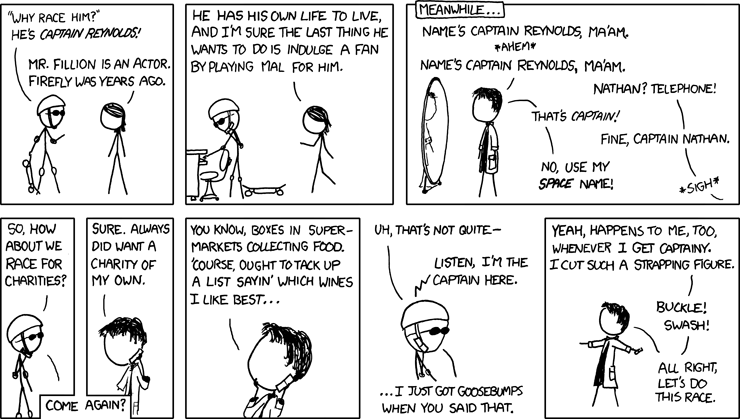
Friday Fluff: Attn Firefly/Serenity Fans!
Okay, I really didn't want to interrupt my fetal malposition series for something non-sequiturish and fluffy, but what the heck. It's Friday and I'm going to see the new Star Trek movie tonight. Geekdom SO trumps continuity.
If you are a Firefly/Serenity browncoat (or Nathan Fillion) fan at all, you have got to check out these comics. Too funny!!!
Be sure to read the whole series. Here's the link to the first in the series.
http://xkcd.com/577/
Here's part 2.

If you are a Firefly/Serenity browncoat (or Nathan Fillion) fan at all, you have got to check out these comics. Too funny!!!
Be sure to read the whole series. Here's the link to the first in the series.
http://xkcd.com/577/
Here's part 2.
Wednesday, May 6, 2009
How Fetal Position Can Affect Labor
We've been talking about how fetal position can affect a woman's belly shape. Today, we start discussing how it can affect labor.
As a reminder of what we discussed last time, remember that an Anterior baby (Occiput Anterior, or OA) means the baby is head-down; the back of the baby's head is towards mom's belly and the baby is facing towards mom's back.
Anterior
Baby
A Posterior baby (Occiput Posterior, or OP) means that the baby is also head down BUT the back of the its head is towards mom's back and baby is facing towards mom's front. Other names for the OP position include "stargazer" or "sunny side up" because the baby seems to be looking "up" at the sky when mom is lying down.
Posterior
Baby
Why Fetal Position is Relevant
Question: Why be concerned about the position of the baby before birth?
Answer: Because the anterior position (facing mom's back) is generally an easier position for birth. A posterior baby (facing mom's belly) is generally a harder position for birth and the cause behind many cesareans these days.
But why is that? Well, there are a number of factors that are at work here.
Speed and Ease of Labor
Generally speaking, anterior babies are born more quickly and easily than posterior babies.
Labor with an anterior baby is usually less painful and progresses smoothly (as long as the baby is lined up well and does not get a hand or arm in the way!).
Labor with persistently posterior babies tends to be slower and more painful, and more prone to stall partway through labor. (More on that below.)
"Fit" Problems
With an anterior baby, the diameter of the baby's head that presents through the pelvis is smaller because the angle is different. The chin is usually tucked down so the smallest possible diameter of the crown of the head presents at the cervix. This then applies nice even pressure on the cervix so it usually dilates reasonably fast and easily.
The angle of presentation of the baby's head is different with a posterior baby, so the diameter of the head that must fit through first is larger. Furthermore, an OP baby often does not tuck his chin to his chest as much (sometimes called a "military" position), and its de-flexed head makes an even bigger diameter to fit through.
Some sources state that the average OA baby's head diameter is about 9.5 cm, compared to 11.5 cm for the same baby if he is OP and de-flexed. Two centimeters doesn't sound like a lot, but it's around 20% of the total diameter of the baby's head, which is significant. And that 20% can make a lot of difference in how quickly and easily the baby fits through the pelvis. (See the pictures below.)
In addition, the "fit" of the baby's head in mom's pelvis is trickier with an OP baby and there's not as much room for error. If the baby is a little out of alignment in an anterior position, he can usually still fit through. If he is a little out of alignment in a posterior position, the same baby may not "fit" as well.
Molding Issues
Because the OP baby's head enters in a larger diameter and is often deflexed, it has to mold more.
"Molding" is where the bones of the baby's head slide over each other, like the metal plates of a vegetable steamer that fold in. This helps to make the head smaller and helps it fit through more easily. It's one of nature's ways to ensure that babies of diverse sizes can fit through pelvi of diverse shapes and sizes.
Molding is natural and no big deal, but there's quite a bit more molding needed with a posterior baby and that takes a lot of time. Alas, hospitals are notoriously impatient with "slow" labors.
Slower Dilation and Labor Dystocia
Because the pressure on the cervix with an posterior baby tends to be more uneven, dilation also tends to be slower and more uneven.
Furthermore, because the presenting diameter of the head is larger and needs more time to mold, a posterior labor often stalls out or slooooows down for a while in the middle of labor. This slowing/stalling is called "labor dystocia" and usually happens at about 4-7 cm.
Even though she is still only about partway through labor, during labor dystocia the mother may be showing classic signs of "transition" (the last part of labor) like shaking, intense pain, a premature urge to push, exhaustion, or wanting to give up.
If the baby needs to do extensive molding, this labor dystocia stage may go on for quite some time and can be very discouraging and tiring. As a result, a lot of women request epidurals (or even cesareans) at this point---often out of sheer exhaustion.
More Interventions
Because the posterior labor tends to be slower and may stall for a while, medical interventions are often used to compensate. Hospitals often try to speed things up by artificially strengthening contractions with drugs (pitocin augmentation) or by breaking the mother's water.
It should be noted that sometimes this does work just fine and may be better than doing nothing.......but sometimes it permanently jams the baby into a bad position that he can't get out of. His head gets stuck in that position, the pitocin augmentation keeps ramming him into the pelvis at a bad angle, and the pitocin may start reducing the amount of oxygen getting to him. As a result, he may go into fetal distress.
Also, once the mother's waters are broken, the cushion of fluid is lost. Labor usually becomes much more painful for the mother, the lack of cushioning fluid makes it more difficult for baby to rotate OA, and the baby has less protection, making him more vulnerable to fetal distress and infection. Many cesareans are done at this point because the baby is not tolerating labor well.
Furthermore, because of the uneven pressure on the cervix, there is often a cervical "lip" left near the end of dilation. Care providers often manually push this out of the way, over the baby's head----another quite painful intervention common to posterior labors.
It's no wonder that many moms with posterior babies are ready to call it quits before the baby is even born.
Back Labor
Labor with an OP baby tends to be more painful and difficult. The back of the baby's head tends to hit against the mother's sacrum, making labor more painful and concentrated in the back and pelvis (and sometimes the hips, if the baby tries to rotate to anterior). Back labor and OP positioning are not always connected, but they are frequent companions.
Requests for pain relief are more common with posterior babies because of the combination of back labor, labor augmentation drugs, breaking the mother's bag of waters, and the sheer exhaustion of a long hard labor. Many, many moms with persistently posterior babies end up with epidurals, even those who strongly desired natural childbirth beforehand.
Sometimes the epidural will help ease the pain from an OP labor enough to relax the muscles and help the baby turn anterior. However, because an epidural partially paralyzes the muscles of the uterus that help maneuver the baby through the pelvis, sometimes the epidural makes it even more difficult for the baby to turn anterior. So while sometimes an epidural can help in an OP labor, sometimes it's just another step along the way to a cesarean.
Ironically, the pain relief from epidurals tends to be less effective with an OP baby. There is often a need for frequent re-dosing of the epidural, and pain relief can be spotty, with "windows" of sensation. No one is quite sure why this happens, but it probably results from a lack of uniform distribution of epidural meds because of the pressure from the baby's head against the mother's spinal column.
Inadequate pain relief during a long, hard labor is another reason why mothers and hospital staff may be more quick to move to a cesarean. No one likes to suffer (or to watch others suffer), and a cesarean may seem like the most compassionate thing to do at that point....the best way "out" of a tough situation.
However, the spotty pain relief associated with epidurals in OP labors may make them less than 100% effective for the surgery itself....so there are no easy answers here.
Long Pushing Stages
Eventually, given enough time (or enough pitocin augmentation), many mothers of OP babies will dilate fully and begin pushing------only to have pushing go nowhere.
A long, painful pushing stage that goes on for hours is a classic sign of a posterior baby. The baby simply doesn't "fit" well in that position, or hasn't molded enough yet to get through.
However, with enough time and molding (or some creative pushing positions), some OP babies will finally "fit" through, hit the resistance of the mother's pelvic floor, and rotate to anterior. They are usually born very quickly after turning to OA.
Some babies remain persistently OP and are born face-up, but often to an exhausted mother and caregiver. They may have avoided a cesarean, but often at a price, because mothers of vaginally-born persistent OP babies tend to have more instrumental deliveries (low forceps or vacuum extractor), more episiotomies, and more (and more severe) perineal tears.
The good news is that they don't have the surgical recovery of a cesarean, nor a scar on their uterus that puts future pregnancies at risk----but it's still not usually an easy birth.
A better choice would be to find a way to prevent the OP position or to turn the baby to OA while in labor so that it could be born more easily, without the collateral damage from either a surgical birth or a rough vaginal one.
Illustrations of the Difference in "Fit"
Below are pictures of anatomical models of a fetal head and a woman's pelvis. In one picture, the baby is anterior (facing mom's back); in the next picture, the baby is posterior (facing mom's front).
Please note, it's the same fetal head model and the same pelvis model, but look how much more room there is around the baby's head when the baby is anterior.

Anterior fetal head
in woman's pelvis

Posterior fetal head
in woman's pelvis
Look one more time for good measure. Notice how much more room there is for the baby's head in the anterior position? Same baby, same head, same mother's pelvis.....but a different "fit" because of the baby's position and the flexion (tucking) of its head.
[Note for the curious: The lines drawn on baby model's head are "suture lines," where the plates of the baby's head bones come together. The diamond shape is the fontanelle or "soft spot" near the front of baby's head. Feeling for the shape of these suture lines is one way midwives and doctors figure out the baby's position during labor.]
Not All Posterior Labors Are Equal
It has to be noted that not all posterior births are difficult. Some women have easy OP births. They tell the story of how their posterior baby "flew out" and wonder why other posterior moms can't birth their babies so easily.
Well, it's because not all posterior labors are created equal.
Some posterior babies are relatively small and have their chins tucked nicely down; these labors take a little while longer than anterior labors on average but tend to be born vaginally. It's the big baby whose head is de-flexed and who is persistently posterior through all of labor that tends to have the most difficult labor and birth.
Many posterior babies flip to anterior partway through labor, once their heads have molded enough to get into the pelvis. These babies may have a slow start to labor, but labor usually progresses quickly once the baby rotates to OA.
Whether you've had a baby before can make a difference. Mothers who have given birth before (multips) tend to have more spontaneous OP vaginal births (no cesareans, forceps or vacuum extractors) than first-time mothers (primips). One Irish study showed that only 29% of primips had a spontaneous vaginal birth with an OP baby, while 55% of the multips had one. (Mind, that still means that even the multips had a 45% rate of major interventions with OP babies, which is still quite high.) Other research has found similar results.
Some posterior births happen when the baby begins labor anterior but then flips posterior partway through labor. Some research shows this can be associated with epidurals; the partial paralysis of the muscles in the area may make it more difficult for the baby to turn properly during its journey through the pelvis. However, a flip at this late stage (when it's already partway into the pelvis) usually means that even an OP baby comes out fairly efficiently and a vaginal birth is common.
It's the persistently posterior baby----one who is posterior from the beginning of labor and remains so consistently throughout, and especially one who is big and whose head is de-flexed----these are the posterior labors that tend to be long, hard, and painful.
That's not to say that a persistent posterior cannot be born vaginally. Of course not! A persistently posterior position is not an impossible position for birth.....but it often needs more time and patience and support from caregivers.
Unfortunately, because of economics and "standard of care" procedures, time and patience for longer posterior labors can be in short supply in hospitals. Therefore, the cesarean rate associated with persistently posterior babies can be quite high.
Research on Persistent Posterior Positioning
Here is a 2003 study that compared the effect of persistent posterior (OP) and anterior (OA) positioning on labor outcomes. There are several other studies like this available as well.
You can see that on average, OP babies had longer labors, longer pushing phases, and more than five times the cesarean rate.
Labor longer than 12 hours
OA: 26.2%
OP: 49.7%
Length of pushing greater than 2 hours
OA: 18.1%
OP: 53.3%
Cesarean delivery
OA: 6.6%
OP: 37.7%
(Ponkey et al. Persistent fetal occiput posterior position: obstetric outcomes. Obstet Gynecol 2003.)
In addition, some studies find that persistent posterior positions are harder on the babies, with more NICU stays or longer hospital stays, more signs of stress, and sometimes lower Apgar scores at birth.
Summary
So you can see, persistent posterior positioning DOES affect labor and birth. It tends to create longer, harder and more painful labors, long pushing phases, and results in a much higher rate of cesareans. It also can be more stressful on the baby.
Posterior positions that occur partway into labor, posterior babies that rotate to OA during labor, posterior babies in multips, or posterior babies that tend to be small and/or with well-tucked heads.......these OP babies don't usually cause as many problems and have a good chance at a normal vaginal birth.
But babies that stay persistently posterior from before labor and throughout labor....these are associated with a lot more difficulties in labor and birth, especially when the baby is big and/or its head is de-flexed. They have a much higher risk for birth via cesarean, forceps, or vacuum extractor.
So now the question arises......What, if anything, should we do to try and prevent persistent OP babies? Is there any effective way to prevent or turn persistent OP babies?
Or is persistent OP positioning simply another variation of normal in labor, and all that is needed is a little more time and patience?
(Ahhh, the $64,000 question!!)
Tune in next time.......that's another post in the series!!
As a reminder of what we discussed last time, remember that an Anterior baby (Occiput Anterior, or OA) means the baby is head-down; the back of the baby's head is towards mom's belly and the baby is facing towards mom's back.

Anterior
Baby
A Posterior baby (Occiput Posterior, or OP) means that the baby is also head down BUT the back of the its head is towards mom's back and baby is facing towards mom's front. Other names for the OP position include "stargazer" or "sunny side up" because the baby seems to be looking "up" at the sky when mom is lying down.

Posterior
Baby
Why Fetal Position is Relevant
Question: Why be concerned about the position of the baby before birth?
Answer: Because the anterior position (facing mom's back) is generally an easier position for birth. A posterior baby (facing mom's belly) is generally a harder position for birth and the cause behind many cesareans these days.
But why is that? Well, there are a number of factors that are at work here.
Speed and Ease of Labor
Generally speaking, anterior babies are born more quickly and easily than posterior babies.
Labor with an anterior baby is usually less painful and progresses smoothly (as long as the baby is lined up well and does not get a hand or arm in the way!).
Labor with persistently posterior babies tends to be slower and more painful, and more prone to stall partway through labor. (More on that below.)
"Fit" Problems
With an anterior baby, the diameter of the baby's head that presents through the pelvis is smaller because the angle is different. The chin is usually tucked down so the smallest possible diameter of the crown of the head presents at the cervix. This then applies nice even pressure on the cervix so it usually dilates reasonably fast and easily.
The angle of presentation of the baby's head is different with a posterior baby, so the diameter of the head that must fit through first is larger. Furthermore, an OP baby often does not tuck his chin to his chest as much (sometimes called a "military" position), and its de-flexed head makes an even bigger diameter to fit through.
Some sources state that the average OA baby's head diameter is about 9.5 cm, compared to 11.5 cm for the same baby if he is OP and de-flexed. Two centimeters doesn't sound like a lot, but it's around 20% of the total diameter of the baby's head, which is significant. And that 20% can make a lot of difference in how quickly and easily the baby fits through the pelvis. (See the pictures below.)
In addition, the "fit" of the baby's head in mom's pelvis is trickier with an OP baby and there's not as much room for error. If the baby is a little out of alignment in an anterior position, he can usually still fit through. If he is a little out of alignment in a posterior position, the same baby may not "fit" as well.
Molding Issues
Because the OP baby's head enters in a larger diameter and is often deflexed, it has to mold more.
"Molding" is where the bones of the baby's head slide over each other, like the metal plates of a vegetable steamer that fold in. This helps to make the head smaller and helps it fit through more easily. It's one of nature's ways to ensure that babies of diverse sizes can fit through pelvi of diverse shapes and sizes.
Molding is natural and no big deal, but there's quite a bit more molding needed with a posterior baby and that takes a lot of time. Alas, hospitals are notoriously impatient with "slow" labors.
Slower Dilation and Labor Dystocia
Because the pressure on the cervix with an posterior baby tends to be more uneven, dilation also tends to be slower and more uneven.
Furthermore, because the presenting diameter of the head is larger and needs more time to mold, a posterior labor often stalls out or slooooows down for a while in the middle of labor. This slowing/stalling is called "labor dystocia" and usually happens at about 4-7 cm.
Even though she is still only about partway through labor, during labor dystocia the mother may be showing classic signs of "transition" (the last part of labor) like shaking, intense pain, a premature urge to push, exhaustion, or wanting to give up.
If the baby needs to do extensive molding, this labor dystocia stage may go on for quite some time and can be very discouraging and tiring. As a result, a lot of women request epidurals (or even cesareans) at this point---often out of sheer exhaustion.
More Interventions
Because the posterior labor tends to be slower and may stall for a while, medical interventions are often used to compensate. Hospitals often try to speed things up by artificially strengthening contractions with drugs (pitocin augmentation) or by breaking the mother's water.
It should be noted that sometimes this does work just fine and may be better than doing nothing.......but sometimes it permanently jams the baby into a bad position that he can't get out of. His head gets stuck in that position, the pitocin augmentation keeps ramming him into the pelvis at a bad angle, and the pitocin may start reducing the amount of oxygen getting to him. As a result, he may go into fetal distress.
Also, once the mother's waters are broken, the cushion of fluid is lost. Labor usually becomes much more painful for the mother, the lack of cushioning fluid makes it more difficult for baby to rotate OA, and the baby has less protection, making him more vulnerable to fetal distress and infection. Many cesareans are done at this point because the baby is not tolerating labor well.
Furthermore, because of the uneven pressure on the cervix, there is often a cervical "lip" left near the end of dilation. Care providers often manually push this out of the way, over the baby's head----another quite painful intervention common to posterior labors.
It's no wonder that many moms with posterior babies are ready to call it quits before the baby is even born.
Back Labor
Labor with an OP baby tends to be more painful and difficult. The back of the baby's head tends to hit against the mother's sacrum, making labor more painful and concentrated in the back and pelvis (and sometimes the hips, if the baby tries to rotate to anterior). Back labor and OP positioning are not always connected, but they are frequent companions.
Requests for pain relief are more common with posterior babies because of the combination of back labor, labor augmentation drugs, breaking the mother's bag of waters, and the sheer exhaustion of a long hard labor. Many, many moms with persistently posterior babies end up with epidurals, even those who strongly desired natural childbirth beforehand.
Sometimes the epidural will help ease the pain from an OP labor enough to relax the muscles and help the baby turn anterior. However, because an epidural partially paralyzes the muscles of the uterus that help maneuver the baby through the pelvis, sometimes the epidural makes it even more difficult for the baby to turn anterior. So while sometimes an epidural can help in an OP labor, sometimes it's just another step along the way to a cesarean.
Ironically, the pain relief from epidurals tends to be less effective with an OP baby. There is often a need for frequent re-dosing of the epidural, and pain relief can be spotty, with "windows" of sensation. No one is quite sure why this happens, but it probably results from a lack of uniform distribution of epidural meds because of the pressure from the baby's head against the mother's spinal column.
Inadequate pain relief during a long, hard labor is another reason why mothers and hospital staff may be more quick to move to a cesarean. No one likes to suffer (or to watch others suffer), and a cesarean may seem like the most compassionate thing to do at that point....the best way "out" of a tough situation.
However, the spotty pain relief associated with epidurals in OP labors may make them less than 100% effective for the surgery itself....so there are no easy answers here.
Long Pushing Stages
Eventually, given enough time (or enough pitocin augmentation), many mothers of OP babies will dilate fully and begin pushing------only to have pushing go nowhere.
A long, painful pushing stage that goes on for hours is a classic sign of a posterior baby. The baby simply doesn't "fit" well in that position, or hasn't molded enough yet to get through.
However, with enough time and molding (or some creative pushing positions), some OP babies will finally "fit" through, hit the resistance of the mother's pelvic floor, and rotate to anterior. They are usually born very quickly after turning to OA.
Some babies remain persistently OP and are born face-up, but often to an exhausted mother and caregiver. They may have avoided a cesarean, but often at a price, because mothers of vaginally-born persistent OP babies tend to have more instrumental deliveries (low forceps or vacuum extractor), more episiotomies, and more (and more severe) perineal tears.
The good news is that they don't have the surgical recovery of a cesarean, nor a scar on their uterus that puts future pregnancies at risk----but it's still not usually an easy birth.
A better choice would be to find a way to prevent the OP position or to turn the baby to OA while in labor so that it could be born more easily, without the collateral damage from either a surgical birth or a rough vaginal one.
Illustrations of the Difference in "Fit"
Below are pictures of anatomical models of a fetal head and a woman's pelvis. In one picture, the baby is anterior (facing mom's back); in the next picture, the baby is posterior (facing mom's front).
Please note, it's the same fetal head model and the same pelvis model, but look how much more room there is around the baby's head when the baby is anterior.

Anterior fetal head
in woman's pelvis

Posterior fetal head

in woman's pelvis
Look one more time for good measure. Notice how much more room there is for the baby's head in the anterior position? Same baby, same head, same mother's pelvis.....but a different "fit" because of the baby's position and the flexion (tucking) of its head.
[Note for the curious: The lines drawn on baby model's head are "suture lines," where the plates of the baby's head bones come together. The diamond shape is the fontanelle or "soft spot" near the front of baby's head. Feeling for the shape of these suture lines is one way midwives and doctors figure out the baby's position during labor.]
Not All Posterior Labors Are Equal
It has to be noted that not all posterior births are difficult. Some women have easy OP births. They tell the story of how their posterior baby "flew out" and wonder why other posterior moms can't birth their babies so easily.
Well, it's because not all posterior labors are created equal.
Some posterior babies are relatively small and have their chins tucked nicely down; these labors take a little while longer than anterior labors on average but tend to be born vaginally. It's the big baby whose head is de-flexed and who is persistently posterior through all of labor that tends to have the most difficult labor and birth.
Many posterior babies flip to anterior partway through labor, once their heads have molded enough to get into the pelvis. These babies may have a slow start to labor, but labor usually progresses quickly once the baby rotates to OA.
Whether you've had a baby before can make a difference. Mothers who have given birth before (multips) tend to have more spontaneous OP vaginal births (no cesareans, forceps or vacuum extractors) than first-time mothers (primips). One Irish study showed that only 29% of primips had a spontaneous vaginal birth with an OP baby, while 55% of the multips had one. (Mind, that still means that even the multips had a 45% rate of major interventions with OP babies, which is still quite high.) Other research has found similar results.
Some posterior births happen when the baby begins labor anterior but then flips posterior partway through labor. Some research shows this can be associated with epidurals; the partial paralysis of the muscles in the area may make it more difficult for the baby to turn properly during its journey through the pelvis. However, a flip at this late stage (when it's already partway into the pelvis) usually means that even an OP baby comes out fairly efficiently and a vaginal birth is common.
It's the persistently posterior baby----one who is posterior from the beginning of labor and remains so consistently throughout, and especially one who is big and whose head is de-flexed----these are the posterior labors that tend to be long, hard, and painful.
That's not to say that a persistent posterior cannot be born vaginally. Of course not! A persistently posterior position is not an impossible position for birth.....but it often needs more time and patience and support from caregivers.
Unfortunately, because of economics and "standard of care" procedures, time and patience for longer posterior labors can be in short supply in hospitals. Therefore, the cesarean rate associated with persistently posterior babies can be quite high.
Research on Persistent Posterior Positioning
Here is a 2003 study that compared the effect of persistent posterior (OP) and anterior (OA) positioning on labor outcomes. There are several other studies like this available as well.
You can see that on average, OP babies had longer labors, longer pushing phases, and more than five times the cesarean rate.
Labor longer than 12 hours
OA: 26.2%
OP: 49.7%
Length of pushing greater than 2 hours
OA: 18.1%
OP: 53.3%
Cesarean delivery
OA: 6.6%
OP: 37.7%
(Ponkey et al. Persistent fetal occiput posterior position: obstetric outcomes. Obstet Gynecol 2003.)
In addition, some studies find that persistent posterior positions are harder on the babies, with more NICU stays or longer hospital stays, more signs of stress, and sometimes lower Apgar scores at birth.
Summary
So you can see, persistent posterior positioning DOES affect labor and birth. It tends to create longer, harder and more painful labors, long pushing phases, and results in a much higher rate of cesareans. It also can be more stressful on the baby.
Posterior positions that occur partway into labor, posterior babies that rotate to OA during labor, posterior babies in multips, or posterior babies that tend to be small and/or with well-tucked heads.......these OP babies don't usually cause as many problems and have a good chance at a normal vaginal birth.
But babies that stay persistently posterior from before labor and throughout labor....these are associated with a lot more difficulties in labor and birth, especially when the baby is big and/or its head is de-flexed. They have a much higher risk for birth via cesarean, forceps, or vacuum extractor.
So now the question arises......What, if anything, should we do to try and prevent persistent OP babies? Is there any effective way to prevent or turn persistent OP babies?
Or is persistent OP positioning simply another variation of normal in labor, and all that is needed is a little more time and patience?
(Ahhh, the $64,000 question!!)
Tune in next time.......that's another post in the series!!
Tuesday, April 28, 2009
Belly Shape and Fetal Position
We've discussed briefly before that belly shape can tell you a lot about the position of your baby before birth.
Now let's get into specifics about fetal position, how it can influence labor and birth, and why it is so relevant for women of size in particular.
Anterior vs. Posterior
The classic big round "basketball belly" usually means that the baby is anterior. The back of the baby's head ("occiput") is towards the mom's front (which is why the position is called Occiput Anterior or OA), and the baby's eyes are looking towards the mama's back.
Look at the picture below and notice that the mother's belly looks big and well-rounded. This is because it is following the curve of the baby's back (and later, when the baby's head engages, its bottom).
Generally speaking, occiput anterior is the ideal position for birth. As long as the baby's head is lined up well, there are no arms/hands in the way, and it tucks its chin, chances are that the birth of an anterior baby will progress smoothly, especially if labor is allowed to start spontaneously.
Obviously there are exceptions, but research supports that anterior babies have more normal, uncomplicated labors and vaginal births than other positions.

Anterior
Baby
Belly
A lumpy, bumpy, not very noticeable belly (especially one with a curved-in spot around or near your belly button) often means that the baby is posterior. Look at the picture below and notice how the belly is not as rounded and has a "dip" below the belly button.
In this position, the back of the baby's head (occiput) is towards the mother's back, so the position is called Occiput Posterior or OP, but most people think of it as the baby facing up, towards mama's belly ("stargazing").
This is usually a much harder position for birth because the diameter of the baby's head in OP is larger and doesn't slip through as easily, and because pressure on the cervix tends to be uneven and so labor progresses more slowly.

Posterior
Baby
Belly
(baby
facing
slightly
to the
side)
Go back and compare the two pictures above again. Notice again the difference in the shape of the mother's belly. The anterior baby belly is more rounded, while the posterior baby belly is more lumpy and bumpy and has a concave area just below the belly button.
Other Differences Between Anterior And Posterior
There are other differences between an anterior and posterior baby too. These include where the mother feels the baby's movements most strongly, how "pregnant" she looks, and clinical signs such as where the fetal heartbeats are found, etc.
Movement
With a posterior baby, often the mom feels lots of weird, fluttery movements in front (the baby's hands and feet). Mom usually feels a lot of movement, pretty consistently, and feels it quite strongly.
With an anterior baby, most movement is usually felt in the upper right-hand quadrant of the belly (or upper left-hand quadrant sometimes), and while she certainly feels her baby's kicks and movements, the feeling may not be as strong or as constant as with a posterior baby.
Belly "Look"
With a posterior baby, people often comment the mom doesn't "look" very pregnant. The belly is not as rounded and doesn't stick out nearly as much.
With an anterior baby, the mom looks much more pregnant. She usually has a more rounded "basketball" belly, and it sticks out amazingly far, like she is ready to go into labor at any minute.
The mother can have the same size baby but look totally different day to day if baby shifts position, and will look a lot less pregnant when baby is posterior than when baby is anterior.
Fetal Heart Tones
Clinically, there are a few other signs as well. With a posterior baby, fetal heart tones are usually more difficult to locate because the baby's back is away from the front of mom's belly. Clinicians usually have to search for the heart tones for a while before they find them and the tones may appear and disappear with even small shifts in the baby's position.
With an anterior baby, fetal heart tones are more easily located because the baby's back is up against the mom's belly. Heart tones are most typically found in the lower left-hand belly area, and they usually stay audible pretty well, even as the baby shifts a bit.
Caveats
Now, please note....fetal position is not that important until near term. Babies need to exercise like anyone else, and they will flip and turn and rotate and surf all through pregnancy until near term when they get too big to do so much gyrating. So before close to term, fetal position is not really something to be all that concerned about. Babies flip around a lot and it's no big deal.
However, if near term (getting near 37+ weeks), you consistently don't "look" pregnant, you tend to feel baby's movement all up front, you tend to have a concave belly around the belly button, and your birth attendant consistently has a difficult time finding the baby's heartbeat (and doesn't usually find it on the lower left-hand side of your belly).....you may have a persistently posterior baby.
If so, it may behoove you to see if you can influence your baby's position before labor. More on that later.
Why Fetal Position is Relevant
Although babies do shift their positions a lot in pregnancy and labor and it's important not to obsess too much about fetal position, a baby that consistently stays in a posterior position can be a cause for concern.
Labor with a persistently posterior baby tends to be longer, harder, and more painful than with an anterior, well-aligned baby. Furthermore, because posterior labors tend to be longer and more painful, they often have more interventions associated with them (breaking the waters, artificially strengthening contractions with pitocin, epidurals for the pain, more vacuum extractions, etc.), and babies may experience fetal distress more often.
As a result, most research shows that the rate of cesareans associated with persistent posterior babies is much higher than the rate associated with anterior babies. In one 2006 study, researchers found that a persistent posterior position was associated with 13 times the risk for cesarean section.
Thus a persistent posterior fetal position can be a cause for concern late in pregnancy, and awareness of fetal position may be important.
Fetal Position and "Obesity"
Fetal position is particularly relevant to women of size. Although no one has studied the issue of fetal position in "obese" women really conclusively, some recent research does show a higher rate of persistent posterior babies in "obese" women. (More details on that later.)
Older research (from the 50s, 60s, and 70s, when they paid more attention to fetal position), also sometimes noted a higher rate of malpositions (especially posterior) in "obese" women.
Anecdotally, my own birth stories and the birth stories of many fat women I've received over the years for my website seems to support the idea of a higher rate of malpositions as well. This may be one reason (among many) why our cesarean rate is higher (especially for "CPD" or babies that don't "fit" well).
More on how fetal position affects labor in the next post, and later, what you can do to try and encourage good fetal position before and during labor.
Now let's get into specifics about fetal position, how it can influence labor and birth, and why it is so relevant for women of size in particular.
Anterior vs. Posterior
The classic big round "basketball belly" usually means that the baby is anterior. The back of the baby's head ("occiput") is towards the mom's front (which is why the position is called Occiput Anterior or OA), and the baby's eyes are looking towards the mama's back.
Look at the picture below and notice that the mother's belly looks big and well-rounded. This is because it is following the curve of the baby's back (and later, when the baby's head engages, its bottom).
Generally speaking, occiput anterior is the ideal position for birth. As long as the baby's head is lined up well, there are no arms/hands in the way, and it tucks its chin, chances are that the birth of an anterior baby will progress smoothly, especially if labor is allowed to start spontaneously.
Obviously there are exceptions, but research supports that anterior babies have more normal, uncomplicated labors and vaginal births than other positions.

Anterior
Baby
Belly
A lumpy, bumpy, not very noticeable belly (especially one with a curved-in spot around or near your belly button) often means that the baby is posterior. Look at the picture below and notice how the belly is not as rounded and has a "dip" below the belly button.
In this position, the back of the baby's head (occiput) is towards the mother's back, so the position is called Occiput Posterior or OP, but most people think of it as the baby facing up, towards mama's belly ("stargazing").
This is usually a much harder position for birth because the diameter of the baby's head in OP is larger and doesn't slip through as easily, and because pressure on the cervix tends to be uneven and so labor progresses more slowly.
Posterior
Baby
Belly
(baby
facing
slightly
to the
side)
Go back and compare the two pictures above again. Notice again the difference in the shape of the mother's belly. The anterior baby belly is more rounded, while the posterior baby belly is more lumpy and bumpy and has a concave area just below the belly button.
Other Differences Between Anterior And Posterior
There are other differences between an anterior and posterior baby too. These include where the mother feels the baby's movements most strongly, how "pregnant" she looks, and clinical signs such as where the fetal heartbeats are found, etc.
Movement
With a posterior baby, often the mom feels lots of weird, fluttery movements in front (the baby's hands and feet). Mom usually feels a lot of movement, pretty consistently, and feels it quite strongly.
With an anterior baby, most movement is usually felt in the upper right-hand quadrant of the belly (or upper left-hand quadrant sometimes), and while she certainly feels her baby's kicks and movements, the feeling may not be as strong or as constant as with a posterior baby.
Belly "Look"
With a posterior baby, people often comment the mom doesn't "look" very pregnant. The belly is not as rounded and doesn't stick out nearly as much.
With an anterior baby, the mom looks much more pregnant. She usually has a more rounded "basketball" belly, and it sticks out amazingly far, like she is ready to go into labor at any minute.
The mother can have the same size baby but look totally different day to day if baby shifts position, and will look a lot less pregnant when baby is posterior than when baby is anterior.
Fetal Heart Tones
Clinically, there are a few other signs as well. With a posterior baby, fetal heart tones are usually more difficult to locate because the baby's back is away from the front of mom's belly. Clinicians usually have to search for the heart tones for a while before they find them and the tones may appear and disappear with even small shifts in the baby's position.
With an anterior baby, fetal heart tones are more easily located because the baby's back is up against the mom's belly. Heart tones are most typically found in the lower left-hand belly area, and they usually stay audible pretty well, even as the baby shifts a bit.
Caveats
Now, please note....fetal position is not that important until near term. Babies need to exercise like anyone else, and they will flip and turn and rotate and surf all through pregnancy until near term when they get too big to do so much gyrating. So before close to term, fetal position is not really something to be all that concerned about. Babies flip around a lot and it's no big deal.
However, if near term (getting near 37+ weeks), you consistently don't "look" pregnant, you tend to feel baby's movement all up front, you tend to have a concave belly around the belly button, and your birth attendant consistently has a difficult time finding the baby's heartbeat (and doesn't usually find it on the lower left-hand side of your belly).....you may have a persistently posterior baby.
If so, it may behoove you to see if you can influence your baby's position before labor. More on that later.
Why Fetal Position is Relevant
Although babies do shift their positions a lot in pregnancy and labor and it's important not to obsess too much about fetal position, a baby that consistently stays in a posterior position can be a cause for concern.
Labor with a persistently posterior baby tends to be longer, harder, and more painful than with an anterior, well-aligned baby. Furthermore, because posterior labors tend to be longer and more painful, they often have more interventions associated with them (breaking the waters, artificially strengthening contractions with pitocin, epidurals for the pain, more vacuum extractions, etc.), and babies may experience fetal distress more often.
As a result, most research shows that the rate of cesareans associated with persistent posterior babies is much higher than the rate associated with anterior babies. In one 2006 study, researchers found that a persistent posterior position was associated with 13 times the risk for cesarean section.
Thus a persistent posterior fetal position can be a cause for concern late in pregnancy, and awareness of fetal position may be important.
Fetal Position and "Obesity"
Fetal position is particularly relevant to women of size. Although no one has studied the issue of fetal position in "obese" women really conclusively, some recent research does show a higher rate of persistent posterior babies in "obese" women. (More details on that later.)
Older research (from the 50s, 60s, and 70s, when they paid more attention to fetal position), also sometimes noted a higher rate of malpositions (especially posterior) in "obese" women.
Anecdotally, my own birth stories and the birth stories of many fat women I've received over the years for my website seems to support the idea of a higher rate of malpositions as well. This may be one reason (among many) why our cesarean rate is higher (especially for "CPD" or babies that don't "fit" well).
More on how fetal position affects labor in the next post, and later, what you can do to try and encourage good fetal position before and during labor.
Tuesday, April 21, 2009
Thanks for the Photos
Thanks to everyone who has submitted pregnancy and birth photos to me. It's been great getting them!!! I've really enjoyed looking through them. There are a couple of great shots that I'm really looking forward to putting on the blog!
However, before I can put them up, I need to do some permission paperwork, so they are not ready to go yet. Once we've got that done, though, you can look forward to seeing several new photos on the blog!! Yay!!
I have several posts I have been working on in the last few days but I am leaving for a birth conference tomorrow and was not quite able to get them finished before going, so they'll just have to wait until afterwards.
Once I get back, I'll intersperse the new blog entries with the pregnancy photos to give a little variety to things. Oh, and I am still open to getting more photos, so if you haven't found yours yet or you haven't worked up the courage to submit 'em yet, it's not too late.
Have a great week! I know I will; this should be a great birth conference and these things always inspire new musings from me, so look forward to some good stuff when I get back!!
As a reminder, I'll be gone till next week so any comments anyone submits will have to wait till then to get approved.
However, before I can put them up, I need to do some permission paperwork, so they are not ready to go yet. Once we've got that done, though, you can look forward to seeing several new photos on the blog!! Yay!!
I have several posts I have been working on in the last few days but I am leaving for a birth conference tomorrow and was not quite able to get them finished before going, so they'll just have to wait until afterwards.
Once I get back, I'll intersperse the new blog entries with the pregnancy photos to give a little variety to things. Oh, and I am still open to getting more photos, so if you haven't found yours yet or you haven't worked up the courage to submit 'em yet, it's not too late.
Have a great week! I know I will; this should be a great birth conference and these things always inspire new musings from me, so look forward to some good stuff when I get back!!
As a reminder, I'll be gone till next week so any comments anyone submits will have to wait till then to get approved.
Thursday, April 16, 2009
Plus-Size Pregnancy Photo Gallery
 Over the many years I have been talking and writing about pregnancy at larger sizes, I have found that many women of size really worry what they are going to look like pregnant...... yet it's very hard to find pictures of fat pregnant women online.
I have searched long and hard for images of women of size during pregnancy, birthing, and breastfeeding to use on my blog and website.
I have found almost no pregnancy and birthing images; I have found a few for breastfeeding (like the one I use for my blog, above right), but even those are hard to find. And often those images are not especially "well-rounded."
Now, of course fat women have been having babies for ages, but apparently there is a cultural taboo against showing it today. If you were looking for images online now of fat pregnant women, you'd be hard-put to find many.
And forget about finding any pictures of fat pregnant women in birth books. That might mean condoning obesity in pregnancy (gasp!).
So if you are a fat woman and want to know what pregnancy or birth as a woman of size looks like, you'd be hard-pressed to find any images, any inspiration whatsoever, anywhere.
This is ironic of course, because fat women were used as fertility symbols in many ancient cultures, like the picture below (from here) of "Goddess Giving Birth," or the famous Venus of Willendorf image.
.jpg)

Of course, many of you fat chicks out there have had babies in the digital age, yet few fat women post their pregnancy pictures online either. Because of body insecurity, fear of harassing emails, and the cultural taboo about being fat and pregnant nowadays, many women of size do not publicize their pictures of themselves pregnant.
 I'd like to change that. I'd like to collect a gallery of photos of plus-sized women who are pregnant, birthing, breastfeeding, and parenting.
Right now, I'm especially interested in shots of fat women pregnant and giving birth, because those are the images I get the most requests for and the ones that are hardest to find online, but I'd be happy to have any sorts of pictures.
Let's show the world that fat women DO get pregnant, DO give birth, DO breastfeed, and DO have children and parent just like everyone else.
If you have a photo you are willing to share on my blog, please send me an email at kmom at plus-size-pregnancy dot org (no attachments, please).
You will need to give me permission to use the photo, and you might want to include a few details like how many weeks you were, number of prior pregnancies, a general idea of your pre-pregnancy size (dress size works well), things like that.
Don't send me 150 photos; pick a couple of the best and send those.

I especially want birthing photos because images of fat women giving birth are the hardest to find, and it's important to document that Yes, fat women can and do give birth vaginally too.
That's not to say that I don't want cesarean photos either, because these are important to document too. But if you have photos of yourself giving birth vaginally, I'd especially love to have those.
I am also always looking to add photos of fat women of color, because women of color are often already under-represented in pregnancy and birthing photos.

I have some photos already that I have used in slide shows about plus-sized pregnancy for NAAFA conferences, birth conferences, and midwifery conferences. However, I am still working on getting permission to use these on my blog.
So I don't have all that many pictures yet for my blog, but here's a few, and some links to others.
I have a series of pictures of a woman of size pregnant with twins, showing how her body changed all through her pregnancy. I've posted this video before, but in the interest of having several of these pregnancy photos all in one place, here's the link again.
Here are a series of pregnancy pictures from a dear friend of mine. You know her; I posted about her recent VBAC, and the image at the top of this blog entry is from her website. You can go to her blog to see her recent pregnancy documented in photos:
25 weeks
28 weeks
33 weeks
38 weeks
40 weeks
Labor and Birth
There's also a slide show of pictures of her from a previous pregnancy there, at the bottom of this link.
What about you? Do you have some photos to share?
Tuesday, April 14, 2009
On Bellies and Looking Pregnant
 One very common fear I've heard women mention many times over the years is:
How will I look in my pregnancy? Will I just look like a giant blob or will people be able to actually TELL I'm pregnant? Will I have the cute pregnant basketball belly too?
And the answer is......it TOTALLY varies. Some fat folk look TOTALLY pregnant and some never do. Some don't look pregnant until near the end.....and some look pregnant right away.
A lot depends on your particular shape and size. If you are a "pear" you will probably show your pregnancy more quickly and obviously than an "apple."
If you have a rack o' doom, your pregnancy might not be as obvious because the boobs tend to overshadow the belly.
Women who are much larger tend to show less obviously than those who are closer to "average size"-----but I've seen very large women who were obviously pregnant and very petite and small women who didn't show their pregnancy much at all. You never know.
A lot depends on the position the baby is in, too.
If your baby is posterior (head-down, but the baby's face towards your tummy), then the baby's rump doesn't stick out nearly as much and you tend to look less pregnant, even at term.
But if your baby is anterior (head-down, baby's face towards your back, which is a WAY easier way to give birth, believe me!), then you tend to get the "basketball belly" look, because baby's rump is hanging out more forward.
[And actually, knowing the position of your baby is really important because fetal position does influence how easy or hard your labor is, and whether your baby fits easily through your pelvis. Poor fetal position is a cause of many cesareans......but more on that in a future post. Just know that it's good to be aware of your belly shape because it can tell you important things about your baby's position before labor.]
Really, whether or not women of size "look" pregnant and at what point depends on so many factors. And even those are generalities; not everybody follows the "rules." You just have to wait and see how you carry.....but in general most fat women actually DO look pregnant at some point. It's just not always right away.
One strategy to avoid the "Is she pregnant or is she just getting fatter" looks is to get some cute, obviously maternity shirts and start wearing them right away.
Empire waist or babydoll-style tops and dresses make you look more "pregnant" than tent-y shirts, which tend to just make you look elephant-ish.
Later in pregnancy, slinky silky knits tend to cling to the baby belly and accentuate it; these were some of my personal favorite pregnancy outfits.
If you are one of those folks who can't bear the cutesy nature of a lot of maternity clothes (and who could blame you?) yet who still dreads the "Hmmmm, is she pregnant or not" looks, don't worry about maternity clothes.....but put your hand on your belly and mention the pregnancy prominently any chance you get. That will get the message across too.
Certainly you don't need to conform to anyone else's perceptions about what you "should" look like or dress like when pregnant, so don't feel the need to do this kind of thing if you don't care what people think....but I know from my email that many women of size do worry about this kind of thing, a lot.
If it makes you feel better, go ahead and wear a maternity-ish shirt early or subtly remind people through words and gestures that yes, you are pregnant as well as fat.
And enjoy the beauty of your baby belly, whatever it looks like. Baby bellies are amazing and blessed miracles, whatever their shape and size.
*Photo from my friend Lexi at www.birthislife.blogspot.com.
Monday, April 6, 2009
Fears Follow-Up and "Silly" Fears
Thank you all for your input about your fears and worries about "obesity" and pregnancy as women of size. I think it's so important to talk about these things, and so helpful to get those fears out in the light of day.
You gave me a lot of ideas for blog entries for the future. Now I just have to find time to write 'em!!
Please note......for every person who shared their worries and concerns, you undoubtedly spoke for several others who were thinking the same thing but didn't write it.
One thing, though----don't ever worry about your particular concern being "too silly" or "trivial" to talk about here. Believe me, I've had all those "silly" and "trivial" worries too, and I've certainly heard many of them via email and support lists too. There isn't much I haven't heard of or thought of myself in my own years of childbearing, parenting, and learning about childbirth in childbirth ed and midwifery classes!
For example, while we all worry about complications in pregnancy that we might be at more risk for or how we will raise a self-confident child in a fat-phobic world, a lot of women also worry about the practical, everyday things.
Things like......how will I ever fit behind a steering wheel in my car at 9 months pregnant? Will my car's seat belt go over my belly? What will I do for clothes? How did I get people to understand that I'm pregnant and not just getting fatter?
Things like.....how will I handle activities of daily life with a giant baby belly in the way? How will I deal with hygiene issues? Will I even be able to feel my baby move because of all the fat in the way? And even.....will my fat crush my baby? Or......how will I ever handle the embarrassment of everyone in the universe seeing my fat ass while I'm giving birth?
I've heard all of those, and more too. So don't ever worry about sharing your "silly" or "ridiculous" or "embarassing" or "trivial" fears too. Believe me, if you've thought it, someone else has too.
Soooo......what are YOUR "silliest" fears about being fat and pregnant? If you are already a mom, what were your silliest fears and did they turn out to be true? If so, how did you cope with them? What would you say to women worried about these things? How would you reassure them or what hints would you give to them about coping?
No fears are "too silly" or "trivial" or "embarassing" for us here!
*Sorry for the short post; we are back riding the Vomit Comet at our house. 2 for 4 so far. Whee-haaaaa! Ah, those fabulous parenting moments we all know and love......!!
You gave me a lot of ideas for blog entries for the future. Now I just have to find time to write 'em!!
Please note......for every person who shared their worries and concerns, you undoubtedly spoke for several others who were thinking the same thing but didn't write it.
One thing, though----don't ever worry about your particular concern being "too silly" or "trivial" to talk about here. Believe me, I've had all those "silly" and "trivial" worries too, and I've certainly heard many of them via email and support lists too. There isn't much I haven't heard of or thought of myself in my own years of childbearing, parenting, and learning about childbirth in childbirth ed and midwifery classes!
For example, while we all worry about complications in pregnancy that we might be at more risk for or how we will raise a self-confident child in a fat-phobic world, a lot of women also worry about the practical, everyday things.
Things like......how will I ever fit behind a steering wheel in my car at 9 months pregnant? Will my car's seat belt go over my belly? What will I do for clothes? How did I get people to understand that I'm pregnant and not just getting fatter?
Things like.....how will I handle activities of daily life with a giant baby belly in the way? How will I deal with hygiene issues? Will I even be able to feel my baby move because of all the fat in the way? And even.....will my fat crush my baby? Or......how will I ever handle the embarrassment of everyone in the universe seeing my fat ass while I'm giving birth?
I've heard all of those, and more too. So don't ever worry about sharing your "silly" or "ridiculous" or "embarassing" or "trivial" fears too. Believe me, if you've thought it, someone else has too.
Soooo......what are YOUR "silliest" fears about being fat and pregnant? If you are already a mom, what were your silliest fears and did they turn out to be true? If so, how did you cope with them? What would you say to women worried about these things? How would you reassure them or what hints would you give to them about coping?
No fears are "too silly" or "trivial" or "embarassing" for us here!
*Sorry for the short post; we are back riding the Vomit Comet at our house. 2 for 4 so far. Whee-haaaaa! Ah, those fabulous parenting moments we all know and love......!!
Monday, March 30, 2009
Sharing Your Fears and Questions
I'd like to start a new series on addressing people's fears and questions about pregnancy and parenting at larger sizes.
However, first let me get some feedback from you. And please, I'd like to hear from as many of you as possible, regardless of your kid status. I want to hear from you whether you've already had kids or not, and whether or not you even plan to have kids.
When you think about the possibility of having a baby (or parenting) at your size, what are your biggest worries, your deepest concerns? What would you most like to see me address here on this blog? What information do you most need?
Let Me Hear From You, Regardless of Child Status
Obviously, readers on my site tend to fall into several categories.
Some haven't had kids yet and are reading here to get more information about "obesity" and pregnancy and parenting. These folks are the primary ones this series would be aimed at, but I don't want to limit it to just them.
I also want to hear from those of you who have had kids, to share what you were most afraid of beforehand, what you think is most important to pass on to those who haven't had kids yet, and to share your continuing struggles with parenting and childbearing and all that entails.
And I want to hear from those who are undecided about having kids, and even those who are sure they are not going to have kids. Your perceptions about pregnancy and parenting are valuable too. Even if you never put this information into practice for yourself, it's still important to hear your own assumptions and concerns so I know what to write about, and to make sure you get accurate information too, even if you personally don't use it.
I also have readers of average size who are involved in the birth world in some way, as birth workers (midwives, doctors, doulas, lactation consultants, childbirth educators, birth advocates) or as parents. Part of the mission of this site is to address the concerns of these folks too.
So here's what I'd ask each one of these groups.
If you haven't had a baby yet:
What worries you most about the thought of pregnancy, birth, parenting? Medical complications, social complications, raising a child in a fat-phobic world, what?
Where does the concern come from....media hyperbole about the risks of "obesity," scare tactics from your doctors, internalized fat hatred, worry and guilt-mongering from your family, knowledge of someone who did have complications.....what are the sources for your concerns? What has you the most concerned and why do you think that is?
What could we do here to most alleviate your fears? What do you most want me to address on this blog?
If you already have children:
What were your biggest concerns, looking back? Were your concerns about pregnancy, about birth, about parenting? Why did you have those concerns?
How realistic were those concerns in the end? What concerns turned out to be no big deal? What blindsided you that you really didn't have on your radar? What are your continuing concerns as you parent your children now?
What would you most like to tell the women thinking about having kids but who haven't yet? What's your top parenting tip having to do with size/weight issues? What do you most want to see me cover on this blog?
If you aren't sure you're going to have children (or even if you're totally sure you're not):
What do you know (and what don't you know) about pregnancy and birth? What would be your fears if you were to go through this as a person of size? What would you most want to know to tell a beloved fat friend or relative about pregnancy, birth, adoption, or parenting?
Remember, you never know for sure whether you're going to have to deal with these issues. About half of all pregnancies are not planned. Surprises happen. Or there's a death in the family and you suddenly need to take in your sister's kids. Or you fall in love with someone who has kids and suddenly you are a step-parent. Or you have the opportunity to do some size-positive mentoring of someone else's kids....nieces, cousins, god-children, friends of the family, whatever.
Life happens, and plans change sometimes. It's important to have this information even if you don't really know if you personally are going to need it.
And even if you are positive you won't/can't/aren't going to have children, discussing the fears and concerns that you would have had is helpful to me to know what sort of things people worry about the most, the kinds of things that most need to be addressed on this blog.
Also, discrimination against women of size in pregnancy, birth, and parenting is an important issue for everyone, regardless of their own plans. Even if this discrimination doesn't personally affect you, you should still care about it, be informed about it, and work against it.
If you are a person of average size and involved in the birth world:
What concerns would you have for a woman of size in pregnancy, birth, or breastfeeding? What worries or concerns do you have for them in parenting? What would you most like your co-workers in the birth field to understand about women of size?
What would you most like to see addressed about "obesity" issues in this blog to benefit other birth workers and advocates?
What I Am Looking For
I particularly want to hear about fears and worries that are particular to people of size.
Everyone out there worries about the usual concerns.....will the baby be healthy, will I be a good parent, how do I combine a career and children, how will this impact my marriage, how will I afford children, etc. etc. Those are definitely important worries too, but certainly not unique to people of size.
What I particularly want to hear about are the specific concerns you might have about pregnancy and parenting as a person of size.
These might include fertility concerns, worries about birth defects, worries about complications in pregnancy, worries about birthing in a larger body, worries about size bias from healthcare workers, worries about parenting children in a fat-phobic world, worries about keeping up with your kids, worries about your kids being embarrassed by your size, worries about your kids being fat too, worries about finding the right balance between promoting health for your kids but not pushing eating-disordered behavior, worries about dealing with "obesity" bias from other parents, teachers or doctors......things like that.
Of all those things (and any others that occur to you), what is most on your mind as you consider the possibility of having kids, whether or not you actually end up having them? What kind of information on addressing fears and questions about pregnancy, adoption, and parenting would you most like to see on this blog?
Hearing from you will help guide me in knowing what is most on people's minds, on what I most need to address, and perhaps in what order I should consider writing this stuff.
Caveats
Before I start this series, I do have to add a few caveats.
Remember, I'm a busy mom of four who wears a number of other hats besides parenting. I have a lot of demands on my time and can't always devote the hours I'd like to my writing. Also, I prefer to cite research whenever possible to back up what I'm saying, and that kind of writing takes quite a bit of prep time.
Therefore, this will be a periodic series, not a sequential one. I'll do a couple of posts on some common concerns, then take a break and talk about other things. Then in a while, I'll do another one on common worries, then take another break, etc. I'll get to all your needs, sooner or later, as best I can.....but sometimes it may be later than sooner. Don't expect all the answers tomorrow, okay?
Also, obviously I can't promise to have all the answers either. I'm not a medical professional or a parenting guru, and I'm still learning and formulating my own answers. Frankly, I still struggle with some of these worries and questions too, especially the parenting ones.
But I think it's important to open up a dialogue and talk about these issues more, and not just with people who already have parenting down to a science. Maybe we can figure out some of this stuff together.
One thing I've learned in my own journeys is that the first step to working through fears and worries is to name them, talk about them, and share them with others.
Doing so takes away some of the power of the fear or worry, some of the stigma around it, makes it more approachable. Name it and why it worries you and you can develop a proactive plan to deal with it.
Examine your pre-conceptions and assumptions and see what they have to teach you and where you can still do some learning.
Then reach out for new information, review where you were right and wrong, and develop a proactive plan to deal with your concerns. Continue to question everything as you move along your journey. Stay flexible so you can meet each new challenge with grace and creativity.
Share your learning and your process with others, to help them on their journeys too.
Remember, sometimes there may not be easy answers to every question. Sometimes we just have to figure things out as we go.
But let's start a dialogue as a first step in that process.
I look forward to hearing from you.
*Please feel free to comment anonymously if you prefer, or even privately by email. Sometimes it's easier to name your darkest or "silliest" fears if you do it anonymously. All your fears deserve hearing; feel free to do it anonymously if that helps.
However, first let me get some feedback from you. And please, I'd like to hear from as many of you as possible, regardless of your kid status. I want to hear from you whether you've already had kids or not, and whether or not you even plan to have kids.
When you think about the possibility of having a baby (or parenting) at your size, what are your biggest worries, your deepest concerns? What would you most like to see me address here on this blog? What information do you most need?
Let Me Hear From You, Regardless of Child Status
Obviously, readers on my site tend to fall into several categories.
Some haven't had kids yet and are reading here to get more information about "obesity" and pregnancy and parenting. These folks are the primary ones this series would be aimed at, but I don't want to limit it to just them.
I also want to hear from those of you who have had kids, to share what you were most afraid of beforehand, what you think is most important to pass on to those who haven't had kids yet, and to share your continuing struggles with parenting and childbearing and all that entails.
And I want to hear from those who are undecided about having kids, and even those who are sure they are not going to have kids. Your perceptions about pregnancy and parenting are valuable too. Even if you never put this information into practice for yourself, it's still important to hear your own assumptions and concerns so I know what to write about, and to make sure you get accurate information too, even if you personally don't use it.
I also have readers of average size who are involved in the birth world in some way, as birth workers (midwives, doctors, doulas, lactation consultants, childbirth educators, birth advocates) or as parents. Part of the mission of this site is to address the concerns of these folks too.
So here's what I'd ask each one of these groups.
If you haven't had a baby yet:
What worries you most about the thought of pregnancy, birth, parenting? Medical complications, social complications, raising a child in a fat-phobic world, what?
Where does the concern come from....media hyperbole about the risks of "obesity," scare tactics from your doctors, internalized fat hatred, worry and guilt-mongering from your family, knowledge of someone who did have complications.....what are the sources for your concerns? What has you the most concerned and why do you think that is?
What could we do here to most alleviate your fears? What do you most want me to address on this blog?
If you already have children:
What were your biggest concerns, looking back? Were your concerns about pregnancy, about birth, about parenting? Why did you have those concerns?
How realistic were those concerns in the end? What concerns turned out to be no big deal? What blindsided you that you really didn't have on your radar? What are your continuing concerns as you parent your children now?
What would you most like to tell the women thinking about having kids but who haven't yet? What's your top parenting tip having to do with size/weight issues? What do you most want to see me cover on this blog?
If you aren't sure you're going to have children (or even if you're totally sure you're not):
What do you know (and what don't you know) about pregnancy and birth? What would be your fears if you were to go through this as a person of size? What would you most want to know to tell a beloved fat friend or relative about pregnancy, birth, adoption, or parenting?
Remember, you never know for sure whether you're going to have to deal with these issues. About half of all pregnancies are not planned. Surprises happen. Or there's a death in the family and you suddenly need to take in your sister's kids. Or you fall in love with someone who has kids and suddenly you are a step-parent. Or you have the opportunity to do some size-positive mentoring of someone else's kids....nieces, cousins, god-children, friends of the family, whatever.
Life happens, and plans change sometimes. It's important to have this information even if you don't really know if you personally are going to need it.
And even if you are positive you won't/can't/aren't going to have children, discussing the fears and concerns that you would have had is helpful to me to know what sort of things people worry about the most, the kinds of things that most need to be addressed on this blog.
Also, discrimination against women of size in pregnancy, birth, and parenting is an important issue for everyone, regardless of their own plans. Even if this discrimination doesn't personally affect you, you should still care about it, be informed about it, and work against it.
If you are a person of average size and involved in the birth world:
What concerns would you have for a woman of size in pregnancy, birth, or breastfeeding? What worries or concerns do you have for them in parenting? What would you most like your co-workers in the birth field to understand about women of size?
What would you most like to see addressed about "obesity" issues in this blog to benefit other birth workers and advocates?
What I Am Looking For
I particularly want to hear about fears and worries that are particular to people of size.
Everyone out there worries about the usual concerns.....will the baby be healthy, will I be a good parent, how do I combine a career and children, how will this impact my marriage, how will I afford children, etc. etc. Those are definitely important worries too, but certainly not unique to people of size.
What I particularly want to hear about are the specific concerns you might have about pregnancy and parenting as a person of size.
These might include fertility concerns, worries about birth defects, worries about complications in pregnancy, worries about birthing in a larger body, worries about size bias from healthcare workers, worries about parenting children in a fat-phobic world, worries about keeping up with your kids, worries about your kids being embarrassed by your size, worries about your kids being fat too, worries about finding the right balance between promoting health for your kids but not pushing eating-disordered behavior, worries about dealing with "obesity" bias from other parents, teachers or doctors......things like that.
Of all those things (and any others that occur to you), what is most on your mind as you consider the possibility of having kids, whether or not you actually end up having them? What kind of information on addressing fears and questions about pregnancy, adoption, and parenting would you most like to see on this blog?
Hearing from you will help guide me in knowing what is most on people's minds, on what I most need to address, and perhaps in what order I should consider writing this stuff.
Caveats
Before I start this series, I do have to add a few caveats.
Remember, I'm a busy mom of four who wears a number of other hats besides parenting. I have a lot of demands on my time and can't always devote the hours I'd like to my writing. Also, I prefer to cite research whenever possible to back up what I'm saying, and that kind of writing takes quite a bit of prep time.
Therefore, this will be a periodic series, not a sequential one. I'll do a couple of posts on some common concerns, then take a break and talk about other things. Then in a while, I'll do another one on common worries, then take another break, etc. I'll get to all your needs, sooner or later, as best I can.....but sometimes it may be later than sooner. Don't expect all the answers tomorrow, okay?
Also, obviously I can't promise to have all the answers either. I'm not a medical professional or a parenting guru, and I'm still learning and formulating my own answers. Frankly, I still struggle with some of these worries and questions too, especially the parenting ones.
But I think it's important to open up a dialogue and talk about these issues more, and not just with people who already have parenting down to a science. Maybe we can figure out some of this stuff together.
One thing I've learned in my own journeys is that the first step to working through fears and worries is to name them, talk about them, and share them with others.
Doing so takes away some of the power of the fear or worry, some of the stigma around it, makes it more approachable. Name it and why it worries you and you can develop a proactive plan to deal with it.
Examine your pre-conceptions and assumptions and see what they have to teach you and where you can still do some learning.
Then reach out for new information, review where you were right and wrong, and develop a proactive plan to deal with your concerns. Continue to question everything as you move along your journey. Stay flexible so you can meet each new challenge with grace and creativity.
Share your learning and your process with others, to help them on their journeys too.
Remember, sometimes there may not be easy answers to every question. Sometimes we just have to figure things out as we go.
But let's start a dialogue as a first step in that process.
I look forward to hearing from you.
*Please feel free to comment anonymously if you prefer, or even privately by email. Sometimes it's easier to name your darkest or "silliest" fears if you do it anonymously. All your fears deserve hearing; feel free to do it anonymously if that helps.
Saturday, March 28, 2009
ICAN Conference in Atlanta in April
Just wanted to mention the International Cesarean Awareness Network's conference, which is being held in Atlanta, Georgia, April 24-26, 2009, at the Sheraton Gateway Hotel.
You can find a description of many of the sessions here, and a schedule of your choices here. You can register for the conference here. (If you register before April 3rd, you avoid the late registration fee!)
Speakers include:
Maternal Mortality and Morbidity in the US (Eugene Declercq)
Eugene Declercq, one of the most impassioned and forthright advocates for improving mother baby health in the USA, breaks down the numbers and gets to the heart of why and how the United States is failing mothers and babies so miserably. Declercq makes it easy to understand the numbers and energizes birth activists towards our goal of providing evidence-based care to all.
Undisturbed Birth: Mother Nature's recipe for safety, ease, and ecstasy (Sarah Buckley)
Australian family physician and homebirth mother of four Sarah J Buckley MD brings her celebrated blend of science and wisdom, explaining in this lecture how the "ecstatic hormones of undisturbed birth" (oxytocin, beta-endorphin, epinephrine and norepinephrine and prolactin) are designed to enhance ease, pleasure and safety for mother and baby through labor, birth and beyond. She also explores how common obstetric interventions -- epidurals, Pitocin, cesareans and even close observation of mother and baby -- interfere with this delicate hormonal orchestration, and can compromise ease and pleasure, and sometimes safety, for mother and baby.
Birth as a Hero's Journey (Pam England)
The hero’s (or heroine’s) journey is so deeply engrained in human psyche, every one resonates with it. Many women spend years, sometimes a life-time, feeling victimized and judged by what they experienced in childbirth. These wounded women seek to make sense of what happened and to find their way home, the final phase of the hero’s journey. When mothers, both expectant and postpartum, identify with the hero’s journey, their birth story and their lives change.
Healing the Wounds of Birth (Sandy Jones)
Giving birth can be deeply fulfilling, but it can also be profoundly wounding -- especially when a mother feels robbed of her birth experiences by an unexpected intervention or distressing outcome. This session sheds light on the emotional pain and loss experience of an unanticipated birth event, its effects on mother-baby and couple bonds, and it explores potential avenues for healing.
Respectful Cesarean (Joni Nichols)
When a cesarean becomes necessary, this sacred moment must still be considered a family-centered celebration. The physical wound is hard enough...we don’t need to leave emotionally wounded women in their wake! How can we achieve this? We need a calm and tranquil atmosphere in the operating room, a mother-to-be with the person (or people!) she wishes at her side, immediate physical contact between mother and baby, continued contact during the remainder of the surgery, and a desire and attitude on the part of the professionals present to be of service to the new family. Think this is impossible? Come and see where these ideas have become realities.
Pregnant Fathers In America (Steve Buonaugurio )
Buonagario will discuss the role of fathers during the birth of their child, how men impact their wives' birth experiences, and how men can be active in creating birth experiences for their wives that empower them.
The Role of the Father in Preventing Cesarean (Rose St. John )
Fathers, once banned from birthing, now thrust into the role of “coach”, are so often put into a situation that inevitably leads to feelings of frustration or failure. Rose St. John uses her experience assisting couples to find their way to a better birth, and addresses the other half of the birthing team and his unique needs. Fathers, partners, mothers and anyone else involved with birthing couples will gain helpful tools to use at births.
Homebirth in the Hospital (Stacey Kerr, MD)
As a physician with strong roots in midwifery, Dr. Kerr is a passionate advocate for childbirth practices that are not only safe but also empowering. Although homebirth is a viable option for many, there are women who do not want to deliver their babies in their own homes. But why should these women be given the message that their bodies are not to be trusted? Can't they birth a baby without unnecessary medical technology and interventions?
Empowering Girls and Women to Love Themselves Promotes Healthy Birth Practices (Pam Chubbuck)
Due to medical, societal, and psychological forces, women are losing their natural ability to give birth joyfully. Women’s self-confidence is eroding as fast and as much as they are told that all childbirth is dangerous enough that it must be regulated by medical procedures all the time. This discussion will cover what happens psychologically/physically during the formative years to stunt girls’ energy to be themselves, what happens to literally change their bodies – so they do not have the energy to do what nature intended - to grow to be women powerful beyond measure, healthy, self confident and wise. Preparing girls to be strong healthy women is foremost in preventing disempowering experiences later on in life. We will also discuss how to heal after negative experiences, and inspire women to start teaching their daughters to be healthy NOW.
There are many other great sessions too; in the interests of space we won't list them all here, but there are many other choices as well. In particular, there are a number of sessions on recovering emotionally after a difficult or traumatic birth, as well as on the politics of birth and birth choices. This conference has something for everyone, whether you are a mom, dad, doctor, midwife, childbirth educator, or doula.
If you are in the Atlanta area, this would be a conference well worth checking out. Even if you are not in the Atlanta area, this is a very worthwhile experience. People come from all over North America (including Canada and Mexico) to ICAN conferences, and sometimes from all over the world. It can be a very powerful experience for attendees, whatever walk of life they come from.
*ICAN is a nonprofit organization whose mission is to improve maternal-child health by preventing unnecessary cesareans through education, providing support for cesarean recovery, and promoting vaginal birth after cesarean.
ICAN recently published the VBAC Ban Survey, which found that nearly 50% of American hospitals do not allow access to Vaginal Birth After Cesarean (VBAC), and is working hard to change this.
You can find a description of many of the sessions here, and a schedule of your choices here. You can register for the conference here. (If you register before April 3rd, you avoid the late registration fee!)
Speakers include:
- Dr. Sarah Buckley (Australian doctor and author of Gentle Birth, Gentle Mothering)
- Pam England (midwife and author of Birthing From Within)
- Joni Nichols (midwife living in Mexico and helping to run a progressive birth center there)
- Eugene Declercq (professor of maternal and child health and Assistant Dean for Doctoral Education at Boston University School of Public Health)
- Dr. Stacey Kerr (doctor and author of Homebirth in the Hospital)
- Steve Buonaugurio (father and filmmaker of Pregnant in America)
- Susan Jenkins (Legal Counsel for The Big Push for Midwives Campaign)
- Ruth Ancheta (author of The VBAC Sourcebook and The Labor Progress Handbook)
- Susan Hodges (founder and president of Citizens for Midwifery)
Maternal Mortality and Morbidity in the US (Eugene Declercq)
Eugene Declercq, one of the most impassioned and forthright advocates for improving mother baby health in the USA, breaks down the numbers and gets to the heart of why and how the United States is failing mothers and babies so miserably. Declercq makes it easy to understand the numbers and energizes birth activists towards our goal of providing evidence-based care to all.
Undisturbed Birth: Mother Nature's recipe for safety, ease, and ecstasy (Sarah Buckley)
Australian family physician and homebirth mother of four Sarah J Buckley MD brings her celebrated blend of science and wisdom, explaining in this lecture how the "ecstatic hormones of undisturbed birth" (oxytocin, beta-endorphin, epinephrine and norepinephrine and prolactin) are designed to enhance ease, pleasure and safety for mother and baby through labor, birth and beyond. She also explores how common obstetric interventions -- epidurals, Pitocin, cesareans and even close observation of mother and baby -- interfere with this delicate hormonal orchestration, and can compromise ease and pleasure, and sometimes safety, for mother and baby.
Birth as a Hero's Journey (Pam England)
The hero’s (or heroine’s) journey is so deeply engrained in human psyche, every one resonates with it. Many women spend years, sometimes a life-time, feeling victimized and judged by what they experienced in childbirth. These wounded women seek to make sense of what happened and to find their way home, the final phase of the hero’s journey. When mothers, both expectant and postpartum, identify with the hero’s journey, their birth story and their lives change.
Healing the Wounds of Birth (Sandy Jones)
Giving birth can be deeply fulfilling, but it can also be profoundly wounding -- especially when a mother feels robbed of her birth experiences by an unexpected intervention or distressing outcome. This session sheds light on the emotional pain and loss experience of an unanticipated birth event, its effects on mother-baby and couple bonds, and it explores potential avenues for healing.
Respectful Cesarean (Joni Nichols)
When a cesarean becomes necessary, this sacred moment must still be considered a family-centered celebration. The physical wound is hard enough...we don’t need to leave emotionally wounded women in their wake! How can we achieve this? We need a calm and tranquil atmosphere in the operating room, a mother-to-be with the person (or people!) she wishes at her side, immediate physical contact between mother and baby, continued contact during the remainder of the surgery, and a desire and attitude on the part of the professionals present to be of service to the new family. Think this is impossible? Come and see where these ideas have become realities.
Pregnant Fathers In America (Steve Buonaugurio )
Buonagario will discuss the role of fathers during the birth of their child, how men impact their wives' birth experiences, and how men can be active in creating birth experiences for their wives that empower them.
The Role of the Father in Preventing Cesarean (Rose St. John )
Fathers, once banned from birthing, now thrust into the role of “coach”, are so often put into a situation that inevitably leads to feelings of frustration or failure. Rose St. John uses her experience assisting couples to find their way to a better birth, and addresses the other half of the birthing team and his unique needs. Fathers, partners, mothers and anyone else involved with birthing couples will gain helpful tools to use at births.
Homebirth in the Hospital (Stacey Kerr, MD)
As a physician with strong roots in midwifery, Dr. Kerr is a passionate advocate for childbirth practices that are not only safe but also empowering. Although homebirth is a viable option for many, there are women who do not want to deliver their babies in their own homes. But why should these women be given the message that their bodies are not to be trusted? Can't they birth a baby without unnecessary medical technology and interventions?
Empowering Girls and Women to Love Themselves Promotes Healthy Birth Practices (Pam Chubbuck)
Due to medical, societal, and psychological forces, women are losing their natural ability to give birth joyfully. Women’s self-confidence is eroding as fast and as much as they are told that all childbirth is dangerous enough that it must be regulated by medical procedures all the time. This discussion will cover what happens psychologically/physically during the formative years to stunt girls’ energy to be themselves, what happens to literally change their bodies – so they do not have the energy to do what nature intended - to grow to be women powerful beyond measure, healthy, self confident and wise. Preparing girls to be strong healthy women is foremost in preventing disempowering experiences later on in life. We will also discuss how to heal after negative experiences, and inspire women to start teaching their daughters to be healthy NOW.
There are many other great sessions too; in the interests of space we won't list them all here, but there are many other choices as well. In particular, there are a number of sessions on recovering emotionally after a difficult or traumatic birth, as well as on the politics of birth and birth choices. This conference has something for everyone, whether you are a mom, dad, doctor, midwife, childbirth educator, or doula.
If you are in the Atlanta area, this would be a conference well worth checking out. Even if you are not in the Atlanta area, this is a very worthwhile experience. People come from all over North America (including Canada and Mexico) to ICAN conferences, and sometimes from all over the world. It can be a very powerful experience for attendees, whatever walk of life they come from.
*ICAN is a nonprofit organization whose mission is to improve maternal-child health by preventing unnecessary cesareans through education, providing support for cesarean recovery, and promoting vaginal birth after cesarean.
ICAN recently published the VBAC Ban Survey, which found that nearly 50% of American hospitals do not allow access to Vaginal Birth After Cesarean (VBAC), and is working hard to change this.
Subscribe to:
Posts (Atom)