
June is Lipedema Awareness Month. In lipedema, a fat storage disorder, an abnormal accumulation of fat develops in the legs and lower body, sometimes extending to the arms and other body parts as well. It is sometimes known as "painful fat syndrome" or "big legs syndrome." Although no one knows its true incidence, it has been estimated to affect up to 11% of women.
To raise awareness about this condition, we have been doing an periodic series about lipedema. Here is what we have covered so far:
- Part One - Typical features of lipedema and how to differentiate between lipedema and lymphedema
- Part Two - How lipedema progresses, the different stages of progression, and why it's so important to be aware of lipedema
- Part Three - Types of fat distribution patterns, pictures illustrating type and stage of lipedema, how lipedema is diagnosed
- Part Four - Possible causes of lipedema, medical conditions often associated with it
- Part Five - Possible treatments for lipedema, broken down into several sub-posts
- Traditional Medicine Treatments
- "Weight Control" and Special Nutritional Approaches (trigger warning)
- Tumescent Liposuction
- Alternative Medicine Treatments
- Summary of Treatment Options
- Part Six - Coping with clothing challenges
- Part Seven - Weight bias in lipedema care
- Part Eight - Living your best life with lipedema
My Story
 |
| Lipedema Posters from LASS, www.lass.org.au, Lipoedema Australia Support Society |
I only learned about lipedema when I was around 50 ─ but I found out about it from the internet, not from any doctor. I fit the classic profile of lipedema perfectly, with all the symptoms and nearly all the complications of it, but no care provider had EVER mentioned lipedema to me. No care provider had ever once thought to look more deeply into my inability to lose weight long-term or to question whether my abnormally heavy legs might mean something. They just chalked it up to bad habits and tried to pressure me to continue to diet, despite its many past failures.
Once I learned about lipedema, all kinds of light bulbs went off in my head. A-ha! So that's why I had that funny shape! So that's why I gained so much weight as a young adult, despite workng incredibly hard to try and lose weight. So that's why I had all those symptoms!
But even once I learned about lipedema, I didn't do much about it. I didn't think that there were many treatment options, so I didn't really bring it up with my care providers. I was more focused on my PCOS (Polycystic Ovarian Syndrome) and hypothyroidism, both of which seemed more treatable. But while treating those did help my overall health, it didn't address my lipedema.
When I finally did bring up lipedema at the doctor's, I had to educate my provider about it because she had never even HEARD of it. Once she read the articles I gave her, she agreed I definitely fit the classic pattern but was at a loss for what to do about it. It's in my medical record now as a sub-note under "obesity" but because there is no official international diagnostic code for lipedema yet (despite it having been known about since 1940) that's all she can really do. Lack of insurance coverage for lipedema treatment is a major barrier and the first step is an official diagnostic code for it.
I'm in Stage 3 lipedema, with the start of lipo-lymphedema (stage 4). I have the Type III classic "pantaloon" shape of my legs, complete with the shouldered ankles and fat pads by the knees, and the lipedema is now in my abdomen and my upper arms as well. I look at lot like the lady in the poster above, but with more cankles and less knees.
Sadly, my eldest daughter seems to have inherited my lipedema; she had the big gain in early adulthood too and is already Stage 2. I'm worried about what will happen with her in the future. On the other hand, my youngest daughter shows no signs of lipedema at all, so I'm hoping she avoided this genetic minefield. Time will tell as she's just a young teenager now.
In the hope that it will help others with lipedema, here is my lipedema story. I've tried to be detailed in case others find those details helpful.
Childhood

I am adopted, so I have only limited family medical history available to me. From what little I do know, it doesn't seem like my birth mother had significant lipedema at the time I was born. She did have other medical issues but apparently not lipedema. I would like to know if there was any history of large legs on either side of my biological family but so far have not been able to discover this information.
I was always "chubby" and pear-shaped to some degree as a child, even while eating the same healthy foods as my thin adoptive family. Although I am not athletic, I still rode my bike, played in the woods, swam competitively, took several years of dance and gymnastics, and played football and baseball with the neighborhood boys. While I preferred reading to running, I was a reasonably active kid. My chubbiness had nothing to do with poor eating habits or lack of exercise.
When I took gymnastics, the teacher was quite amazed at how limber I was, especially my back. I was much more limber than the other girls. I was able to do a no-handed back bend and pick up a cup off the floor with my teeth; no one else could. Now I realize that this was probably a sign of hypermobility, something many people with lipedema have. I was not double-jointed, but I was definitely more limber than most by far.
My adoptive mother was always bothered by my weight. She felt it was a negative reflection on her, and people would assume she was feeding me junk food. Being naturally quite thin, she simply didn't understand how I could be chubby, and she was afraid of how it would affect me. She was of the generation where a girl's looks were everything; she was afraid I'd never find a man, which in her worldview was the real measure of a woman's worth.
She wanted to put me on a diet at 5 years old but the doctor wouldn't let her. He just encouraged her to make me be as active as possible, so she was always booting me out the door to play. Didn't make me thin. When I was nine, we moved to a new town and the new doctor agreed to put me on a diet. It was a "healthy" diet, nothing radical, just mildly hypocaloric. I did lose some weight for a little while ─ until it came back, as it usually does. (And not because I slacked off.) So then I dieted again, and again the weight came back. So then we did it again, only this time with a lower calorie count, etc.
Thus began my many years of yo-yo dieting. I dieted off and on (mostly on) from the age of 9. Generally speaking, each diet was more rigorous as I got more and more desperate to lose weight.
Teens
 |
| Image by Sarah Bishop |
I had great difficulty buying regular pants because my waist was so much smaller than my hips. This is typical of women with lipedema. My mom made many of my clothes for me when I was younger in order to give me elastic waists. It was the only way to get pants that didn't gap hugely at the waist.
I wasn't extremely fat, though I was certainly perceived as fat by those around me. I can remember people staring at or remarking on my legs as a teen. One boy who was interested in me said, "Well, now I can see why you don't wear shorts!" (Nope, he most certainly did not become my boyfriend.)
When I was 13, my adoptive father had a heart attack; heart problems ran strongly in his family. Although we had always eaten healthy, our diet got even more rigid after that. We ate low-fat, semi-vegetarian, and rarely had sugar ─ yet I still gained weight.
So I continued to diet off and on via calorie restriction and carb restriction. My legs remained heavy even when the rest of me lost weight, but frankly I never become a "normal" size no matter what I did, and the weight always came back with extra.
I started skipping periods occasionally due to PCOS but the PCOS went undiagnosed. Around age 15-16 I did some serious time with Weight Watchers (WW) and did lose a bit of weight, but not not nearly what was expected for the amount of time I was on the program and I never got to a "normal" BMI. Despite the weight loss, I still had a definite pear-shape and my periods stayed irregular.
I remember being treated suspiciously by the Weight Watcher leaders because I wasn't losing "enough" weight; they suspected me of lying about my intake. But I was very strict and carried a scale with me everywhere to weigh my food or carried my own healthy snacks with me when I went out in an effort to strictly control my calories. Still, the weight came back. Weight Watcher weigh-ins became a nightmare. I grew to really loathe weigh-ins because of the judgment I received at them.
I got more and more desperate and began to develop some eating-disordered behaviors ─ nothing major, but still not healthy, mainly trying to manipulate weigh-in results. I eventually quit WW in disgust because I wasn't losing weight anymore despite my most dedicated efforts, and because I was concerned the neurotic food behaviors and attitudes of the people at meetings were encouraging me to become more eating-disordered. Far from being "healthy," it felt like a very unhealthy place to be. I also tried Overeaters Anonymous, but was even more put off by that program because the extreme eating behaviors the other members described did not fit my experience. Again, it felt like a very emotionally unhealthy place to be.
Late Teens and Early 20s

During my senior year of high school, I started gaining weight like crazy ─ all while dieting and getting plenty of exercise, including biking, cross-country skiing, and even climbing a mountain, but none of that made any difference.
The weight gain accelerated in college. I took a Fitness Class in an effort to stem the weight gain. I was jogging, running stairs, biking, swimming, and lifting weights. I remember the coach criticizing my "HUGE legs" (his words, with that amount of emphasis). I gained 25 lbs. in a semester during that Fitness class, despite being on Weight Watchers again and getting tremendous amounts of exercise during the class. I'm pretty sure the coach thought I was binge eating in a closet somewhere but I wasn't. I was simply in the middle of a significant lipedema "flare."
My parents were horrified by my large weight gain. I moved out of the dorm so I could avoid "fattening dorm food" (even though my dorm-mates ate the same food and were skinny). I saw a number of doctors over the years, trying to figure out the weight gain, but found no answers. They noted that my thyroid TSH labs were borderline but because they were still within the "normal" range, they basically just told me to eat less and exercise more.
Although I had always been a healthy eater as a kid, I started developing more unhealthy eating patterns in response to all of this. I began alternating between restrictive diets and overindulging in "unhealthy" foods (though I was never a true binge eater). In desperation, I went back to WW several times during my college years, but found little weight loss and lots of food neurosis. Again, I manipulated for weigh-ins. I was concerned about what I was starting to do but felt such pressure at those weigh-ins. The basic food plan wasn't bad but the attitudes around food and weight in the WW meetings were extremely toxic. I quit to save my own sanity and because I was concerned I was headed for an eating disorder. I saw women around me in college with true eating disorders and how difficult that was. I realized I was headed in that direction if I didn't stop, so I did.
Over the course of several years, despite all the dieting and exercise, I gained about 100 pounds total, most of it in the lower body. I had a terrible time finding clothes to wear; there was no internet then and my college was in a fairly small town. Chain stores and Goodwill had nothing in my size. I lived in men's overalls because that's all I could find to fit.
It was hard to be positive about my body, but I was fortunate to have a boyfriend who loved me as I was. Being away from my mother's well-meaning but neurotic weight focus also helped boost my self-esteem and confidence. I developed a can-do attitude, worked hard for top grades, and didn't let me weight keep me from what I wanted to do.
Still, I was worried what my weight would do to my health. In desperation, eventually I joined a special medical weight loss clinic, following a low-calorie ketogenic diet. I lived on 500 CALORIES A DAY, far below starvation levels, in ketosis, for SIX MONTHS during my senior year of college. (This is slightly lower than the caloric intake of the Dutch famine victims in World War II, for about the same amount of time, and the Dutch famine is considered a severe famine exposure). I lost 50 lbs., but still had fat legs, hips, and arms, and never got remotely close to a "normal" size. By the end of the 6 months, I slowly began gaining weight back ─ while on 500 calories a day. And I still wasn't thin enough to suit my mother.
That starvation diet was a real wake-up call. I saw how foolish such an extreme approach was and how awful I felt, so I stopped the program. That program made me realize that something else HAD to be going on physiologically and that it wasn't just about my intake and output. I quit blaming myself. I went back to eating normally. It didn't take long before I returned to my original weight plus a little more ─ but with much more abdominal fat than I'd had before. That's when the lipedema really began affecting my abdomen too.
In hindsight, I think I had a "perfect storm" combination of PCOS, hypothyroidism, and lipedema all hit me at once, and this triple-whammy caused the massive weight gain. I had gained about 100 lbs. despite multiple bouts of Weight Watchers, fitness classes, a starvation diet, and a million other things to try to stop the weight gain. Every doctor I consulted told me I just needed to eat less and exercise more; that it was just a matter of adjusting the math of intake vs. output, and having strong willpower. One endocrinologist I went to for thyroid testing told me that I was "just looking for an excuse for being fat."
I knew there had to be more to the story but eventually gave up going to doctors because my concerns weren't taken seriously and I was tired of the weight harassment. I just tried to live a reasonable life and accepted that I would always be fat.
Mid-20s to Early 30s

Eventually my weight stabilized in my mid-20s. I stopped dieting, which helped stop the weight yo-yos and probably also stopped a full-blown eating disorder from developing. Leaving dieting certainly boosted my self-esteem and improved my mental health!
Of course, I still encountered weight bias in my career and in the world. I was "morbidly obese" and people didn't hesitate to let me know it. I had a boss verbally pressure me to lose weight, and it came up in my job performance reviews...but only unofficially, so he didn't get into trouble. Another boss looked for a replacement for me because I wasn't "pretty enough" (code for too fat), as if physical appearance had anything to do with competency in my field. Fortunately I was very skilled and kept the job.
It was frustrating to have all kinds of assumptions made about me based on my size, but I didn't let it hold me back. I got married, achieved in my career, traveled a lot, acted on stage, and participated in many fun activities. I lived my life and was happy.
In my late 20s, I finally found a doctor who was willing to consider my symptoms of subclinical hypothyroidism. We did a trial of thyroid meds, which improved my life greatly. I stopped skipping periods and my skin issues improved. I had other PCOS symptoms that didn't abate but the thyroid meds blunted the worst of them. I felt like a reasonably normal human being again. I felt SO much better once I started on the thyroid meds, even though it made little difference to my weight or body size.
My lipedema did worsen in my 20s. My legs got larger, my arms got larger, and weirdly, my bust also got suddenly larger despite a stable weight. By my late 20s, it was quite hard to find clothes that worked for my body (large bust, small waist, very large hips).
My legs were pretty heavy by my 30s; I couldn't wear boots or knee-high socks anymore. It was hard to find clothes that fit me, even with big-city clothing stores. Still, my legs didn't interfere with my life too much. I had no mobility issues and I was able to be active. I wasn't any kind of athlete but took periodic aerobics or yoga classes and did a lot of folk dancing, walking, dancing in plays, and just generally enjoyed my life.
Mid-30s and early 40s; Four Pregnancies
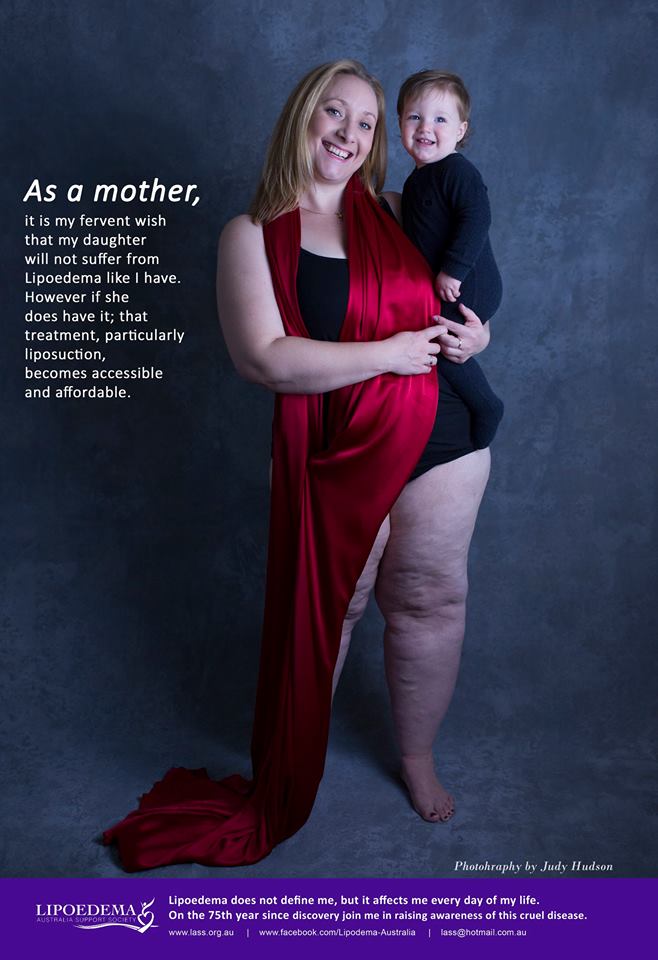 |
| Poster from LASS (see above) |
I had four pregnancies between age 33 and 43, resulting in 2 girls and 2 boys. The first pregnancy was rough because there was no information on pregnancy at a larger size available then, and I encountered a lot of size bias in that pregnancy. I had a nightmare cesarean after a long hard induction and developed PTSD. Breastfeeding was rough at first because I got poor advice. Afterwards, I spent a lot of time educating myself about pregnancy and breastfeeding so I wouldn't go through anything like that again, and started my website to help other large moms get information and empowerment.
I had much better experiences with my later pregnancies. I did have another cesarean after a long hard labor with #2, but in some ways it was healing, even if it wasn't the birth I wanted. With my last 2 children, I had VBACs (Vaginal Births After Cesarean), and they went a long way towards restoring my faith in my body. So did breastfeeding all four of my children long-term.
Some women with lipedema find that pregnancy and birth worsen the lipedema. For the most part, my experiences were normal and I didn't experience the severe issues that some women with lipedema do in pregnancy. I didn't gain much weight and I didn't develop any serious complications.
However, I did gain more lipedemic fat in my abdomen with each pregnancy and I really started to feel the fat nodules under the skin there. This wasn't the result of pregnancy weight gain; I gained less than the weight of my babies with each pregnancy and ended all four pregnancies at about the same weight I started them. But despite being the same weight, I had quite a bit more abdominal fat afterwards. Classic lipedema.
Some women with lipedema find that pregnancy and birth result in secondary lymphedema. I did find I experienced severe swelling after the births of #1 and #4, but not the others. Why I had it with only some births but not others is not clear but it's interesting that I only experienced it with my daughters. Of course, birth interventions can also influence edema. It's my opinion that it takes a combination of factors to cause problems.
One major negative thing was that I had a LOT of back pain and joint issues (pubic symphysis and sacro-iliac joint issues) in my pregnancies. I had a lot of pain until I finally started seeing a chiropractor in my 3rd pregnancy. Since lipedema is associated with joint laxity and hypermobility, that (plus my history of car accidents) may well have been the source of my joint issues.
Seeing a chiropractor highly trained in pregnancy starting with #3 was extremely helpful in getting my back and pelvis aligned. It reduced my discomfort tremendously and helped the baby be in an easier position for birth. I strongly believe it was the reason I was able to have normal vaginal births (VBACs) with my last two children but not my first two. My last two babies were better-positioned and far easier to birth and I really credit that to the chiropractic care.
Despite being nearly 43 and "morbidly obese," my last pregnancy was my best. Even the edema and lipedema flare I had postpartum was a relatively small blip on the radar. Don't let the fact that some women with lipedema experience difficult pregnancies put you off having a baby; some women with lipedema do just fine in pregnancy. It's probably sensible to try to avoid the big interventions like inductions and cesareans whenever possible because they predispose to edema and complications afterwards. Remember that lipedemic bodies can give birth just fine naturally with a truly size-friendly provider.
Personally, I did not find that lipedema affected my pregnancies very strongly; my biggest difficulties were with weight bias/over-intervention by providers, and in dealing with hypermobile joints during pregnancy. However, I did find that pregnancy increased my abdominal lipedemic fat every time, despite almost no weight gain, and I did experience significant temporary edema after two of my births.
Perimenopause and Menopause

As I transitioned into middle age, I did find that my leg size increased quite a bit, especially as I went through perimenopause and menopause from my mid-40s to mid-50s.
More than simply a size change, the shape of my legs changed. I developed major fat pads and "folds" just under my knees, and I got some major-league "cankles" (calf-ankles). My arms have also gotten much larger now. I now have a truly significant amount of fat on my hips, abdomen, legs, and arms, and people really do stare. Although I am pretty at peace with my body in general, it's not always easy.
Clothing-wise, lipedema has made aging more challenging. Finding good clothing is always hit-and-miss due to my unique proportions. Cold weather outer gear and rain gear have been my biggest challenges, as I've written about before. I often have to buy men's gear, which goes to larger sizes than women's sizes but it is geared towards a big belly and no hips, which is not my shape. Still, it's better than nothing. I have found good coats in my size through Columbia Sportswear but I have yet to find a pair of rain boots, rain pants, or snow pants which really work well for me.
In summer, I do wear shorts and go swimming and the heck with anyone who doesn't like it. Most of the rest of the year I wear pants, the comfortable kind in cotton-and-spandex stretch fabric. I found my tolerance for restrictive fabric has diminished. Now, I mostly care about whether my clothes are comfortable. I wear pants or long skirts at work or when speaking to help others focus on me instead of staring at my legs. It's hard enough for people in our society to take fat people seriously; it's even harder when you have lipedemic legs. So in certain situations, I do cover my legs and arms to be taken more seriously, but that doesn't mean I always dress that way.
After some car accidents in my late 40s, I developed significant knee problems. I'm sure my weight didn't help the injuries, but I'd been at the same weight for many years without any problems so it wasn't all about my weight. Yet the orthopedic surgeon I consulted told me my knee pain could only have been caused by arthritis due to weight, despite an x-ray showing very little arthritis the year before the accident. He refused to do an MRI, saying it was pure coincidence that the pain developed after the accident. He was unwilling to treat my knee issues with anything other than weight loss or injections. We compromised on physical therapy but it didn't help. I haven't been back to an orthopedist since. I should have my knees replaced but am reluctant to risk having surgery cause a lipedema flare.
The difficulty in finding a doctor who doesn't blame everything on weight is a source of continuing major frustration to me, especially as I age. It's hard to be taken seriously as a person of size when you are young: it's even harder as a middle-aged woman. We are virtually invisible in society and especially in medicine.
Cancer

As if that wasn't enough, it gets harder. My lipedema was made worse by the fact that I was diagnosed with cancer in my mid-50s. Not any of the cancers that might be associated with weight, but lung cancer, a type of cancer that is completely unassociated with size. Talk about a shocker. I never smoked or had any other risk factors. The only possible risk was perhaps genetic ─ my birth father died of lung cancer in his late 50s ─ but doctors tell me this type of cancer is not directly inherited. Who knows why I got it.
My cancer was largely silent at first. I had very few major symptoms until it was advanced. The subtle early symptoms were things like breathlessness, some hoarseness, lack of endurance, and weak legs. I blamed it on being anemic and getting out of shape. I kept trying to get back into shape but just could not sustain my exercise program because it made me so fatigued. Yet nothing felt really alarming.
The first symptom that was really obvious and alarming was large lumps under my skin ─ subcutaneous tumors. At first I assumed they were lipedema nodules, but when they started appearing in areas not normally affected by lipedema (spine and shoulder) I thought they were lipomas (fatty benign tumors) or perhaps Dercum's Disease, which some patients get in addition to lipedema. However, the lumps on my body were not painful, unlike Dercum's Disease, so it didn't fit perfectly. I made an appointment to see a doctor but for various reasons the appointment got put off.
Eventually I developed severe respiratory symptoms. We thought it was pneumonia. I didn't see my normal care provider due to circumstances, and the other doctor didn't take it seriously. He should have done a chest X-ray but he didn't. He said it was just a sinus infection. We tried antibiotics but they didn't help. I kept going back to the doctor multiple times and he basically told me to tough it out and I probably just had asthma. (Cause you know, fat.) Due to all these delays, by the time my cancer was diagnosed, it had spread all over my body.
How did lipedema affect my cancer diagnosis? It certainly made it more difficult to figure out because we thought the subcutaneous tumors were part of lipedema or Dercum's. And of course the weight that goes with lipedema meant that my doctor did not take my respiratory symptoms, weakness, and fatigue seriously, even though they were very serious and debilitating. By the time my cancer was diagnosed, I was nearly dead.
I am lucky that my particular mutation of lung cancer does have some treatments available, and that means my prognosis is better than some. Many lung cancer patients die within the first year and I have already surpassed that. My targeted therapy treatments brought me back to life and made me mostly functional again. I'm not back to normal but I'm a lot better than I was! However, I am unlucky in that my cancer is not curable. It will likely kill me but the treatments are changing so rapidly that it's difficult to predict the future.
The cancer treatments and related complications have triggered the development of lipo-lymphedema ─ lymphedema on top of the lipedema. This has been difficult. One of the side effects of my first cancer medication was severe ankle and foot edema. Although my feet had always been spared before (one of the defining aspects of lipedema), suddenly now I had massively swollen feet as well as legs. Eventually I changed medications and my foot swelling went away, but I still struggle with leg lymphedema.
I have to be honest; the increase in leg size has been quite challenging. It makes it harder to get around and it's very tiring. Cancer often involves muscle wasting; a lot of food energy is diverted to the tumors and the cancer starts cannibalizing your own muscle for additional energy. To be a large person with lipedema and then experience muscle wasting means that mobility becomes a real issue. After a stay in Intensive Care, I had trouble walking for a while. I had to go to rehab and get physical therapy before I could return to my home. Now I am much improved, but walking is still definitely exhausting and I don't go all that far. I miss taking a nice walk but am trying to build that up to that again.
Dealing with Lipedema

Dealing with lipedema has not been easy over the years, but has definitely gotten more challenging as I have aged and other health challenges have arisen. When I was younger, it was more of an aesthetic problem and a problem with finding clothing than a real interference in my life. It didn't affect my mobility much and I did most things I wanted to do. However, lipedema plus cancer has now affected my mobility and I find that very difficult, though I try not to let it get me too down. I work hard not to let lipedema or cancer define my life, but it's not easy some days.
The things that I have not found helpful in my lipedema journey are dieting of any kind and rigid attitudes about food. I don't follow either an anti-inflammatory diet nor a ketogenic diet; these approaches are simply somebody's guess at a treatment; there is absolutely NO proof that they help. At this point, nobody's even tested them so it bothers me to see them talked about in lipedema circles as if they are a proven treatment. They're not.
Unfortunately, many people in the lipedema community are still stuck in the dieting mentality and weight loss emphasis. Food restriction is a strong thread in many lipedema and medical organizations' guidelines. That is very off-putting to many people of size who would otherwise involve themselves in the lipedema community. Many care providers try to be understanding about weight issues, but the one thing most cannot understand is clients not actively trying to lose weight. They have been taught the "good fatty/bad fatty" paradigm; you can be fat, but that's no excuse for not continuing to try to lose weight. But for me, trying to lose even the 5-10% doctors recommend means playing Russian Roulette with my body because weight loss always ends in a rebound for me. Furthermore, I refuse to be a famine victim anymore. I'm done trying to starve myself.
Many women with lipedema, especially the more severe cases, choose weight loss surgery to try and cope with the physical effects of so much weight. This is a personal decision made by each woman and I am not here to judge it. However, from what I've seen, I don't believe it's very effective long-term for lipedema. Weight loss is mostly from other parts of the body and only minimally from lipedemic areas, and significant regain is very common after a few years. Personally, I am not interested in weight loss surgery of any kind because I have seen too many people with bad side effects after a few years. Lipedema is bad enough without adding malnutrition issues. But that's my choice; everyone gets to make their own choices about it.
Of course, we don't want to add to our lipedema by being excessive. I try to be sensible about carb intake and not over-indulge, but neither do I abstain from carbs, including sugar. I just try to be reasonable. My motto is everything in moderation (including moderation!). I try to avoid getting neurotic over food or making "good food/bad food" judgments; that is eating-disordered thinking. Some food is healthier for you than others but that doesn't make you a better person for eating it, nor will it make you skinny. I hear friends trotting out the usual "it's-a-lifestyle-change" cliché but if it eliminates major food groups or is highly restrictive, it's still a diet. Food Police moralism isn't helpful. Food is just food; simply be sensible about it.
I try to follow Health At Every Size® (HAES) paradigm instead of a weight-centric one. HAES is a health approach that de-emphasizes the scale, restrictive eating, and punitive exercise; it encourages intuitive eating and enjoyable movement. I aim for weight stability and reasonable eating habits, and use lab results to guide my health and nutrition decisions. I find my weight stays reasonably stable with that approach.
The cancer has made nutrition more challenging because the meds change the sense of taste and food is often very unappealing. Muscle wasting and malnourishment from cancer is real even for fat people, an irony which is not lost on me. My oncologist has emphasized the importance of eating and getting enough calories, even if they are not "perfect" nutrition. It's hard to let go of all the pressure from people to eat this or avoid that to "fix" my cancer, but my doctor says it's more important to just eat. Your body needs energy to deal with the cancer.
The care practices I personally have found most helpful in my lipedema journey include chiropractic care, medical massage, and complete decongestive therapy. The chiropractic care and massage helps address the hypermobility problems and muscle tightness than can occur. After I developed lipo-lymphedema from the cancer treatments, I found that Manual Lymph Drainage (MLD) and compression were immensely helpful in preventing some of the skin complications. At one point in cancer treatment, my legs had such severe swelling, my skin cracked and leaked lymph fluid. I developed a mild cellulitis infection, which we were fortunately able to nip in the bud with antibiotics. I've had to become much more careful about caring for my legs and keeping down the swelling. With MLD and compression, they are doing okay.
If I had unlimited money and no cancer, I would pursue specialized liposuction for the lipedema; it has to be done by specially trained doctors. Proper compression afterwards is critical. Research so far shows this type of liposuction to be quite helpful for many people. Sadly, most insurance will not cover this and my budget does not allow it, but it may be a valid choice for some people with lipedema.
Emotionally, I find it difficult to deal with the judgment heaped on people of size. When you say that you have lipedema, people think you are just making excuses. That I find really frustrating, especially when it comes from friends. I know some think I could lose weight if I tried harder, and that hurts. But I can't control what other people think, and anti-fat bias is so prevalent in our society it's no surprise they think that way. I try not to let those biases get in the way of friendship as long as they are respectful.
While I can't honestly say I'm thrilled with the appearance of my legs or arms, I don't let it bother me too much because there's realistically very little I can do about it. I don't like being stared at, but I try to see it as the other person's issue, not mine. Remember that how people react to you often has more to do with their own fears and insecurities, not yours. Let condemnation and judgment roll off of you.
I personally have been fortunate to have never struggled with depression the way that many people with lipedema have. That doesn't mean that dealing with lipedema and with cancer has not been frustrating or upsetting; it most certainly has! But depression is not one of my issues and I know that's lucky.
While I can't honestly say I'm thrilled with the appearance of my legs or arms, I don't let it bother me too much because there's realistically very little I can do about it. I don't like being stared at, but I try to see it as the other person's issue, not mine. Remember that how people react to you often has more to do with their own fears and insecurities, not yours. Let condemnation and judgment roll off of you.
I personally have been fortunate to have never struggled with depression the way that many people with lipedema have. That doesn't mean that dealing with lipedema and with cancer has not been frustrating or upsetting; it most certainly has! But depression is not one of my issues and I know that's lucky.
However, anger is one of my issues. Sometimes it makes me SO angry that I've been saddled with PCOS and hypothyroidism and lipedema. Talk about a genetic triple whammy! That is incredibly frustrating. And now cancer on top of that?!??! So incredibly unfair!!!!!!!
Having all of those conditions just sucks and I do sometimes indulge in the "Why me?" game. Sometimes I throw myself a really good pity party and let myself wallow in it for a while. I think that's reasonable and healthy ─ after all, having these conditions DOES suck and it is TOTALLY unfair. It's important to acknowledge and mourn your challenges and let yourself be angry. But spending too much time in anger is not healthy either; I don't want it to keep me from experiencing the positive things in life. So I pick myself up, brush off the negativity, and remind myself to count the blessings I do have. That helps counterbalance my pity party days.
Being adopted has added to my emotional frustration; I would really like to know more about my birth parents' genetic heritage so I could see how genetic any of this really is. I know there is an extremely strong history of diabetes and autoimmune disease on my birth mother's side, which leads me to suspect an autoimmune component to lipedema. However, it's been difficult to get more detailed information. I know there's a strong history of cancer on my birth father's side, and that he died of lung cancer at about the same age as I am now. However, there's no way to know if it's the same type of lung cancer or not, and we'll never know. That's a difficult burden, because I don't know how concerned to be for my children.
I try to remind myself that I also have good genes that balance these unfortunate ones, and I hope I passed on those good genes to my children. I try to remember the blessings I did inherit. Of course I have worries about my lipedema. How could I not? But now they've been supplanted by bigger worries, namely cancer. In the long run, lipedema is small potatoes compared to cancer. So while we have every right to be upset about our lipedema, remember to keep it in perspective. There are other challenges out there too. Keep it all in perspective.
Some days it's hard to be positive but mostly I look at my children and my spouse and feel blessed.
Final Thoughts

To summarize, I believe I've had lipedema my whole life, to one degree or another. I was never a "normal" size and I always had a pear shape, even as a young child. Puberty made it worse.
However, the lipedema really kicked into high gear as a young adult and I gained a tremendous amount of weight despite doing everything I could to stop it. Lipedema probably acted synergistically with PCOS and hypothyroidism and that's why the weight gain was so severe.
Dieting seemed to make the lipedema worse. The dieting made me gain weight rather than lose it over the long run, plus it took me close to an eating disorder. For me, it was much healthier to stop actively trying to lose weight. Instead, I follow the Health At Every Size approach and that has been incredibly helpful to me.
The lipedema in my legs and especially my belly got mildly worse with all my pregnancies and I had significant foot/leg edema after two of my pregnancies. However, other than that, it really didn't affect my pregnancies too much. I was fortunate in that way.
The lipedema got worse with peri-menopause and a major car accident but I was still mostly functional. My diagnosis of cancer threw a new wrench into the mix. The treatments for cancer made me develop lipo-lymphedema and I have struggled with that, but Manual Lymph Drainage and compression has helped. My mobility took a big hit; for a while I was in a wheelchair but I can now walk and climb stairs again.
While lipedema and cancer give me significant challenges, I get on with my life and I don't let it derail my happiness. I don't let it silence my voice, my contributions, or my opinions. I will not let the lipedema or the cancer define me.
I try to make sure that I continue to live my life with joy and purpose. Lipedema does interfere with my life, but I refuse to let it make me unhappy or to take away my pleasure in the important things of life. Cancer may take my life eventually but I will live as fully and as joyfully as I can until then.
How has lipedema affected you? And how do you try to handle it proactively?


