Showing posts with label postpartum. Show all posts

Tuesday, January 2, 2018

Intuitive Eating and Postpartum Weight

Image result for pregnancy weight scale


There is intense pressure from some care providers to lose pregnancy weight gain after the baby is born. This is because many women do retain weight from pregnancy long-term and never go back to their pre-pregnancy weight, resulting in a permanent net gain.

However, the best way to return to pre-pregnancy weight is hotly debated. This study finds that Intuitive Eating works better than rigid dieting rules. This is very compatible with Health At Every Size® practices and a much more sane way to live, especially for new mothers.


Reference

Matern Child Health J. 2017 Feb 7. doi: 10.1007/s10995-017-2281-4. [Epub ahead of print] The Relationship Between Intuitive Eating and Postpartum Weight Loss.Leahy K, Berlin KS, Banks  GG, Bachman J. PMID: 28176035 DOI: 10.1007/s10995-017-2281-4
Objective Postpartum weight loss is challenging for new mothers who report limited time and difficulties following traditional weight loss methods. Intuitive eating (IE) is a behavior that includes eating based on physical hunger and fullness and may have a role in encouraging weight loss. The purpose of this study was to examine the relationship between IE and postpartum weight loss. Methods Women 12-18 months postpartum completed a questionnaire regarding weight changes surrounding pregnancy, exercise, breastfeeding and intuitive eating using the Intuitive Eating Scale. Latent growth curve modeling was utilized to determine the relationship between IE, breastfeeding, weight gain during pregnancy, and postpartum weight trajectories. Results Participants (n = 50) were 28.5 ± 4.9 years old, had an average pre-pregnancy BMI of 26.4 ± 6.8 and the majority were married, and non-Hispanic white. The conditional model revealed that more intuitive eating practices predicted greater postpartum BMI decreases (Est. = -0.10, p < .05) when controlling for breastfeeding duration, exercise duration, and initial BMI and pregnancy BMI changes. Greater pregnancy BMI increases were associated with more rapid postpartum BMI decreases (Est. = -0.34, p < .001) while breastfeeding duration, exercise and initial BMI were not related. Conclusions for Practice Postpartum weight retention is a challenge for many women. Following a more intuitive eating approach to food consumption may encourage postpartum weight loss without the required weighing, measuring, recording and assessing dietary intake that is required of traditional weight loss programs. IE could offer an alternative approach that may be less arduous for new mothers.

Monday, May 30, 2011

Honoring Our Bellies Month: Healing Through Belly Art


As May ends, it's time for some final thoughts on "Honoring Our Bellies" month. 

My thanks to all the wonderful women who have been willing to share their thoughts and their pictures with the rest of us.  You may never know what a service you have done for future women of size contemplating pregnancy, and perhaps even in helping non plus-sized folks see the beauty and the wonder of pregnancy in women of size too. 

As we end this month, let's discuss a few final thoughts; a few more ways to honor our bellies, our selves, and our journey; and let's feature a few more pictures of pregnant bellies and related belly art.

Document Your Journey

First, if you are pregnant, please please please take the time and effort to document your pregnancy and your motherhood in pictures. 


 Too many fat women are missing in action from their family's photo albums because they are self-conscious or too embarrassed to be photographed much. What a tragedy this is!


The truth is that our pregnant bodies are beautiful. And they deserve to be seen in all their glory.


No one cares if you are not stick-thin with a bump; certainly your children don't care.  They only know that you are that most beloved of people ─ mommy ─ and if mommy isn't in the pictures of their childhood very much, what does that say to them?  Be present in your children's lives, both in the moment and in their archives.


If you don't get pictures of yourself pregnant, you will be losing such a wonderful memory.  Every pregnant woman is beautiful, and we all deserve to have our pregnancies documented in pictures. 


Sweet moments like these are so incredibly precious later on.  If you miss the chance to document it, that opportunity is gone forever.  Remember, you can always throw away or delete the really terrible shots, but you can't go back and get pictures you never took. 


Don't be the gaping black hole in your child's baby album.  Take pictures of yourself both in pregnancy and as a mother, and make sure your existence is documented, both for your child and for yourself. 

You deserve it.

Honor The Normality of Ambivalent Feelings

Remember, it's normal to feel some ambivalence about the changes happening to your body.

The truth is that your body will never be quite the same again...but that's okay. Life is change, and change is hard sometimes.  Often, we want everything to stay the same, forever, but that just doesn't happen.  Change is the norm in life, but it's not always easy. It's okay to acknowledge that.


And when that change is reflected on the body, it's normal to mourn those changes, whether they happen because of pregnancy or accidents or just plain time.  You're not a "bad" fat-acceptance person for having smidgens of dissatisfaction or body ambivalence.  It's just a normal part of dealing with changes in your body.

And few changes are bigger or more fast-acting than those wrought by pregnancy! So it's very normal to have mixed feelings about changes in your body around pregnancy. 

Just don't stay in that place of ambivalence.  Recognize its normality, recognize the challenge to your sense of self-confidence and worth, and actively find ways to work through it. 

Don't stay stuck in negativity. Do the work you need to do to get back to a place of self-acceptance and self-love.

Find a Way To Honor Your Body

Even as you process normal feelings of ambivalence about these changes, it's important to  honor your belly for all the amazing work it's doing in pregnancy, and one way to do that is through belly art.

There are many types of belly art you can do to honor your body in pregnancy.  Look around online and see which type calls to you.

[No, not all the images below are of women of size; but some are.  Others are presented just for ideas. Links to sources of some of these pictures are presented near the end.]


 We've already discussed belly henna, temporary tattoos using henna, which starts as a dark paste on your belly (like above)......


................and then turns to a reddish-brown hue like this when it rubs off, lasting for about 2 weeks or so.

Another beautiful and fun thing to do is belly bump painting.  This can run the gamut in quality and subject matter (depending on who your artist is!), from toddleresque to whimsical to seriously artistic.  It all depends on what you want.


A lot of people enjoy doing silly baby bump painting.  And what better Halloween costume can there be than a pumpkin baby bump? I've also seen baby bump paintings of watermelons, basketballs, and even a beachball!  It certainly doesn't have to be fancy.


You don't have to be a skilled artist to create some of these.  I am very artistically-challenged, but even I could probably manage a basic pumpkin or ladybug like the ones above. 


For those slightly more skilled, relatively easy themes might be butterflies or flowers.


There are a lot of whimsical ideas for belly painting, from turtles to speed bumps to Hello Kitty to the "She's Got The Whole World In Her Hands" riff above.


One of my favorites for sheer creative simplicity is this snowman.  Not very hard to do, yet it certainly brought a smile to my face!


And hey, who says you can't have fun with belly art, even if you can't paint?  Wouldn't this picture be a great conversation piece in a photo album in years to come?


Or you can have someone document your baby's position for you, late in pregnancy, with belly mapping.  This can be educational as well as fun, as you discover how fetal position can influence labor.   You can learn more about this at www.spinningbabies.com (this picture is from their site), or buy their book about it here


Or ditch your artistic and educational pretenses entirely and just let your kids go wild.  As I shared before, it can be a lot of fun to have your older children paint your belly, whether or not it turns out pretty or artistic.  My kids and I had a grand old time bonding over painting my belly, and it was a nice way to distract myself at the end of pregnancy number four.  If you are artistically challenged, just do it as a fun kid activity, not to turn yourself into a modern Renoir painting.

On the other hand, if you are the more artistic type, you can aspire to something more lofty. You can even hire someone well-versed in fine art to paint your belly for you.  Isn't this an amazing work?


There are a lot of fun examples out on the internet of different images women have painted onto their bellies, like some of these that I've pulled for us.  Some artists even specialize in this art form, or offer tips on how to do it.  There are even blog sites and flickr accounts to dig through for ideas. 


The possibilities for beauty and whimsy are endless. Let your imagination and your creativity run wild!

Create a Lasting Keepsake

Another way to honor your pregnancy belly is to create lasting keepsakes of it.

You can do this in many ways.  Photography is one of the best. 


Having professional or high-quality photographs of your pregnancy or family is one of the most beautiful keepsakes ever.  Almost without fail, women who have done this are glad that they did.  If you can't afford to have professional work done, try it yourself at home. Don't be afraid to experiment with it and try different things.


Pictures that use black-and-white tones, sepia tones, or that use lighting in an artful way can be some of the most striking pictures. Give that a try.


Then, be creative with your images.  Artsy them up with photoshop and see how they turn out.


Or focus on whimsical, fun shots.  Do whatever makes you happy.  The trick is to just do it. 

Remember, you are not obligated to keep every shot.  Take lots of shots so you are more likely to get a good one among them, and then discard the others.

Another fun idea is belly casting.  In this, you make a plaster cast of your belly in the latter stages of pregnancy.  This takes your memory of pregnancy from 2-D photos into 3-D sculpture. How cool is that?


This is a photo of someone having a belly cast done. You slather your belly with lubricant (like Vaseline, olive oil, or Crisco), then use quick-setting plaster strips (like Rigid Wrap), available at most big craft stores. You just wet them down in a pan of water and apply. There are kits available to buy online, or you can gather your own supplies fairly cheaply. 

You can do as much or as little of your body as you want.  You can do belly only, part of the belly, belly and breasts, or even the whole torso and upper legs.  Furthermore, you can be as demure or not as you prefer.  If you don't want your nipples to show, just wear an old bra under the casting, cover them with Saran Wrap, or put an arm over your breasts.  If you don't want any belly sags to show, don't cast that part of your belly.  It's completely up to you and there are no "right" or "wrong" ways of doing it.


When done, your belly cast can be left in its plaster state, like this one....


.......or finished and polished, but still with a plaster-like look, like this one from Molded Moments............


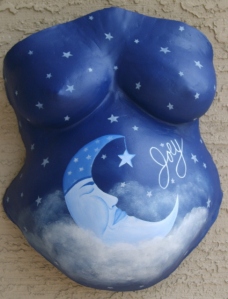
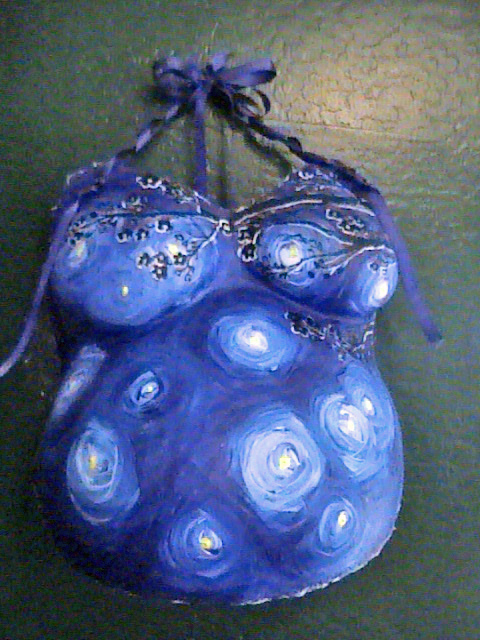
.....or it can be finished and painted for hanging on your wall, such as this one by artist Bethany Farrell....


......or personalized, like this one by artist Tina Killackey..........


........or decorated with added pieces, like this one from artist Nic Hohn.......


.......or given elaborate designs, like this one from my friend Amy Swagman of The Mandala Journey........


........or this beautiful but simpler one from Massage-ology.


You can even take a picture of your newborn nestled in the inside of the bellycast, just like they were positioned in the womb, which makes a wonderful piece of memorabilia for baby albums.  Or put paint on your baby's feet and do footprints on the inside (or outside) of the cast, to commemorate all that fetal kicking!  Or write a letter to the baby and tape it to the inside of the cast, to be given to them when they are older.


It can be as detailed or basic as you prefer ─ the possibilities are endless ─ but what a lovely keepsake to have forever.

There are any number of websites available that discuss how to make a bellycast, how to finish and display them, and which offer many images and ideas to choose from for decorating them. 

I personally did not have the nerve to do a bellycast in my first 3 pregnancies, but decided to do one in my last pregnancy. I really had to challenge myself to go through with it ─ but now I'm very glad I did. Alas, I've never found the time to actually have the cast finished ─ maybe by the time she graduates high school! ─ but what we did was sort of like the picture below. 


My husband put his hands on my belly, then I put my hands atop his.  It was difficult to differentiate between his hands and mine with plaster strips, but you can see it if you look for it.  Then later, after the cast dried a bit, we added a cast of my other children's hands too.  Doing them one at a time, later on, helped us make this work, since my kids would never have had the patience to do it otherwise.  Eventually, we will paint each person's hand a different (but complementary) color, and then finish the whole thing with beautiful uniting color and perhaps the outlines of my daughter's feet in the middle.

For now, my belly cast sits in its unfinished-but-still-inspiring-state in my office, looking down at me as I work, giving me inspiration as I write.  Even though it's not finished, I still treasure it and am immensely glad I took a chance on trying it.  I would always have regretted it had I let body self-consciousness get in the way of making this one-of-a-kind gift to myself.  Now, even if it's never formally finished, it's still a treasured memento of a very special time in my life, and of a very special child of my heart.

Conclusion

It's really not unusual for women of all sizes to experience body image issues during and after pregnancy.  There are huge changes happening to the body, and any pre-existing image issues can get magnified in uncomfortable ways as a result.

But while it's very normal to experience body ambivalence, that doesn't mean we have to stay in that murky place.  Rather, see it as an opportunity to work through and heal yourself in new and deeper ways.

One great way to work on healing pregnancy body ambivalence is through belly art. Photography, belly painting, henna, belly casts....all of these and more are good ways to honor ourselves, our bodies, and our babies.

It doesn't really matter which form you pick, but do find some way to document the experience.  It is only a brief moment out of your life, but it is such an important and memorable one.  It (and you) deserve to be honored in a special and unique way.

Don't let your size or body image keep you from memorializing this so-special moment in time in some way.  You will treasure it later, trust me!

*For more ideas and images of belly casts, belly painting, and henna tattoos, click here.

Monday, March 14, 2011

Belly Blog Carnival!

The beauty of my body isn't measured by the size of the clothes it can fit into, but by the stories it tells. I have a belly and hips that say, 'we grew a child in here' and breasts that say, 'we nourished life.'

- Sarah from I Am Beautiful: A Story of Women in Their Own Words
In January and February, I wrote two posts called Belly Thoughts and Further Belly Thoughts.  They were about belly ambivalance, specifically about how my generally good body acceptance was challenged by pregnancy and birth, and how I sometimes still struggle with that.

However, even as I explored topics of body ambivalence, I tried to end on a positive note with an acknowledgement and honoring of the work our pregnant bellies had done.  I wrote about honoring my belly, I posted some pictures of how my older children painted my belly in the last weeks of my last pregnancy, and I discussed how much those pictures meant to me.

That was my way of trying to bring the conversation back to a positive place, because even as I am challenged to fully love the changes in my body brought about by age and multiple pregnancies, I also do not regret having had children, not for a single moment.  My children are more than just compensation for the changes that have happened to my body.

As I've written before, I think it's a crime that there are not more images of women of size pregnant, birthing, breastfeeding, and parenting.  I certainly could have used some images like that when I was first pregnant and afterwards, and I know many other women of size feel the same.

Most of the information out there on fatness and pregnancy is very negative, and rarely do you see any pictures at all in the media ─ let alone beautiful pictures ─ of women of size in pregnancy and afterwards.  And we need images like those. 

And many of us, trained to be self-conscious or ashamed about our size, neglect to document our own pregnancies in any significant detail, whether that be with belly pictures, birth pictures, breastfeeding pictures, or parenting pictures.  Far too often we take the pictures, instead of letting ourselves be the subject of pictures, and that just adds to the lack of documentation out there....and the lack of documentation of our own lives.

And we need documentation.  We need to STOP being invisible mothers.  We need ─ and deserve ─ to be seen.  We deserve to take up space in the world as women and as mothers.

A number of you have sent me pictures of yourselves pregnant as a result of my post about the lack of images, and I think this is awesomeThank you to everyone who has sent in or shared their pictures with me.  I have so enjoyed them.

However, I've been a little reticent to use some of them on the blog because of the fear that a troll might take these pictures and abuse them.  Unless you have made it really clear to me that you are okay with your pictures being online forever like this, I usually haven't used them, just to be cautious.

But even as I worry about these things, I've decided it's really important that we declare our independence and post our pictures anyhow.  It's SO important that there be pregnancy and parenting images of women of size out there, showing that we do have babies, we do give birth, we do breastfeed, and we do parent.

We women of size are women, just like other women, and we have families, just like other women.  It's about time we got more documentation of that.  And it's about time we celebrated that more, instead of hiding whenever the cameras come out.  It's time we became visible moms.

So as a positive coda to my series on belly thoughts, I would like to propose a BELLY BLOG CARNIVAL. 

If you have had children, blog about your pregnancy belly and body, and post pictures too.  Document your experience in words and/or in pictures, and share your feelings ─ positive,  negative, challenges and all. 

If needed, please use trigger warnings out of respect for others, but I would ask that everyone try to end with a focus on the positive, if at all possible.  We can document our challenges, but let's also not forget to celebrate our bodies.  I especially welcome entries which celebrate their bodies in creative ways.

When you have posted your entry, send me a link to it (with a brief summary of what it's about). You can send it to kmom  [AT]  plus-size-pregnancy [DOT]  org.  Send it by March 31st, 2011.  Then I'll summarize everyone's posts together (with links) in one place here on my blog sometime in April.

If you don't have a blog and just want to share a picture, you can email that to me as well, along with permission to use the picture and whatever brief information  you want to appear with it. I generally discourage the use of real names, since this will be available online forever, but if you are absolutely positive you want this picture of you, identified with your name, available forever (the logistics are too much if you change your mind and want to delete it later), I will publish that as needed. Depending on how many I receive, I may put it in one big post, spread them out over a number of posts, or open a Tumblr account or something (if I can figure out how...I'm new to that!). 

(If you send me a picture, please remember to give me explicit permission to use your picture or I won't post it.  People often send me a picture but forget to add permission, and I don't have time to do follow-ups to get that.  In addition, if you'd like to include permission for me, kmom, to use your picture in whatever way I need for future posts, articles, presentations, publications, etc., I'd love to have that as well.  I'm always interested in adding to my gallery of plus-sized pregnancy and parenting photos to use as needed in my various projects. I welcome pictures from everyone but am particularly in need of pictures of any stage of pregnancy or parenting from women of color, and pictures from women of size during labor and birth.)

In summary, it's time to cap this belly discussion with a positive finale.  Over the next few months, expect to see periodic pregnant belly pictures on my blog from various women of size. We may even have related posts about belly casts, belly henna, belly painting, and other things we as women of size can do to celebrate our beautiful lush pregnant bodies. 

Bring on the bellies!!

*And isn't that picture from "Lyista" at the top of this post just the MOST gorgeous belly photo ever?  My thanks to her for sharing and for giving me permission to use the photo!

Monday, February 28, 2011

Further Belly Thoughts

About a month ago, I published a post called Belly Thoughts that was quite controversial to some people. 

I've been writing a follow-up for a while, but I've been working on a big project at work and have had sick/injured kids, so I have had a hard time finishing it. I have also been struggling to clarify my dismay and surprise over people's response to that post. Honestly, the response upset me and I thought it best to wait a bit before replying so I could make a more measured response.

But I think it's time now to continue the discussion.  Forgive me if it's a bit rambly.  It's just time to get it out there, imperfect as it is, so we can discuss it and then move on.

Trigger Warning: Frank discussion of body image issues and body ambivalence will follow.

First, thank you to those who commented, even if I didn't agree with you or like what you said.  Dialogue is important and it's not always a bad thing to hear dissenting voices.  It generates discussion and can clarify issues or further the conversation. Obviously, this topic provokes some strong feelings, and I think that's an important point to explore. 

One complaint that was made was that the post needed a Trigger Warning.  With some reflection, I can see that point. I thought about putting one in the original post, but I thought it was not needed because I felt I was pretty clear in the intro paragraphs what was going to be in the post.  However, I can appreciate that some people in their journey need a really clear and obvious warning about these things. So that point is noted and I have already gone back and added a trigger warning to the original post and to this one as well.  My apologies to anyone who I inadvertently triggered.

Some folks objected to the Shamu word. That may have been a bad choice, but I was actually being ironic, and I think folks missed that. I see people on the feed mockingly use words commonly used to deride us (like "deathfat" etc.), so that's where I was going with Shamu, but the ironic intent may not have been clear enough. I was trying to point out the tremendous irony of worrying about what I'd look like at 9 months pregnant and then not looking pregnant at all. By using the term Shamu, I thought it made for a better, more pointed bit of irony. But alas, I think the term is so emotionally loaded for some that they didn't see an ironic use of it. I'm sorry it caused bad feelings for some.

One thing I think it's important to clarify is that what I was talking about was body ambivalence, not body loathing.  No, I don't always have perfectly happy loving feelings towards every part of my body 24/7 (who does?), but sharing that does not mean that I hate my body or am engaged in fat-based self-loathing. It only means that I have mixed feelings towards parts of my body sometimes.  It doesn't mean that I don't have good feelings towards my fat body at times, or that I've been hiding secret loathing behind a facade of fat acceptance.  It's just body ambivalence, not body hatred.

Perhaps I wasn't clear enough in the post that most of the time, I'm pretty at peace with my body ─ a lot more than a lot of the thinner women I see around me, in fact.  But not 24/7/365, and some parts are more challenging to love than others, you know?  I was just trying to be up front about that, because I think we NEED more of this kind of honesty, especially among mothers, and especially among mothers of size.  But it wasn't about hating myself, just my struggle to love the changes that pregnancy has wrought.

Before pregnancy, my most difficult part to love was my chest, because I'm very well-endowed and that has all kinds of physical and emotional burdens attached.  After pregnancy, once breastfeeding worked out, that actually was the part that experienced the most positive self-image improvement.  The part of me that had previously only been a burden before suddenly was responsible for nourishing and protecting my babies for  months ─ years ─ on end, and my babies certainly loved that part of me, so why couldn't I?  I just had a totally different take on my breasts after that, even as I still sometimes struggle with loving them fully.

My belly was a different matter, much to my surprise.  Before pregnancy, I was pretty much fine with my belly.  But I was really surprised how much challenge I had with it during and after my pregnancies ─ especially after multiple pregnancies.  It does take a toll on your body shape and your body image, and I was just trying to articulate how that challenged me in my fat-acceptance and body-acceptance process.

So folks, if you were worried about me loathing my body or that I was suddenly revealing secret reservoirs of self-hate, please be reassured that most of the time, I'm pretty self-accepting.  But I don't think it's a problem to share that I'm not always that way, or that certain things really challenge my body image more than others.  I think a combination of pregnancy and recent aging-related changes of perimenopause gave rise to more reflection than usual on that, that's all. 

One thing I was very much troubled by was the fact that some folks questioned whether my posts belonged on the Fatosphere.  That in particular really shocked me, considering all the work I've done in Fat-Acceptance over the years.  Heck, I've been in the Fat-Acceptance movement for longer than some of my readers have been alive.  I'm not just talking the talk, but have been actually walking the walk for many years, and have been writing, researching, publishing, and presenting at conferences on the topic of fatness and pregnancy for more than a decade.  I've been a quite vocal and active FA-advocate, and have been a member of NAAFA for years.  To be questioned in my own backyard about my "FA-ness" was quite distressing.

Let me be clear.  I don't see my post as contrary to the purpose of the feed at all, or to Fat Acceptance in general. The Fatosphere is SUPPOSED to be a place where we can work through a lot of our feelings, good and bad, about our bodies. In my view, it's not a "you can only express positive things about your body no matter what" place.

Certainly, I surely see a lot of body ambivalence on other blogs. Why would my blog be exempt from being able to talk about that? The fatosphere is supposed to be the one place where we CAN talk about these things without being judged. And yet, there I was, being judged for some pretty normal feelings, ones extremely common to mothers after pregnancy, and I wanted to talk about how that interacted with my self-acceptance beliefs. I see that as very much in concordance with what the Fatosphere is supposed to be about.

I'm also very frustrated with the idea that I can't express ambivalence about the droopy baby belly, the "flap" if you will. Nearly all mothers have some ambivalence about this ─ it's very normal in women of all sizes, and I think it's intensified for many women of size. Why is this okay for women of average size to talk about ─ but not for us as women of size?  We all have to process it; it's a very normal feeling.  Some people experience the belly flap more than others, but we all have to process body changes to some degree.

It's not like because we are fat-accepting, we have a magic shield against negative feelings from body changes.  We have these issues too, and it may be intensified in those with previous body image issues.  Even those of us who are pretty far along on the fat-acceptance spectrum can still feel challenged by these things ─ and that's okay. And it doesn't mean that we are now body-haters and full of self-loathing and about to sign up for surgery.  It means we're processing normal feelings.

My whole point is that the changes in my body (and specifically my belly) resulting from several pregnancies, lipedema, and age are challenging my fat- and self-acceptance in a way it's not been challenged in a long time, and I continue to struggle with that. I think being honest about these kinds of struggles is absolutely VITAL to the fat-acceptance discussion. What are we here for if we can't discuss that kind of thing?

I'm not telling others how THEY should feel about their bellies. If you came through pregnancy perfectly positive about your belly, more power to you. I'm simply trying to express that even in me, a VERY self-accepting and fat-accepting person, dealing with this pregnancy after-effect has been quite challenging, even years after my last pregnancy, and how surprising this has been to me as an activist.

I certainly think that postpartum feelings about your body (and the unique challenges that might bring to fat women) is an appropriate topic for my blog, don't you? I KNOW a lot of other women of size have struggled with the same feelings because they've written me about it. I was articulating my own struggles as a way to not only help me with my own ambivalence, but to help others explore their own.

It was such a shock to me, how pregnancy challenged my fat-acceptance in so many ways. For example, as I've written about before, I went from a take-no-guff-from-doctors FA person to a meek little sheeple who got railroaded and frightened into a whole bunch of unneeded and fat-phobic interventions in my first pregnancy. It took me quite a while to get past that, but working through that and empowering myself enough to question the doctors led me to create my website and my blog. The journey was worth it ─ but it didn't happen overnight, and it took a lot of emotional processing to get there.  Sharing that is helpful to other fat women struggling to figure out what interventions are needed in their pregnancies and which ones are questionable,  what choices they really have in birth, and cutting through the anti-fat rhetoric that surrounds so much of the information out there on pregnancy and fatness.

I think a similar journey is worth it on the whole belly ambivalence question too. Pregnancy (and especially post-partum) totally challenged my FA-ness, and I still work through it. I don't think talking about that is in opposition to the fatosphere at all. I think it will help other women on their journey, which is why I talked about it in the first place. People are at all different points on their journey to fat acceptance, and I think it's extremely helpful to see someone else struggle with that journey too. To have my FA credentials questioned because of that is extremely frustrating to me.

Another thing that frustrated me was that while I discussed my belly ambivalence very frankly, I also made a real point of bringing the question back to positiveness at the end of my post. I made a point of honoring our bellies anyhow, even in the face of ambivalence, and acknowledging the incredible work they did. I thought I made that point pretty strongly, using my words and my belly-painting pictures, because it's very much how I feel. So it's upsetting to me to have that conclusion ignored or negated. Yes, I talked frankly about belly ambivalence and the challenges I've experienced, but then I brought the discussion back to a positive conclusion. That's an important point that got ignored by some.

Furthermore, it makes me frustrated to feel censored in what I'm "allowed" to talk about as a "good" fattie. Ambivalent feelings are part and parcel of the journey to FA, even for people well along on that journey. Other people can talk about this on the feed (and do), but for some reason it created a lot of reaction when I did it. Perhaps it's harder to hear it in relationship to pregnancy (society really tends to discourage expressing negative or ambivalent feelings about pregnancy).  Or perhaps it's hard to hear someone who doesn't usually express much body-ambivalence actually express some.

But the whole point was that this is a NORMAL and VERY COMMON response to pregnancy and post-partum body image in women of all sizes, and that it's often intensified for women of size and we should be discussing that.

Expressing that doesn't make someone anti-FA. It just acknowledges a common feeling among many women of size, something many of the women in the comments commiserated with, you'll note.

The fall-out from all this is that right now, I don't feel safe choosing topics for the blog, and that alarms me. I was planning a big series addressing the risks of pregnancy in women of size, because the fat-phobic doctors contend that a pollyanna approach ("everything will be fine") to fatness and pregnancy is misleading and intellectually dishonest. Research is clear that there are more risks for certain complications in women of size in pregnancy ─ the problem is that doctors DISTORT that information and use it as a scare tactic or a way to pressure women into questionable interventions. I want my series to look at the research dispassionately, acknowledge what risks there are, make sure people understand these potential risks, discuss how we can be proactive to lessen those risks, and make sure people understand that, though there, these risks are still generally small ─ that most fat women will have healthy babies just fine.

But now I'm questioning whether I should even attempt such a series, whether this will be seen as too negative or not "FA enough" for some. Yet I think not doing that series would be a tremendous disservice to women of size.  The whole purpose of my website and my blog is honest and accurate information, not just rah-rah cheerleading and a polyanna approach.

Women of size NEED intellectually honest discussions about the research, good and bad, along with primers for understanding it and using it to help improve our outcomes and experiences.  We don't need more "everything will be just fine" or "oh my God you're going to die" extremism.  We need a more nuanced approach.

I just am frustrated with the idea that we should only be fat cheerleaders and never be allowed to go beyond that.  Fat Acceptance is a journey, and I think it's important that we be allowed to fully process our feelings, even the ambivalent ones, along the way, without people jumping to conclusions about our FA-ness. 

Okay, so now I've vented a bit and expressed my concerns too.  Feel free to discuss in the comments section.  Just please be respectful and polite, even if you disagree and need to argue a point, okay?  I'm feeling particularly tender and touchy on this subject right now and would appreciate some delicacy, even as I know that dialogue is important.

But I don't think the discussion ends here.  This is of necessity a rather negative post, and I'm okay with that up to a point.  I think the frustrations needed to be aired and perhaps some good will come of the dialogue.

However, I prefer to bring the discussion back to the positive whenever possible.  So I decided to put the negative things in this post and do a whole different post next time that focuses things a little differently, a little more positively without being false, that puts things back on a more constructive footing. 

I'd like to propose a Belly Blog Carnival next time ─ more on that soon!!

Wednesday, January 19, 2011

Belly Thoughts

So, for those of you who have been pregnant, how did you feel about your pregnant belly?  How did you feel during pregnancy?  After pregnancy, with the post-mummy tummy?  Years later?

I was reflecting the other day on my relationship to my belly, especially in regards to my pregnancies and births ─ how I've celebrated it in some ways, and how I've struggled with it in other ways. 

I thought about things that I expected to happen and how the reality did or didn't meet those expectations, things that surprised me, things that pleased me, and things that made me unhappy or which challenged my peace with my body. 

Thought I'd share some of those thoughts here.  Hope you will share your own experiences too.

Trigger Warning:  Frank talk about body ambivalence and negativity. Some folks may find this post challenging or triggering and may want to opt out.


Worrying About Shamu

My first pregnancy was a surprise.  I went from being told I would not be able to get pregnant without "help" to being pregnant a few months later without trying.  So I was totally not prepared to think about pregnancy bellies! 

I hate to say it now because it sounds so vain, but I was really worried about what I'd look like pregnant.  I was already a large person; I figured when I was pregnant I'd look like Shamu. 

Now, I don't mean that in a negative way; I was pretty at peace with my body pre-pregnancy, and I didn't really "fear" being huge in pregnancy.  But I was having a hard time picturing the giant basketball belly you see on skinny women added to my already sizable frame, you know?  And I wondered what I'd be wearing on that basketball belly (or if I could find anything to wear at all, considering that it wasn't easy to find clothes even when not pregnant).

I know a lot of other women of size wonder these things too, because the top post viewed on this blog (by a HUGE margin) is the one on plus-sized pregnancy photos.  There are so few pictures of women of size out in the media, let alone pregnant women of size.  (And fat pregnant women of color?  Nearly impossible to find. Gah!)

The most common search words people use when they find my blog has to do with this search for images of fat pregnant women.  Except the phrases are usually "overweight and pregnant photos" or "obese pregnant belly" or "obese pregnancy pictures" or "plus-size pregnancy belly pics" and things like that.  There is a tremendous desire for pictures of pregnant women of size because I think so many fat women have that "Oh-My-God-What-Am-I-Going-To-LOOK-Like" anxiety. 

The Shamu obsession, I call it.

The Not-Looking-Pregnant-Surprise

The ironic gotcha to all that worry is that once I was well into pregnancy, I was disappointed to realize that I didn't look pregnant at all. 

People kept looking at me and wondering where the pregnancy belly was, I could see it in their eyes.  Well, it was there ─ it just wasn't visible to the casual onlooker.  I have a big ole rack-o-doom and that tends to hide any belly popping out pretty well, plus my baby was facing my belly (occiput posterior) for much of the pregnancy, which means you "show" a lot less (cause the baby's behind is facing the other way!). 

I was so NOT showing in pregnancy that most people couldn't even tell I was pregnant until the baby was nearly born.  My classic story of this was when I had to move during my 8th month of pregnancy.  I showed up to my new doctor's office, told them I was transferring care there from another state ─ and they eyed me and asked me if I needed a pregnancy test!  I said, uh no, I'm 8 months pregnant already and if you need confirmation, you can come over here and feel her kicking!  They still looked dubious but took my word for it. I was so upset that they couldn't tell I was pregnant even at that point.

The only time anyone knew I was pregnant was just before I gave birth at 40 weeks.  I was in an elevator, going up to my last OB appointment, and a doctor on the elevator remarked on my pregnancy (he didn't know me; he was just being kind and making small talk).  I could have kissed him!!  Finally, FINALLY, someone saw I was pregnant.

So in the beginning, I was most worried about just how large I might get in pregnancy, only to have the ironic problem of no one even knowing I was pregnant most of the time.  Some fat women do look obviously pregnant, but some don't.  A lot depends on factors like the position of the baby, your shape ("pears" show more than "apples" or "hourglasses"), and your overall frame. 

If you are bothered by folks not knowing you are pregnant, the secret is to wear obvious maternity clothing, stand with your hand massaging your belly a lot, and talk a lot about your pregnancy.  That will make it clear to all but the most oblivious by-stander that it's not just fat but actual baby in there too.  (Sad we have to be so OBVIOUS about it, but hey, if it brings you peace of mind, go for it.)

The Hard-Belly-Surprise

The biggest thing that surprised me about my actual pregnant belly was that it was hard

I was used to my belly being a bit more on the soft and squishy side ─ not flabby but not rock-hard either.  But in pregnancy, my "bump" was quite hard and that really surprised me.

The not-so-lovely part of this was that the squishy parts then drooped down to the underside of the baby bump and I developed an "overhang" that I'd never had before.  Eywww.

Now, I'm generally a lot more self-accepting than most but even I had trouble being loving and accepting of the big belly droop that sent all my fat south for the winter.  Permanently

That was a not-so-pleasant surprise.

And it only got worse with each kid. 

Four of 'em.

The Postpartum-Belly Reality

I have to be frank about this ─ this belly droop thing has been hard to deal with.  Honestly, it's not a part of my body that I'm so at peace with anymore. 

Hard as it may be for some people to believe, I really was okay with my belly before babies.  It wasn't flat, it did have a bit of a roll, but nothing all that remarkable. I carried more of my weight in my boobs, hips, and legs.  I was okay with my belly.  I wasn't photographing it and sending it off to magazines, but I really didn't hate it and I really did enjoy the fact that my waist was so much smaller than my hips, giving me that va-va-va-voom hourglass vibe. 

But post-children ─ oy.  The va-va-va-voom factor?  It va-va-va-vrooomed off to another universe.  The belly droops down now in a way it never did before.  If I move in just the "right" way, I can hear the "slap-slap-slap" sound of my flesh hitting against itself.  It never did that before children!  Oh my gosh, I cannot tell you how much I absolutely loathe that.

And that hourglass figure?  Well, it's not a straight line but it's closer.  I gained a lot of abdominal fat in my pregnancies, and I dislike that for a number of reasons, both aesthetic and more importantly, because abdominal visceral fat is much more of a health risk.  I used to be very much a pear, or at least an hour-glassy pear with boobs.  Now I gained an apple to add to the pear with boobs, leaving me just fat all over.  That didn't make me very happy. I don't mind being fat, but I really liked actually having a shape.  Now, I feel more like a blob.

The extra abdominal fat certainly wasn't from gaining "too much" weight.  I gained a total of 5 lbs. net (lost 10 or so and then regained 15) on average with each child.  I bounced around a bit between each but ended up at about the same weight I started my first pregnancy.  However, you'd never know it from looking at me.  I look quite a bit heavier now than I did before my pregnancies.  And that sucks, I have to say.

It sucks not because I'm fat but because I look a lot fatter than I really am.  I basically am the same weight as 16+ years ago....but I sure look a lot heavier.  I'm not thrilled with that ─ but the real reason it sucks is because I know from the research that abdominal fat really is more risky. Even though I didn't gain "too much" and even though my eating habits actually improved from pre-pregnancy....I look more at risk, and probably am more at risk.  Damn.

The Lipedema Effect

As a side note of interest, I should point out that the bellyfat gain is probably due to lipedema (warning: not a fat-acceptance link).

People with lipedema (not the same as lymphedema) have a tendency to gain abnormal fat deposits in the lower body, especially the legs, but sometimes also in the abdomen or upper arms. They often gain a lot of these fat reserves during times of major hormonal changes, like puberty, pregnancy, menopause, etc.

My legs look just like the picture here, my legs got bigger symmetrically, I have the classic "cankles" with the ring overlap at the bottom yet my feet are not affected, and it is extremely painful to have any pressure on my legs, especially my lower legs.

While the lipedema fat gain did happen a bit, it was not too bad with the first few pregnancies. However, in the fourth pregnancy (in my 40s), the combination of pregnancy plus perimenopause plus postpartum thyroiditis did seem to add an awful lot of fat, both around my ankles and in the abdominal area.

So while I'm technically at the same weight I started my pregnancies out with, my fat levels have definitely increased, and that's been difficult to be at peace with.

Now, the belly droop thing is pretty common among women of size after pregnancy.  Fat women often experience this, regardless of how much weight they gained, how they gave birth, etc.  (Some get it without pregnancy too, especially if they've had a lot of drastic weight loss/regain in their lives.) 

But mine may be worse because of my 2 cesareans, because many women (fat or skinny) who have had cesareans find they have a post-cesarean "shelf" or "flap."  I'm sure some would be there anyhow without cesareans, but most cesarean moms really do see a marked increase on the belly flap-o-meter, and I'm sure being fat and having lipedema and having had cesareans only magnified that lovely effect.  [Another *#ing gift from my cesareans!]

So all in all, I've had some real challenges to my body acceptance after four children.

Belly Ambivalence

I take some comfort in knowing I'm not alone in my belly ambivalence, though.  A lot of women have droopy bellies postpartum, a ton of stretch marks, and a different overall shape than before. 

A change that drastic ─ well, it's just not that easy to come to terms with, no matter how much you love your body in general, or how much you adore your babies and wouldn't trade them for the world. So having a hard time coming to peace with your body afterwards is very normal, as you can see here:

http://www.theshapeofamother.com/

Beware, though, this is not a body-acceptance or fat-acceptance site at all.  These women have all the self-hate of their bodies (and especially their fat bodies) that is so typical of women in our society.  Add in the wrinkly, saggy belly that is universal immediately postpartum, and the body hate talk there can be really strong at times.  So while the pictures at Shape of a Mother are great to see, you should know that the self-hate talk may be triggering for some. 

Personally, I still find the site useful, even though I find the self-loathing and pro-dieting talk frustrating. I try to remember that it does reflect the ambivalent feelings many women have about their bodies post-partum ─ magnifying whatever body image issues they already had pre-pregnancy ten-fold.  Plus I just don't know any other sites out there that have such honest pictures of postpartum bodies. So I value the absolute honestly of the pictures themselves enough to try and overlook the self-hate talk.

Here is the link to the category of pictures of pregnancy and post-pregnancy bellies in women of size:

http://theshapeofamother.com/category/plus-sized/

[Again, be warned that there's lots of diet talk and WLS (weight loss surgery) discussion there.]

Belly Honor

No, it's not easy to stay at peace with your body (and especially your belly) during pregnancy and post-partum.  There are many challenges to body image, and the natural changes that come with pregnancy can exacerbate the body image issues of even the most self-accepting woman.

Still, it's important to honor the vital work that our bodies did, to love every bump and curve for the job it did bringing a new soul to the earth, growing a healthy being and helping it into this world, and nurturing that new life afterwards.

I guess my main message on this is that it's normal and okay to be a bit ambivalent about your body shape and condition after birth (even long after birth).  Don't hate on it, recognize the important work it did ─ but realize that it's totally normal to have some ambivalence about it too.

Acknowledge that, and then take some time to honor your belly anyway. 

To honor my belly despite my ambivalence, here are some shots of me several years ago in my last pregnancy.  I was "overdue" and impatient to have the baby, but I'd been down the Seduction to Induction Road before, knew how often it leads to a cesarean, and refused to get lured into that trap again.  So I was waiting....and waiting....and waiting...and waiting.  Baby didn't come until nearly 43 weeks by LMP (nearly 42 by adjusted dates).  Augh!

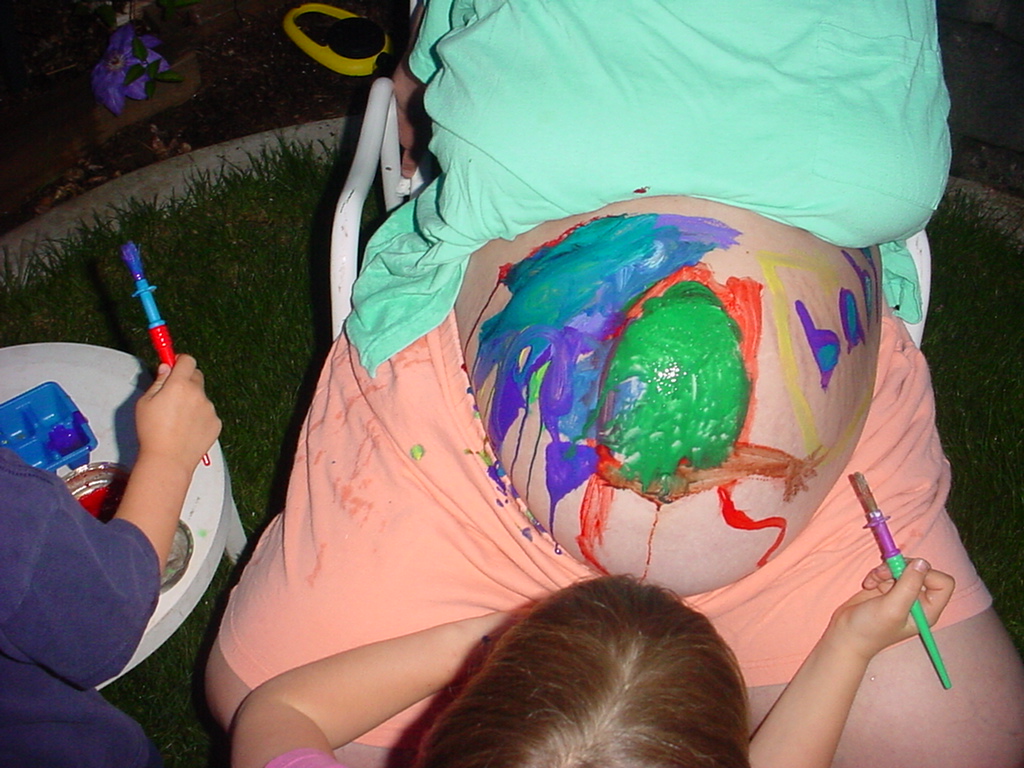
So to distract myself and to have some fun in those last few days, I put on my oldest, ugliest painting clothes, gave my kids a bunch of washable tempera paint, went out into the back yard, stuck out my belly, and gave them a new and unique painting canvas. 


They were young; the resulting artwork is probably not beautiful to anyone in the world except me, but we had a BLAST.   


I remember that belly-painting session with tremendous fondness.  I hope they do too. 

So I honor my belly, stretched out and saggy and droopy as it was (and still is), for all the work it did bringing my wonderful babies to me, like this one, below. [Yes, she is the one in-utero above.]


It was totally worth it, every bit of it.  

Enjoy. And find a way to honor your bellies, too.

*Art Docent HintsIf you enjoy a good mystery and want to try and deciper the painting, look for the picture of the baby they drew.  Look for the green head with a brownish arm sticking out to the side underneath (the rest of the body is a bit amorphous, I'm afraid). Also look for the word "baby" on the side.  There was an arrow below it, pointing to the baby, but it got obliterated by an overenthusiastic toddler.  Then they filled in the blank spaces with random colors and swirls. The final result was a bit Picasso-ish, but hey. 

**Fetal Position Postscript: For the curious, yes, in this picture my baby bump is really quite visible, but then my baby in this pregnancy was in the most optimal position for birth, which is anterior.  That means the little butt was sticking out in front, making a nice big bump to paint on.  In my first pregnancy, when I didn't look pregnant at all, baby was posterior and in that position the baby butt doesn't stick out and make much of a discernible bump.  The difference? I saw a pregnancy-trained chiropractor and got some adjustments.  That made my last pregnancy SO much more comfortable, and it helped baby to be anterior after 3 prior pregnancies with a posterior baby!  Trust me, that's a MUCH easier labor!
Tuesday, November 9, 2010

Breastfeeding Lowers the Risk for Diabetes And Other Maternal Disease Later In Life

There's an interesting new study out on breastfeeding and later diabetes in the mother. 
It found that breastfeeding for at least one month lowered the mother's risk for developing diabetes later in life, even after controlling for many confounding factors such as physical activity status, BMI, etc. 

Interestingly, women who had given birth but not breastfed for at least a month were at greater risk for diabetes later on than women who had never given birth at all.  That was a surprising finding.

According to a discussion of the study at the Breastfeeding Medicine blog:
The study included 2,233 women between the ages of 40 and 78 who were members of a large integrated health care delivery organization in California. Strikingly, one of every four mothers who had never breastfed had developed type 2 diabetes.

Mothers who had not breastfed were almost twice as likely to develop diabetes as women who had breastfed or women who had never given birth. These long-term differences were notable even after considering age, race, physical activity and other factors which affect risk of diabetes such as alcohol and tobacco use...
In other words, breastfeeding is part of the way mothers’ bodies recover from pregnancy. When this process is interupted, and an infant is fed something other than...mother’s milk, a mother’s body suffers.
The authors did control for BMI and physical activity in the analysis, among other things. According to the study's abstract:
Multivariable logistic regression was used to control for age, parity, race, education, hysterectomy, physical activity, tobacco and alcohol use, family history of diabetes, and body mass index while examining the impact of duration, exclusivity, and consistency of lactation on risk of having developed type 2 diabetes.
A couple of limitations of the study are its fairly small size --- 2233 women total, only 1828 of whom were mothers --- and its low threshold for length of breastfeeding (greater than or equal to 1 month of breastfeeding). 

That means the study had only 1024 women who breastfed 1 month or longer, and while that's nothing to sneeze at, you really need a bigger data set, looking at a longer duration of breastfeeding, to prove population-wide effects most clearly. 

Sadly, only 56% of the women in the study had breastfed their children for more than one month, another limitation of the study.  This very low rate almost certainly reflects the age of the women in the study (40-78) and the active discouragement of breastfeeding many of the older women encountered.

Still, the study reports a striking finding and yet another reason to pursue breastfeeding. 

It also points out what a disservice doctors did to women years ago when they actively discouraged breastfeeding, and the dangers of sweeping health policies that interfere with the way our bodies were designed to undergo pregnancy, birth, and postpartum.

Previous research on Breastfeeding and Later Diabetes

Some previous research has also tied length of breastfeeding to a lower risk for later diabetes in mothers. 

A Chinese study (Villegas 2008) found that breastfeeding modestly lowered the risk for later diabetes in women followed for just under 5 years.  They reported:
Women who had breastfed their children tended to have a lower risk of diabetes mellitus than those who had never breastfed [relative risk (RR)=0.88; 95% CI, 0.76-1.02; p=0.08]. Increasing duration of breast-feeding was associated with a reduced risk of type 2 diabetes mellitus. The fully adjusted RRs for lifetime breast-feeding duration were 1.00, 0.88, 0.89, 0.88, 0.75 and 0.68 (p trend=0.01) for 0, 0 to 0.99, 0.99 to 1.99, 1.99 to 2.99, 2.99 to 3.99, and greater than or = 4 years.
One of the largest studies on breastfeeding and maternal diabetes was published in The Journal of the American Medical Assocation (Steube 2005).  It used large datasets from the Nurses Health Study (121,700 women from 11 states) and the Nurses II Health Study (116,671 women from 14 states) to study the effect of lifetime duration of breastfeeding on later risk for diabetes. They found:
Among parous women, increasing duration of lactation was associated with a reduced risk of type 2 diabetes. For each additional year of lactation, women with a birth in the prior 15 years had a decrease in the risk of diabetes of 15% (95% confidence interval, 1%-27%) among NHS participants and of 14% (95% confidence interval, 7%-21%) among NHS II participants, controlling for current body mass index and other relevant risk factors for type 2 diabetes...
Longer duration of breastfeeding was associated with reduced incidence of type 2 diabetes in 2 large US cohorts of women. Lactation may reduce risk of type 2 diabetes in young and middle-aged women by improving glucose homeostasis.
So there's a study with a very large dataset that found that breastfeeding -- the longer the better -- lowered the risk of mothers developing type 2 diabetes later on.

Keep in mind that this study also reflected our society's tendency towards short breastfeeding periods.  They traced a woman's lifetime exposure to lactation (how long she breastfed all her children cumulatively), and their highest category was "greater than 23 months." 

Greater than 23 months over your lifetime?  Heck, I breastfed every single one of my kids at least that much each time, so how does that affect my risk for type 2 diabetes?  My total lifetime exposure to lactation is right around 10 years.  Does each additional cumulative year above 23 months help lower my risk that much more?  The Chinese study cited above seems to suggest so, but its maximum lifetime exposure category was greater than or equal to 4 years.

I would love to seen the JAMA researchers collect information about a far greater lenth of total lactation in U.S. women than 23 months, but the fact is that our long-term breastfeeding rates in this country are so poor that they probably would  have had trouble finding enough women to make such a sub-analysis statistically meaningful. How sad is that?

The study did have a small subanalysis on how lactation affected risk for diabetes in women with significant risk factors, like women with high BMIs, women who had gestational diabetes during pregnancy, etc. They found:
In the NHS II cohort, higher BMI at age 18 years was associated with shorter duration of breastfeeding, and in both cohorts, duration of lactation was inversely associated with family history of diabetes. Gestational diabetes was not associated with duration of lactation. Nevertheless, adjustment for family history and BMI at age 18 years did not substantially diminish the inverse association between lactation and risk of type 2 diabetes, suggesting that the association we observed was not an artifact of pregravid or pregnancy obesity and its associated insulin resistance. However, stratification by history of gestational diabetes revealed that in this high-risk group of women, lactation did not affect risk of subsequent type 2 diabetes.
While it was encouraging that the protective effect of breastfeeding was present for women of size too, it was certainly discouraging that the protective effect did not seem present in women with gestational diabetes.  However, a recent smaller tudy (Gunderson 2010) found a lower rate of metabolic syndrome in women with GD who breastfed longer, so further study seems to be indicated.

Regardless, breastfeeding is always worthwhile because of the tremendous immunological benefits and superior nutrition that breastmilk provides to the baby.  Furthermore, there is research that suggests that breastfeeding is protective against the baby developing diabetes later in life.  For example, Pettitt 1997 found that breastfed infants of Pima Indians (a group at very high risk of diabetes) had less than half the risk for diabetes later in life compared to those who had been bottlefed:
The odds ratio for NIDDM in exclusively breastfed people, compared with those exclusively bottlefed, was 0.41 (95% CI 0.18-0.93) adjusted for age, sex, birthdate, parental diabetes, and birthweight.
One important question is how long the maternal benefits of breastfeeding last. The JAMA study did find that as time went on, the protective effects of breastfeeding against maternal diabetes began to fade. They noted:
In these analyses of 2 large prospective cohorts, we found that duration of lactation was inversely associated with risk of type 2 diabetes in young and middle-aged women, independent of other diabetes risk factors, including body mass index, diet, exercise, and smoking status. This association appeared to wane with time since last birth.
Perhaps long-term breastfeeding has more of a delaying effect than a prevention effect on diabetes, especially in women with very strong risk factors for the disease. 

Another interesting finding was that the longer the period of exclusive breastfeeding, the greater the effect against diabetes.  As the authors noted in their discussion:
Our data on exclusive breastfeeding and duration stratified by parity suggest that the length and intensity of breastfeeding with each pregnancy affect the association with diabetes risk. We found that each year of exclusive breastfeeding was associated with a greater risk reduction than total breastfeeding. This may reflect the greater metabolic burden imposed by exclusive breastfeeding.
We also found that longer durations of breastfeeding per pregnancy were associated with a greater benefit, with 1 year’s lactation for 1 child resulting in a 44% reduction in age-adjusted risk, compared with 1 year’s lactation between 2 children resulting in a 24% reduction in risk.
It appears from our analysis of primiparous women that the beneficial association begins to accrue after 6 months of lactation. These data suggest that sustained lactation-associated metabolic changes have more profound effects on diabetes risk.
This was an encouraging study because it shows in yet another way just how important breastfeeding is --- not just for the baby, but also for the mother. 

However, on a personal note, despite research showing that long-term breastfeeding decreases the risk for type 2 diabetes, I still think there's a very strong possibility that I will get it at some point, despite my 10 years of breastfeeding exposure.  PCOS reflects an underlying metabolic abnormality that no one knows how to "fix" at this point, and breastfeeding's improvements in insulin sensitivity and glucose tolerance probably only end up delaying the progression of that metabolic abnormality, not fixing it permanently.

Still, the less time you have diabetes, the less cumulative damage there is from it to your body, so even a delaying effect could have considerable impact on your long-term health.  I hold that thought close. And of course I do what I can to lower my risk in other ways.

What About Other Maternal Diseases?

Findings from other studies show that longer breastfeeding duration is not only protective against diabetes, but also against hypertension, high cholesterol, and heart disease.  In Schwarz 2009, for example, data from the large Women's Health Initiative study found that longer breastfeeding was associated with lower risk factors and less cardiovascular disease:
Dose-response relationships were seen; in fully adjusted models, women who reported a lifetime history of more than 12 months of lactation were less likely to have hypertension (odds ratio [OR] 0.88, P less than .001), diabetes (OR 0.80, P less than .001), hyperlipidemia (OR 0.81, P less than .001), or cardiovascular disease (OR 0.91, P=.008) than women who never breast-fed, but they were not less likely to be obese. In models adjusted for all above variables and BMI, similar relationships were seen...
Over an average of 7.9 years of postmenopausal participation in the Women's Health Initiative, women with a single live birth who breast-fed for 7-12 months were significantly less likely to develop cardiovascular disease (hazard ratio 0.72, 95% confidence interval 0.53-0.97) than women who never breast-fed...
Among postmenopausal women, increased duration of lactation was associated with a lower prevalence of hypertension, diabetes, hyperlipidemia, and cardiovascular disease.
These findings were echoed in another large study (Steube 2009) that found that women who had a lifetime breastfeeding exposure of at least 2 years had lower risk for heart attacks/cardiovascular disease than parous women who had never breastfed. 
Compared with parous women who had never breastfed, women who had breastfed for a lifetime total of 2 years or longer had 37% lower risk of coronary heart disease (95% confidence interval, 23-49%; P for trend less than .001), adjusting for age, parity, and stillbirth history. With additional adjustment for early-adult adiposity, parental history, and lifestyle factors, women who had breastfed for a lifetime total of 2 years or longer had a 23% lower risk of coronary heart disease (95% confidence interval, 6-38%; P for trend = .02) than women who had never breastfed.
These findings mean that there's a lot of potential room for prevention (or or at least delaying) of diabetes, heart attacks, and other health issues, just by promoting higher rates of breastfeeding....and in particular, promoting breastfeeding for longer durations.