Showing posts with label fat parenting. Show all posts

Tuesday, February 10, 2015

Adventures in Gardening: Hügelkultur Experiments

Periodically, I write about gardening on this blog. I'm sure some readers scratch their heads and wonder why, given that I generally focus on issues pertinent to weight or on pregnancy/birth/breastfeeding, but I view gardening as part of the mission of this blog too.

I write about gardening for several reasons. First and most importantly, I write about gardening as part of my Health At Every Size focus. I think it's obvious that as a society, we would be better off if we ate fewer processed foods and more whole foods, and gardening is an important part of the "slow food" movement. It promotes better nutrition and gives us exercise, all in one convenient package. Not that we all have to be perfect or obsessive, but striving for more whole foods is just common sense.

Second, I write about gardening as part of my Parenting focus. Kids will eat more vegetables and fruit if they help grow it themselves, and it's good for kids to appreciate the kind of work it takes to provide the food we eat. Far too many kids have no concept of how food reaches their table. Gardening also helps kids connect with nature, gets them outside, gives them exercise, and helps them learn to care responsibly for living things. I think every child should learn to garden in one degree or another.

Finally, I write about gardening as part of my Emergency Preparedness message. It's important as parents to have a stock of food on hand in case of a natural disaster or other emergency. Too many people are completely dependent on grocery stores for all their food, and most have very little stored food in reserve for emergencies. Gardening helps you have a renewable source of healthy food for your family. Gardening also lends itself to preserving, which helps you keep a stock of preserved food around. It's important that we keep gardening and preserving skills alive for our children, and it's also important to have a food reserve for our families in case of an emergency.

Gardening is a win-win all around on so many levels. Even though it might not seem like a logical topic for this blog on the face of it, it really does fit my blog mission too.

Today I wanted to share about a gardening experiment I've been toying around with this year. It's called Hügelkultur gardening.

Raised Beds on Steroids

Since a big car accident a few years ago significantly damaged my knees, I mostly garden in raised beds now. Saves my knees a lot of grief and my back likes it too. I'm a real fan of raised beds.

But raised beds have challenges too. They are more watering-intensive; they dry out sooner and need to be watered more often. Being the lazy, less-than-attentive gardener that I am, I'm not always good about watering regularly, which can be stressful on the vegetables.

Also, the soil in raised beds can get "tired out" and depleted of nutrients if you don't refresh them regularly. I prefer to garden organically, so I've been experimenting to see how I can best "feed" the soil in my gardens without having to resort to artificial fertilizers or additives.

It was in response to these challenges that I began to learn about a new/old technique called Hügelkultur Gardening (pronounced HOO-gull-cul-ture). 

Hügelkultur Gardening Basics

First layer of hugelkultur bed - pieces of wood in various
sizes. Image by Jon Roberts, from Wikimedia
Although Hügelkultur gardening has been practiced in several different cultures, the name is German and the idea was popularized by permaculturist Sepp Holzer.

Basically, it means "Mound Culture" or mound gardening. You pile a bunch of wood in various stages of decomposition at the bottom of the pile, water it in well so the wood soaks up the water, then add other layers of soil, kitchen waste, leaves, straw, compost, manure, bark chips, etc. until you have a mound. Then you plant in that mound.

Sometime the mound is small, sometimes it's large, but you basically are planting in a compost pile that's in process. Using different sizes of wood means that it processes slowly and that the nitrogen from the kitchen waste etc. does not overwhelm the carbon content, which is a common problem in many compost piles.

The benefits of hügelkultur are:
  • it improves soil fertility (through decomposing organic matter)
  • it aerates the soil and improves its structure (the soil around the logs naturally creates air pockets, which helps keep the soil from compacting to much, thereby improving its structure)
  • it improves water retention (water is released slowly over time from the water-soaked logs, necessitating less watering in the drier months after the first year or two)
  • it warms the soil (making it easier to plant earlier and longer in the growing season)
  • it promotes earthworms and other beneficial animals/fungi in the garden (they are attracted to the decomposing organic matter and help break it down)
Permaculturists like hügelkultur because it recreates replenishment of soil in the garden in the same way that it happens in nature:
Hügelkultur replicates the natural process of decomposition that occurs on forest floors. Trees that fall in a forest often become nurse logs decaying and providing ecological facilitation to seedlings. As the wood decays, its porosity increases allowing it to store water "like a sponge". The water is slowly released back into the environment, benefiting nearby plants.
Image from richsoil.com 
Personally, it's the watering benefits I'm most interested in. While my area of the country gets lots of moisture in the winter, we get very little during the summer, so we have to do a lot of watering in the summer. My new hügel bed is on the side of my house that doesn't have easy watering access, and it's far away from the raised garden beds that get my main (if inconsistent) watering attention. I wanted more gardening space but less upkeep, so I'm hoping the new hügel bed will help by giving me a new garden space that I don't have to spend so much time watering.

There are lots of different ways to do hügel beds. Although it is helpful to read up on ways to optimize the process, it's basically just planting into soil mounded over buried wood. Some online accounts make it seem complicated, but if you keep in mind the basics, the process is pretty forgiving.

Some people like to build their hügel beds in a trench. You dig a long hole, pile up woody debris in it, then fill in the gaps with kitchen waste, compost, straw, etc. until you have a good mound. The digging part can be a lot of work, so some gardeners don't bother with the trench; they just pile the woody debris directly on the ground and then fill in the gaps. Personally, I used a trench because I think it gives more stability to the mound and because putting the wood directly in the earth accelerates its decomposition, brings more worms, and enhances water retention in the dry months.

Some writers suggest building your hügelkultur beds to run in a line north to south. This is to maximize sun exposure (otherwise, the mound nature of the bed means one side of an east-west bed will get too much shade). Some surround the base of the hügel mound with rocks, logs, or other materials for stability and neatness; others do not. Rocks along the edges may help warm the soil better, but otherwise it's a personal choice.

It's important to use different sizes and ages of wood in the bed if possible. You want some to be old and partially decomposing already, some to be new, some to be thick pieces of wood, and some to be small thin twigs and branches. If you start with all-new and thick wood, your hügel bed may not do as well for the first couple of years, since it needs time to absorb water and start the decomposition process. For maximum benefit, use wood of various sizes and states of decomposition, and start your hügel bed in the fall so that the wood can absorb the winter moisture before planting in the spring.

If you don't have enough woody material of your own, look around. Tree-trimming companies, power companies, and government agencies often have some you can get, or you can collect fallen wood from a friend's back yard, etc. Just make sure it's untreated wood. No plywood or treated lumber should be used.

Another suggestion I've read is to put some of the wood in vertically instead of horizontally, especially if using less water is one of your priorities. Supposedly the wood wicks moisture more efficiently if it's vertical instead of horizontal. I can't speak to this but it seems plausible to me.

Some authors also suggest adding alfalfa pellets when building the bed in order to add more quickly-available nitrogen to balance the carbon dominance of the bed in the first year or two. If you don't have much manure available, this might help. After that, the wood should start breaking down and create its own balance of carbon and nitrogen.

(As an alternative, some people suggest pouring diluted urine or peeing directly onto the logs, but surprisingly, my teen-aged boys declined to do this. I thought they'd love the chance to mark their territory but they were absolutely appalled by the idea.)

Alternate layers of greens and browns in your pile, like in "lasagna gardening" (sheet mulching). Use kitchen waste, garden waste, bark chips, manure, straw, grass clippings, whatever you have on hand. Top it all off with a thick layer of compost and then straw or other mulch to help keep the soil in place and hold in moisture. When you plant, simply move aside some of this top layer and plant the start (or seed) directly into the pile. When you see the seedling is high enough, put the mulch back around it. The first year or two you will have to water seedlings more often, but after that you should have to water much less often.

The more organic material you add (especially nitrogen material) on top of the wood, the sooner your bed will produce results. If you have mostly woody material with minimal soil, it's going to take a couple of years to start breaking down and you won't get much results until then. But if you start with well-watered wood in all stages of decomposition, then add lots of nitrogen-rich material and soil layered with smaller carbon materials (like straw or bark chips), you should be able to plant in the first year and get reasonable returns.

Each year, the organic materials will break down more and more, so you'll need to occasionally add more compost, leaves, manure and bark chips to the hügel beds over the years. Just fill in the holes periodically. The best growing results are typically several years into the process.

But really, although these are suggestions to make hügelkultur more efficient, there's not a lot of strict rules to follow. It's a very forgiving approach, which is why I like it. You can make it what you want and adapt it for your own needs.

My Hügelkultur Beds

Hügelbed, minus top layer of soil.
(This is not my hügelbed, but mine looks
a lot like this, not very mounded yet.)
Image from Wikimedia.
Personally, I started my hügel bed in a small trench and filled it with fallen tree limbs, some firewood, and some old branches and logs from our school grounds. (If I were to do another hügel bed, I think I'd add in even more wood, as I don't think we have enough in there to truly go without extra watering.)

My hügel bed is more of a mini-hügel than a true hügel. The classic hügel is a very high mound with very steep sides. I do not have enough soil and compost right now to make a mound that high, so I'm doing what works at my property...a mini-hügel. It won't last as long, but it should still last several years. That's good enough for a first experiment.

I let the wood get good and soaked in the fall rains, then we began covering it up with layers of kitchen scraps, manure, straw, wood chips, grass clippings, half-cooked compost, the original soil from the trench diggings, garden leftovers, and dead leaves. At this point, it's not very mounded yet, so we need to add more compost, straw and other materials this spring to continue to build it up.

The top of the pile has last year's Halloween pumpkins on it; I'm hoping they seed and start new pumpkins in the pile for this year. Pumpkins are supposed to love hügel beds. My hügel bed is in the former rabbit pen, so it should have lots of good rabbit poo to make the pumpkins happy, and the pumpkins will have lots of room to spread out and grow, which was a problem in my raised beds.

I plan to plant several berry bushes of different types in the hügel bed this year, mostly huckleberry, josta berries, and blueberries. These will form the backbone of the hügel garden, the "perma" in my permaculture. Their root structures will hopefully grow strong over time and give stability to the bed.

Some people also put stuff around the edges of the bed to give it stability, but since mine was built in a trench and isn't very mounded, I'm not too worried about this. I probably will put down some cardboard and bark chips around the edges of it to create a walking path and hopefully deter the grass from growing up the sides, though.

I will plant some nitrogen-fixing plants like peas and beans this year, which hopefully should help provide balance for the carbon in the wood pile underneath. This may be especially important in the first year of growing, since a hügel bed tends to be carbon-dominant at first. I didn't add any alfalfa pellets, but I may look into getting some to add to the beds (since my teens aren't cooperating with territory-marking plan).

In future years I will add more variety of plants, intercropped between the more permanent plants, but for now, I just want to get the basics in the bed and get it up and running. I'll probably have some annual greens there this year as an interim plan.

I like the hügelkultur idea so much that I'm trying to convert some of my raised beds on the other side of the house to a hügelkultur hybrid bed. I have my teenagers digging up the dirt in the raised beds, shunting it to the side, putting old soaked wood and branches in the bottom, and then mixing in kitchen waste, half-finished compost, rock/mineral dust, straw, bark chips, and manure into the rest of the soil. They won't be true hügelkultur beds because they won't have nearly as much wood, but will hopefully give my raised beds a good shot of soil replenishment ─ and maybe lessen watering requirements if I'm lucky.

I wrote previously about my experiment with trench composting, i.e. composting my kitchen waste directly into holes in the raised gardens. Overall, that has been great (far better than messing with a compost pile!), but I did notice that some of my raised beds tended to have too much nitrogen this year. As a result, some of my tomatoes had tons of green growth but not as much fruit in some places.

So the hügelkultur hybridizing of my raised beds will hopefully also help bring more carbon to balance the nitrogen created by the trench composting, which I love and want to continue. Hopefully, a better balance between "browns" and "greens" in the garden will create maximum produce production.

Although it's still early in the process, I'm pretty optimistic about the Hügelkultur beds I'm creating. Since it simply re-creates the process as it happens in nature, I think it has a great chance of succeeding and will greatly add to the productivity of my garden. Better yet, I'm hoping it will lessen the amount of watering, fertilizing, and fussing I need to do, which would be great because I'm a very lackadaisical gardener. I enjoy it when I get around to it, but I have too many other time demands and interests to obsess about it too much.

If you are interested in Hügelkultur for your own gardens, check out some of the links below. Happy gardening!


Resources

Thursday, July 25, 2013

Blame the Mothers: Fat Children Equals Child Abuse?


I thought these research abstracts, published recently, deserved to be displayed together for sheer irony.

The first shows the parent-blaming inherent in the "childhood obesity epidemic" public health campaigns.

The second points out the unfair nature of this parent-blaming and the sexist, mother-blaming nature of most of the media messages around public health campaigns against child obesity.

The third helps refute the common idea that fat kids eat excessively and that fatness is always related to the amount of calories consumed.

Unfortunately, it is only the first message only that is being communicated to the public these days. Here's the typical take-away message that many people get from childhood obesity public health campaigns:
If a child is fat, it's THE PARENTS' FAULT, and they are bad parents to have "let" their child get that way (and it's especially the mother's fault because it's her job to see that everyone is healthy).   
Parents of fat children have failed in their duties as a parent, and perhaps their child should even be taken from them. 
If a child is "morbidly obese," then the parent has allowed him to become that way, and that is a form of child abuse
Like the attitudes behind this lawyer's comment:
The idea here is that a minor who is morbidly obese has an unacceptable amount of health risks due to, basically, the gross negligence of their parents...they have to be taught to lead a healthy lifestyle, which they obviously haven’t been taught yet thus far.
"Gross negligence of their parents"?  Because no child could possibly be morbidly obese unless their parent was force-feeding them huge amounts of junk, right?
The state will step in and stop parents who won’t feed their kids. Why shouldn't the state step in and stop parents who keep shoveling food down their kids’ throats?
"Shoveling food down their kids' throats"? Really?  Because children can only be obese if they are consuming huge amounts of calories?  Because their parents are lazy or ignorant and don't know anything about feeding "healthy" food?  Because all that's needed for fat kids to slim down is to unplug the TV/computer and exercise a little restraint at the dinner table, right?

The societal pressure on parents of fat children is tremendous.  Look at some of these quotes from people about the stories on removing fat children from parental custody.
-I get extremely frustrated when I see an obese child. I mean, REALLY frustrated. I immediately look to the parent to see why this child is overweight. Is the parent obese as well? Is it just carelessness? Does the parent not see it? Does the child have a thyroid problem? Can they not afford healthier food? All these questions run through my mind, and yes, in that very moment I do want to snatch the child away from the parent. I want to bring the child into my home and introduce them to REAL food, that nourishes their growing body....
-I get sooooo angry when I see obese kids too. I literally want to punch the parents in the face and tell them to wake up!!   
This idea that parents are solely responsible for making a child fat and that this is tantamount to bad parenting and child abuse drives so much of the discussion around "childhood obesity" hysteria these days, yet this perception is fundamentally flawed.

A fat child does not equal child abuse.

Let's say it again:

A FAT CHILD DOES NOT EQUAL CHILD ABUSE.  

Yet there are a number of health and social care professionals that seem to believe it does:
Does allowing a child to become morbidly obese qualify as child abuse? Some health and social care professionals believe it is a question that needs to be considered more seriously... 
"It is my view that child obesity should be treated as a form of child mistreatment, as any type of under-feeding is," says Joanna Nicolas, a child protection consultant who has been a social worker for 17 years. 
"If a child is obese it is a form of abuse because of the physical impact on the child, the implications for their future health and the psychological impact," she told Radio 4's The Report.
This is parent-blaming at its worst. It is a reflection of negative public health discussion that views obesity as a entirely voluntary state, caused by bad habits, laziness, and/or ignorance about nutrition, and a condition that is supposedly easily modifiable by reasonable behavior.

Yet if obesity were so easy to prevent and/or treat, why hasn't been it taken care of by now? Why don't the many obesity intervention programs out there result in more permanent weight loss? Why do most weight loss intervention studies tellingly not include long-term follow-up? Why do study after study show only a small number of people losing weight and keeping it off long-term? Why do many people who initially lose weight end up heavier in the long-term after dieting? Are that many people really that weak-willed and ignorant?

Why do many super-obese people who have SURGERY to restrict their stomachs and re-route their intestines still remain clinically obese, even after losing lots of weight? Why do they often remain fat to some degree (and even regain lots of weight after a couple of years) despite being unable to eat a lot of food or absorb many nutrients from the food they do eat?

Could it be that fatness is related to factors other than just intake and output?

The only way healthcare and social professionals can explain the tremendous statistical failure of diet programs is by blaming fat people themselves.  In their view, it can't be the fault of the diet/lifestyle programs, it can't possibly be from some metabolic difference, nor can it be because there are strong biological mechanisms for defense of body weight.

No, it must be fat people's own intransigence, laziness, ignorance, lack of self-discipline, or unwillingness to change habits that is behind their continued fatness.

In other words, it has to be fat people's fault because these healthcare folks NEED it to be their fault.  They need to believe in a paradigm where it's fat people's fault because otherwise, it questions everything they believe in and the very nature of their own body privilege.

And because this is the narrative that society wants to hear, this is the message they are given, over and over again in the media.  Read the stories featured in the media and see how rare it is to see a message that doesn't conform to this paradigm. As Abigail Saguy discussed in her excellent article for the Washington Post:
The way we talk about fatness as a medical issue and a public health crisis brought on largely by reckless personal choices may be worsening anti-fat prejudice and related health problems.
Well, it certainly is worsening the prejudice and pressure that parents of fat children experience.  If the trend keeps going the way that it is in some areas, there will be more and more blame put onto the parents of fat children, and more efforts to take fat children away from their parents in order to "save" them.

And that is just incredibly frustrating and alarming to the parents of fat children everywhere.


References

J Law Med. 2012 Sep;20(1):124-51. Childhood obesity, parental duties of care and strategies for intervention. Nolan EJ.   PMID: 23156652
Childhood obesity is an increasingly serious issue which causes significant health problems among children. There are numerous causes of childhood obesity. However, the ultimate responsibility for the problems and costs associated with an obese child should be attributed to that child's parents. Parents owe a duty of care to their child and, when their child is obese, have arguably breached that duty. However, if parents were required to pay their child damages, this would arguably be problematic and of little utility. Rather, intervention strategies should be implemented which seek to treat and prevent childhood obesity and to address the identified causes of childhood obesity.
Appetite. 2012 Nov 24. pii: S0195-6663(12)00448-5. doi: 10.1016/j.appet.2012.11.005. [Epub ahead of print] "Fat is your fault": Gatekeepers to health, attributions of responsibility and the portrayal of gender in the Irish media representation of obesity. Brún AD, McCarthy M, McKenzie K, McGloin A.  PMID: 23186694
We investigated the representation of obesity in the Irish media by conducting an inductive thematic analysis on newspaper articles (n=346) published in 2005, 2007 and 2009 sampled from six major publications. The study analysed the media's construction of gender in discussions of obesity and associated attributions of blame. Three dominant themes are discussed: the caricatured portrayal of gender, women as caregivers for others, and emotive parent-blaming for childhood obesity. Men were portrayed as a homogenous group; unaware and unconcerned about weight and health issues. Dieting and engaging in preventative health behaviours were portrayed as activities exclusively within the female domain and women were depicted as responsible for encouraging men to be healthy. Parents, specifically mothers, attracted much blame for childhood obesity and media messages aimed to shame and disgrace parents of obese children through use of emotive and evocative language. This portrayal was broadly consistent across media types and served to reinforce traditional gender roles by positioning women as primarily responsible for health. This analysis offers the first qualitative investigation into the Irish media discourse on obesity and indicates a rather traditional take on gender roles in diet and nutrition.
Pediatrics. 2012 Oct;130(4):e936-42. doi: 10.1542/peds.2012-0605. Epub 2012 Sep 10.
Self-reported energy intake by age in overweight and healthy-weight children in NHANES, 2001-2008. Skinner AC, Steiner MJ, Perrin EM.  PMID: 22966024
...METHODS: We examined dietary reports of children ages 1 to 17 years by using the National Health and Nutrition Examination Survey, 2001-2008 (N=12648)... CONCLUSIONS: In a nationally representative cross-sectional sample, overweight and obese girls older than 7 years and boys older than 10 years reported consuming fewer daily calories than their healthy-weight peers....


Thursday, July 18, 2013

One Little Pound: Boy Scouts and Arbitrary Weight Limits


My oldest son is at Scout Camp this week.

This is not just any Scout Camp, mind, but one of THE ultimate Scouting experiences you can have.  It's a huge national gathering of Scouts called "Jamboree."  Thousands of Scouts attend, mostly from the U.S., but also some from all over the world.

Jamboree only happens every few years and it incorporates all kinds of "High Adventure" opportunities.  This year's Jamboree is being held for the first time in a brand-new facility in West Virginia. They expect over 50,000 participants, staff, and visitors. This is a VERY BIG DEAL in the Scouting world.

My son's Jamboree troop flew into Washington D.C. and spent some time sight-seeing, visiting Gettysburg and other spots of historic interest, and then traveled on to the area around Beckley, West Virginia and the brand-new Summit Bechtel Family National Scout Reserve facility near the New River Gorge area.

This is especially meaningful for me, because part of the extended family that had been unknown to me until just recently grew up right in this area.  My son will be tramping through family stomping grounds, just by coincidence.  How cool is that?

This National Jamboree is the Scouting experience of a lifetime, and my son is the Senior Patrol Leader (SPL) of his Jamboree troop, which is basically the student leader of his entire troop. This is a huge honor and great leadership opportunity for him. He is very close to becoming an Eagle Scout, the ultimate Scout achievement (attained by only 2% of Scouts), and I'm sure this will be one of his most memorable Scouting experiences of all time.

But he almost didn't get to do it.  You know why?

Yup. His weight.

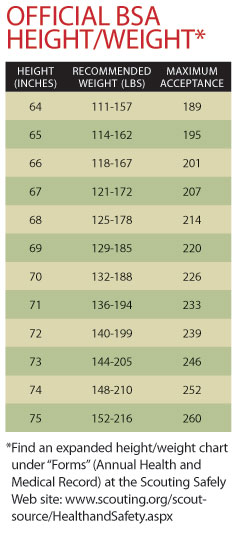
According to the published BSA High Adventure guidelines, my son weighed exactly the maximum allowed for his height.  If he had weighed even one pound more, he might not have been allowed to go. (*See update below)

I find these weight limits to be outrageous and egregiously unfair. I understand the impulse from which they come, but the way they are applied is short-sighted and wrong.

Boy Scout Weight Limits - Details

A couple of years ago, the Boy Scouts put into effect strict weight limits that prevent people who don't meet these limits from participating in High Adventure programs. This applies to both Scouts and their adult chaperones.

This doesn't mean that the Scouts are preventing fat kids and adults from participating in Boy Scouts. Not at all. Fat folks are still welcome to Scouts...but they can't participate in every activity or outing. And disturbingly, there is now an underlying message of judgment and condemnation around body size being pushed by Scout leadership.

The bottom line is that people of size can participate in most Scout activities and outings, but can't participate in High Adventure programs.

High Adventure programs are ones where participants are more than 30 minutes away from access to medical attention and where activities tend to be more strenuous, like long backpacking trips, whitewater rafting, rope courses, zip lines, mountain biking, rock climbing, etc. In other words, some of the most fun stuff Scouts can do.

Looking at the height/weight limit chart and calculating BMIs from the chart, the cutoffs fall pretty universally at a BMI between 32 and 33.

So they are letting those in the "overweight" (BMI 25-29) or just barely into the "obese" category (BMI 30-32) participate in High Adventure programs.  How very magnanimous of them.  But how did someone determine what level of "obesity" is too much for High Adventure program?  What research proves that a BMI of 33 is too heavy to safely participate?

According to the Scouting website:
The Annual Health and Medical Record is based on several evidence-based sources, including the revised Dietary Guideline for Americans from the U.S. Department of Agriculture and the Department of Health and Human Services, and has been successfully deployed by our high-adventure bases.
Well, frankly, that doesn't say much. Notice the Scouts don't cite specific evidence, just general "evidence-based sources." That's not enough. I'd like to see the evidence that these cut-offs for participation are justified. Likely all these sources say is that a person with an obese BMI is at greater risk for blood pressure and blood sugar etc. issues, not that they all automatically have these things or that there is a sudden spike of risk starting at a BMI of 33.

The guidelines do make room for an end-run around them if you can meet body-fat percentages instead.  In other words, if you are one of the many athletes that fall into the "obese" category based solely on BMI, then you can bypass the weight guidelines if your body fat falls below 15% for males, 20% for females.  But of course, to do that, you have to pay for an expensive specialized body fat test instead, which few people are going to do. Not to mention the fact that many fit folk and even some athletes don't meet those particular body-fat cutoffs, let alone most regular folk. The body-fat requirements would eliminate most people from participation, not just fat ones.

So basically, this escape clause around the weight limits is a dead end. They've created the appearance of flexibility while not being flexible at all.

Here's my gripe:

These weight/height guidelines are extremely arbitrary and they don't take actual fitness into account, just weight and body fat. 

What's really important here is the question of FITNESS. Is the individual in question fit enough to participate safely in these activities?

The problem here is that Scout officials are assuming that weight, BMI, and/or body fat percentages are an adequate surrogate for fitness, BUT THEY ARE NOT.

Plenty of kids with a BMI of 33 or more are quite fit, and plenty of kids with a BMI less than that are not fit. Allowing participation in High Adventure activities based only on BMI will arbitrarily restrict a lot of kids from participating in the very coolest Scout activities, even though many of them are perfectly fit enough to do these activities safely. And that's just wrong.

Jamboree vs. High Adventure Weight Cut-Offs
UpdateIt's important to note that I learned yesterday (after I had written this post) from recent stories that there are actually two different sets of cut-offs, one for High Adventure trips (no one with a BMI greater than 33), and a slightly more liberal one for Jamboree (no one with a BMI greater than 40). 
[They justified the "morbidly obese" cut-off at Jamboree because the brand-new Jamboree site in West Virginia is very hilly and there is a lot of walking involved.  As if kids with a BMI over 40 are not able to walk several miles a day or go up and down hills!]
Here's the crucial point: Scouts with BMIs between 32 and 40 were allowed to attend Jamboree if they provided additional information to Jamboree medical staff that proved they were healthy enough for the activities. That means my son would have been able to go to Jamboree after all, even if he'd weighed a bit more. 
However, that's news to our family. The official medical form we were given for Jamboree cited weight limits that aligned with the stricter High Adventure standards. And the wording on the Scouting "Medical Forms FAQ" lists the Summit Bechtel Reserve as one of the "High Adventure Bases." So we thought he had to meet the strict standards.
Somehow we got wrong information about this. The point is moot because my son made the cut on the lower High Adventure limits─barely─by being the exact weight specified on the medical form as the "maximum allowable weight."  But we sure sweated it. 
Whether or not the more liberal Jamboree cutoffs would have allowed my son to go, the bottom line is that there are still Scouting activities and camps he would not be allowed to attend if he were one pound heavier, which I find ridiculous because he is a very active and fit kid.  And that is why I'm going to go ahead and publish this post, despite yesterday's discovery of slightly more flexible Jamboree cut-offs.

I want my son to be able to do the High Adventure trips in the future, and as the High Adventure cut-offs stand, he may or may not be able to do them. That's the real point here.
More on the Weight Limits

Here's a little more background on the High Adventure weight limits and why they were put into effect. According to an article on the new restrictions from a Scouters magazine:
The Annual Health and Medical Record, which takes effect in January 2010, restricts participation in high-adventure activities based on standardized height/weight ratios. For wilderness outings where health care is 30 minutes or more away, Scouts deemed too overweight won’t be allowed to participate....
[Ruth T. Reynolds RN, BSN, and medical coordinator for the Boy Scouts of America] doesn't apologize for that. She says the BSA intends the new forms to be in line with the Scout Oath: “I will keep myself physically strong, mentally awake, and morally straight.” She argues that, “We as Scouters are not taking responsibility for who we are. The Scout Law says a Scout has 12 important characteristics, but it doesn't say a Scout is sedentary, fat, or unhealthy.”
Leaders say Scouting must confront the issue of obesity, the biggest health threat facing children today, as part of its commitment to child advocacy. 
“Our role is clear,” [Chief Scout Executive Robert J. Mazzuca] says, “We must continue to aggressively create and promote programs that help build healthier lifestyles for our Scouts. As leaders, we must do all we can to set the example for encouraging these healthy choices, not only for our Scouts, but for their parents and peers as well. Their future is Scouting’s future.”
I am so disappointed in these Scout leaders, perpetuating this kind of stereotyping and prejudice about fatness to our Scouts. What kind of example are they setting for our youth with this kind of bigoted talk?

Yes, the Scout Oath says they will keep themselves physically strong, but many fat kids are physically strong. (My "obese" son is physically much stronger than a number of his thinner troop-mates.) Many Scouts with a BMI over 32 can absolutely meet the rigorous physical standards needed for High Adventure activities.  I know my son can and does.

Furthermore, being fat doesn't always mean you are sedentary or unhealthy.  It really ticks me off to see a Scout leader in the national organization conflating these things. Sadly, these leaders have been brainwashed by the public health obesity campaigns that assume that fat people can't possibly be healthy, fit, strong, or active. The truth is that these things are separate issues, but they are not being treated as such.

I was also disappointed to see that some of the articles in Scouts publications recycle the old myth, "This generation will be the first not to outlive its parents" because of obesity.  Folks, there is absolutely no statistical evidence to back up that claim and its time people stopped making it, but it still gets passed around as if it's truth. To see it in a Scouting article is especially frustrating.

Many Scout leaders also decry too much time in front of screens (TV or computer) and the lack of exposure to the outdoors, what some people call "Nature Deficit Disorder." They link it to obesity. (As if a fat person only ever sits in front of the TV or computer and never gets outside, and as if no thin person ever spent much time in front of a screen.) They cite Scouting as the answer:
Jason Barlow, area commissioner for the Northeast Region, uses public service announcements aired on local radio stations as an answer to obesity: “Our kids are spending too much time indoors, online, and logged on to the computer. At Scout camp ‘logged on’ means putting more wood on the campfire and ‘online’ means catching a great trout for dinner. Scouting will get your son unplugged from screen time and plugged into the great outdoors, where he will develop character and leadership skills.”
While I completely agree that this generation spends too much time in front of screens, I reject the common assumption that this is the main factor that drives childhood obesity. It can be a factor for some, but just unplugging the screens won't make fat kids thin, and plenty of thin kids get far too much screen time without becoming obese.  Using BMI as a cutoff to make assumptions about who gets enough outdoor time and who gets too much screen time is wrong.

Weight Limits for Adult vs. Kids

In many articles, the media attention to this issue has focused on the limits this puts on adult volunteers who must chaperone Scout trips. But to me, the issue is much more about weight limits for kids.

To be fair to the BSA, there are some reasonable concerns driving these weight limits. High Adventure excursions go out into the wilderness and are far from medical help.  The BSA was presumably seeing out-of-shape adults going on these trips as chaperones and then encountering medical issues far in the wilderness, where it was a struggle to help them. They were concerned about liability of having middle-aged, Weekend Warrior parents who over-estimated their fitness having a heart attack in the middle of nowhere on a Scouting Trip.  As a Scouting FAQ notes:
Standards are put in place to protect the health and well-being of all participants. The participant that is not healthy enough to participate in a given activity puts himself/herself and others at risk. No one wants a Scout or Scouter to be placed in a situation that is risky or could lead to permanent disability or death.
So while I'm not a fan of the arbitrary nature of adult weight limits, I understand the impulse they come from.  Middle-aged adults are more at risk for heart attacks and other problems, and there are some who are probably not fit enough to safely participate in some of these activities.  What a terrible thing it would be for a boy to go with his dad on a wilderness backpacking trip, only to see him die of a heart attack on the trail because they couldn't get him to medical help in time.

So I get where the BSA is coming from on this concern.  They want to minimize the risk of something awful like this happening.

The problem I have with these weight limits, though, is that they judge a person's fitness solely by weight.  And that's just not a very accurate or reliable method of judging fitness.

The BSA simply doesn't buy into the possibility that a fat person can be fit enough to do these High Adventure activities.  They've totally bought into the myth that fat automatically equals unhealthy, unfit, and someone who never exercises. This ignores the fact that fat people can be fat and fit.

It also conveniently ignores the fact that many thinner people are very unfit and at strong risk for heart attacks too.  I can think of several men I've known over the years who would have met the BSA adult weight requirements to go on High Adventure outings, and yet who had heart attacks or strokes in their 30s or early 40s just doing normal activities. They weren't fat, but they weren't fit. They certainly were fortunate that their medical crises didn't take place in the woods─but under the Scout guidelines they would have been eligible to go.

Yes, I'm sure there are plenty of fat parents who aren't fit enough to go on some of these High Adventure treks. But I'm also sure that there are some fat parents who are (and who did it many times before this new guideline was put into place). And I'm also sure that there are plenty of adults with a "normal" BMI who really aren't fit enough to participate safely.

To me, it should be about proving fitness, not assuming fitness based only on arbitrary cut-offs.

And really, is a 16 year-old fat kid at the same risk for a heart attack as a middle-aged fat adult? Are teens really dropping like flies from heart attacks on wilderness treks?  I don't think so.  And to me this is why these arbitrary limits are even more ridiculous for kids.  Fat kids are not at the same kind of risk for the kind of disastrous scenarios they are most concerned about.

OK, fatness is a mild risk factor for lower-extremity injuries in kids. This may be because of an increased mass causing more force in a fall, but it may also be because supportive equipment is not designed for larger bodies or because coaches don't know how to help larger bodies safely. Still, the absolute risk is still quite low, and very few kids will experience such an injury, fat or not.  It's certainly not worth banning a kid from an activity across the board.

So while I understand the impulse behind weight limits, to me the reasoning is even more ridiculous for kids.  Again, you can't tell someone's fitness from their BMI.  As NAAFA's recent press release on the issue noted:
One mother reported to NAAFA in 2009 that her son was having issues attending Philmont High Adventure Boy Scout Camp in Cimmaron, NM. "Philmont has a weight standard and anyone over this standard is labeled unhealthy and cannot participate. I tried to explain to them that my son plays football, wrestles and runs relays, shot put, discus thrower, in track & field and [is] a weight lifter. During the summer he swims, weightlifts and conditions for football. He has been conditioning for Philmont by hiking for 2-3 hours with a 50 pound pack on his back for the last 2 months. He weighs 261 lbs. and has been eating a 1200 - 1400 calorie diet trying to lose weight. Unfortunately he only lost 3 pounds... According to Philmont medical staff if he doesn't weigh below 246, he will be sent home. It didn't matter to them if he is active, only his weight number. I have watched my son condition for football and he can run circles around other players that are what society deems healthy."
Frankly, neither kids nor adults should be banned from High Adventure activities based only on their BMI. Standards should be fitness-based instead.

My Own Kids

My son throwing discus at a Track and Field meet
Let me clarify my son's situation.  We're not talking about a kid here who has mobility or fitness concerns.  My son is an extremely healthy 16 year-old who is very active and in great shape.

Interestingly, he would never be identified as obese by most people.  He really doesn't look "fat." I have more familiarity with Body Mass Index guidelines than most, but even I was deeply surprised at his last check-up to find out that he is considered to have an "obese" BMI.

He is a very solidly-built kid, like his dad and paternal grandfather. Not "big-boned" in the way that people use to make excuses, but truly big-boned in that he has a very substantial frame and is built solidly and muscularly. He doesn't have six-pack abs, mind, but he's plenty fit.

In years past, he played soccer, swam on a swim team, skied, and did track and field. He regularly does long hikes with the Scouts, he got his Kayaking merit badge last year in Alaska, and he just earned the BSA Lifeguard Merit Badge, a demanding achievement that few Scouts attain.

This is not an out-of-shape kid. He truly is plenty fit enough to do demanding programs, and there are a lot of skinnier kids in his troop that are a lot less fit than he is. Yet he is the one who wouldn't get to attend a High Adventure trek if he weighed one more pound.

Given his build, he will probably always be close to the edge of the limits allowed for any High Adventure trips he might want to do in the future.  He's an ambitious and adventurous kid, and I want him to be able to have these adventures while he can.  But I worry that any little fluctuation will bar him from participating.

In addition, I worry about him trying to manipulate his weight to meet these stupid guidelines, like the Scout in the NAAFA press release.  Boys are less at-risk for eating disorders than girls, but they do still get them.  Wrestlers and jockeys are notorious for them because of the strict weight limits enforced by those sports.  I don't think my son will go down that path, but I do worry about it if the Scouts keep being so uptight about these cut-offs.

But I'm not just worried about my older son.

I'm even more worried and sad for my younger son (who is just hitting puberty) because he likely won't meet the height-weight guidelines unless his upcoming growth spurt changes something drastically. He was always an average-sized kid until shortly before puberty, when his weight suddenly increased drastically. You can see that he has very strong insulin resistance because he has acanthosis nigricans (darkened skin around his neck and armpits) and lots of skin tags. I think he has the male version of my PCOS. If he's like me, that means it will impact his weight and make it very difficult to lose to "normal" levels.

Once he hits his growth spurt, I'm sure he'll outgrow some of the weight (as many kids do), but I doubt if he'll ever lose enough to meet these Scout weight cutoffs. That means he likely won't be allowed to go on High Adventure activities. And I'm outraged at that on his behalf.

He is not quite as fit as his older brother, mind, but he's worked hard at improving his fitness, whatever his weight. He works out every morning on our treadmill, and he goes for hikes with the local Scouts (he's out on Wilderness Survival this week). He played soccer for many years, swam, skied, and also participated in Track and Field. But he's still heavier than his brother and definitely heavier than the High Adventure cut-offs.

I will continue to encourage him to work on his fitness, just for the sake of his insulin resistance and general health, but I doubt he'll ever be a "normal" size.  And I'm concerned he'll get discouraged and stop when he realizes he may never meet the weight cutoffs for High Adventure programs.

I want him to get the concept that exercise and fitness are not for the purpose of losing weight or meeting arbitrary weight standards, but rather for the purpose of health and feeling good in his body.  But these Scout guidelines make getting that across more difficult.

And that's another reason that I dislike these Scouting weight cut-offs so much.

Final thoughts

I'm not without sympathy for the BSA here. I don't envy the Scout leadership some of the tough risk-management decisions they have to make. I agree there is room for concern about out-of-shape folks taking part in activities that they aren't ready for. I don't think it's unreasonable for the Scouts to put some limits on participation in strenuous, back-country activities that take place far from medical help.

But these height-weight guidelines just seem too arbitrary. They don't take into account fitness, which is the real question here, but instead use BMI as a surrogate for fitness. That's wrong.

Too many BSA leaders have bought into the notion that weight = fitness level. This is the caustic result of public health campaigns about obesity, that leaders can't even consider the possibility that fatness and fitness are two different things.

But they are two different things.  Conflating them means that many people who could safely participate in High Adventure activities will automatically be denied access to them, while others who may not be fit enough get to take part in them, endangering themselves and the people around them.

To me, the rhetoric we've heard from Scout leaders on these guidelines represents holier-than-thou attitudes about obesity from naturally skinny leaders who don't have a clue about how someone could possible have a BMI greater than 30.  Their bodies don't work that way, so they assume everyone's bodies should work similarly. They believe that if we all just ate better, turned off the screens, and got outside, we'd all have a BMI of 22. But it just doesn't work that way for many of us.

My oldest son was lucky that he just managed to squeeeeak past the fascist weight cut-offs, but we were sweating it for a while, not knowing that there was a bit more flexibility for Jamboree. But the guidelines allow NO wiggle room whatsoever for the High Adventure activities. You either make the weight cutoff or you don't go, period.

What a loss that would be for him.....but even more, what a loss for the Scouts. They are all about training leaders for a new generation, and he is an outstanding leader, if I do say so myself (not that I'm biased!). Yes, he can continue as a leader in non-High Adventure outings, but that's not the same.

And even non-High Adventure outings are starting to lean towards weight restrictions.  As the Annual Health and Medical Record Form notes:
Enforcing the height/weight limit is strongly encouraged for all other events, but it is not mandatory.
This is apparently meant to encourage anyone exceeding the High Adventure standards to lose weight, but the way the statement is phrased fills me with dread. How long till these draconian limits are enforced in non-High Adventure activities?  How many local troops are going to start enforcing these limits for regular scout outings, not just High Adventure ones?

The Scouts just don't seem to see that they are shooting themselves in the foot here. They already have a problem with kids dropping out before they finish the program; if fat kids aren't allowed to do the most fun activities, that will only increase drop-outs from the program. In addition, these limits will lead to fewer adults being available to chaperone Scout outings. They have trouble already getting enough adult chaperones to meet requirements. This will only increase that problem.

Furthermore, the publicity surrounding these weight limits may backfire. Instead of helping Scouts lose weight, it may discourage many families with fat kids never to join Scouts in the first place. Why would they join something where they couldn't participate in everything, and where this kind of fat-phobic rhetoric gets modeled by leaders?  How can they trust that their child will be treated respectfully and not be subjected to yet more weight-loss pressure and fat-hate propaganda?

Scouts are against bullying, but the kind of fat-hate language and stereotyping being used by Scout leaders in some of the articles about the weight limits certainly has more than a whiff of weight bullying and prejudice in them. What a poor example they are setting for the kids. I can't emphasize how disappointed I am in the Scout leadership about that.

If we weren't already part of Scouts and my husband an Eagle Scout himself, frankly I'd be thinking twice about having them in Scouts at all. In fact, I almost decided not to publish this blog post because I'm concerned that just writing about this issue may discourage some of my fat readers to avoid Scouts completely. (Many want to now; see the comments in this blog post here.)

And that would be a tragedy, because whatever you think of some of their policies, Scouts is an excellent organization that offers OUTSTANDING programs. I can't say enough good things about that part of Scouts. No, I don't agree with all their policies, but we have chosen to give our sons the benefits of Scouts and work from the inside to change things about Scouts with which we don't agree. Scouting just has too many positive things about it to abandon.

Scouting helps children develop responsibility, self-reliance, first-aid skills, fitness, wilderness knowledge, community service, and other important life skills. Most importantly, it helps develop character and excellent leadership skills. It has been a TREMENDOUSLY positive influence on both of my sons, especially in their leadership abilities. I can't say enough about the benefits they have experienced.

I don't come from a Scouting family or a camping background; my boys are only in Scouts because my husband was a Scout and wanted to pass that on. Having seen what it's done for my sons, I'm a big believer in Scouts now, despite having disagreements with some Scout policies. But these weight limits are pushing me near the breaking point.

The Scout fitness-fascist leaders hope that these weight limits will motivate fat folks to get off their butts and lose weight, and that the end result will be a more fit society.  They think it will motivate fat people to lose weight if they are not allowed to participate in some activities.

I think they're wrong. I think fat kids in Scouts will only feel more isolated and stigmatized, opt out of the more challenging outings, drop out at earlier ages, or worse yet, won't join Scouts at all. And that will hardly promote Scouting's goal of improving society's fitness levels, getting more kids out into nature, and developing future leaders.

I don't think the answer is more restrictive weight limits, but rather more inclusiveness and emphasis on fitness as the goal, instead of on arbitrary weight limits.

The goal of increasing fitness in Scouts is a valid one.  But this is not the way to encourage it.

Thursday, July 14, 2011

Taking Away the Fat Kids Again

Well, the story that consistently strikes fear in the hearts of fat parents everywhere has resurfaced again:  Should parents lose custody of super obese kids?

OMFG.  There are actually people at the Journal of the American Medical Association who are promoting this crap?  Who really believe that very fat children should be traumatized by being taken away from otherwise loving parents, simply because of weight?  Who really believe that foster care ─ where many children are abused and mistreated ─ is going to be a better environment for these children?

Here we go again, blaming the parents for their children's obesity.  Because, you know, no child could ever be that fat without their mothers actively force-feeding them deep-fried cupcakes, ice-cream IVs, and chocolate-covered french fries.*

This just ties into the popular notion that obesity is only ever about gluttony and sloth, that fat children only become that way because their parents' bad habits, and that if very fat children are just given proper nutrition they will become a "normal" weight and maintain it seamlessly for the rest of their lives.  That putting these children in a controlled environment and giving their parents nutritional lectures is going to fix everything (and won't make things worse).

In the fat-acceptance community, we've been fighting this battle for SO many years, because authorities have been periodically taking fat children away from their parents and into enforced Fat Camp Foster Care for a long time.  This is certainly no new trend; I have been in NAAFA for years and can remember cases like this going back quite a while. 

Like with most diets, the "super obese" kids in foster care lose some weight at first.....but does the program result in lasting weight loss or "normalized" bodyweights?  Not usually. But because some weight is lost for a while, the doctors and social workers and foster care system can tell themselves it worked.  Then the parents get the kid back, the kid regains the weight because that is what happens after most diets, and the parents can again be blamed for the weight.  What a vicious circle for those poor parents!  And for that poor child.

But what's really going on in these situations?  Is it always a case of ignorant, negligent, or just plain gluttonous parents feeding their children into the grave?  Or might there be more at work here? 

Even the experts who question taking away fat kids are caught up in the usual arguments; they just blame the obesogenic environment instead of directly blaming the parents:
University of Pennsylvania bioethicist Art Caplan said he worries that the debate risks putting too much blame on parents. Obese children are victims of advertising, marketing, peer pressure and bullying — things a parent can't control, he said.
I'm glad this guy is speaking up for the parents and I do think an "obesogenic" environment is relevant to some degree, but I believe he's missing an even bigger point. 

What if there are other factors at work that doctors are missing because they are so focused on only the "personal responsibility" and "obesogenic environment" arguments?

I remember one case, quite a while ago, a Giant Toddler of Doom was publicized and much ado was made about the parents and how negligent they were to "let" their child get that fat.  But this child was later found to have a genetic condition that caused him to be so fat at such a young age.  Did this fact then get publicized?  NO. The media uproar was focused on the beginning of the story, but when they later discovered the medical condition that caused this child's fatness, this fact went conveniently unpublicized. I only heard about it via my involvement with NAAFA. How much trauma was done to this young child because the doctors did not look deeply enough into his condition early on? And how much damage was done on a societal level because the media did not properly follow up on the story?

This is what I suspect in the cases of many of these "super obese" kids.  How does a child get to be 400 lbs. without something being wrong in their metabolism?  I just find it very hard to believe that a child could eat so much and move so little as to achieve that kind of weight in so little time without something being wrong.  Sure, some kids are more genetically susceptible to fatness than others, but that much?  Mightn't there be another factor at work?

Little children remarkably self-regulate their intake.  I find it very hard to believe that someone could overfeed a child to such a point of extreme fatness in so little time, even with "bad" habits like too much junk food and sweets. Remember, lots of other children in the world eat waaaaay too much junk food and sweets, yet do not become "super obese."  What makes these children so vulnerable to such fatness?

This is the problem around society's moral narratives around fatness in this country.  It lets care providers settle for the easy answers and keeps them from looking at the problem more deeply.

When doctors focus on the moral interpretations around fatness in children (the mother must be overfeeding her child, the child must be neglected or abused and is filling its emotional needs through overeating), then medical personnel conveniently don't have to look any further for biological reasons for the child's fatness. 

No onerous searches for difficult-to-detect genetic diseases or metabolic variations that might be causing (or adding to) such extreme adiposity.  Just blame it on the parents, take away the child, and ta-dah, you're done.  No messy complicating details.  And it fits what authorities want to believe about fatness.

But how many of these children really lose weight permanently under these structures?  This latest news story is careful to document several cases where the children are taken away and magically lose weight with "proper" parenting and nutrition.  But as always, the question becomes.....what is the follow-up?  If you look at only a year or two of follow-up, many weight loss efforts look successful.  It's the longer-term look that reveals the weakness of a dieting or "lifestyle change" approach and the overall harm that usually follows such approaches.

And what is the cut-off of "too much" weight, when children need to be taken away?  Who decides this?  On what basis?  And how do you weigh the potential benefit of even temporary weight loss against the tremendous trauma of being taken away from your parents?

I believe that foster care decisions should be made on the basis of other factors and not weight as the primary factor.  If the child really is being neglected or abused, then yes, take him away.  If not, but the parents really are feeding him terribly unhealthy food choices, get them nutritional help and support.  If parents are completely unresponsive, refuse to feed the kids decent food, and really are promoting terribly unhealthy practices, then look more closely ─ that kind of attitude doesn't happen in a vacuum.  Undoubtedly there is neglect happening in other ways too, and foster care can be considered on a combination of several factors. 

But take away kids from otherwise loving and caring parents solely on the basis of fatness?  No F*cking Way.  That should be fought with every breath and every fiber in our beings.

Striking Fear in the Hearts of Fat Parents Everywhere

As you might guess, this story feels very personal to me, as I bet it does to every fat parent out there. Many of us already endure the condemnation of society for daring to have children at our size, and if those children also turn out to be fat (as genetically most will be prone to do), then we suffer from the condemnation of a society that assumes that therefore we must be making them fat. 

Many of us endure the shame and stigma of frequent weight loss propaganda and lectures from doctors, school nurses, and teachers.  We live with having every item in our shopping cart analyzed by friends and neighbors and grocery clerks, and our kids' school lunches critiqued by teachers and principals.  Some have to live with BMI report cards and well-meaning but stigmatizing "obesity" programs at school.

Some of us are afraid to let our kids watch even occasional TV because we know we'll be accused of "too much screen time" making them fat....despite all the other kids we know who watch far more TV and aren't fat at all.

Some of us feel pressured to make our kids enroll in sports teams or exercise classes to show that they're fat despite getting regular exercise; sometimes we encourage them to participate even when they don't want to so we can point to their activity level and say, see, they do get plenty of exercise!

When our children gain weight and get more rounded shortly before puberty, we live with the guilt that gets heaped on us for "letting" our children get even fatter, even though "puberty pudge" is a common and natural process for many kids. 

We constantly hear news stories that blame us as parents for every ounce of our children's weight and we endure the lectures from healthcare professionals and acquaintances about the supposed "bad" habits we're teaching our kids and how to "fix" them....based more on what they assume are our habits, rather than what our habits actually are.  And we're supposed to just shut up and take these lectures or risk being labeled "uncooperative" or "non-compliant" parents.

And deep down, many of us fear that, sooner or later, someone will suggest that our children should be taken from us and put in the Fat Gulag because obviously we are doing something "wrong."  And we fear fighting back from a HAES perspective because we are afraid of being labeled "non-compliant" and giving them even more reason for taking our children away. From the above article:
In a commentary in the medical journal BMJ last year, London pediatrician Dr. Russell Viner and colleagues said obesity was a factor in several child protection cases in Britain. They argued that child protection services should be considered if parents are neglectful or actively reject efforts to control an extremely obese child's weight.
My kids are nowhere even remotely near the size in these stories, yet my first reaction to this story was still a heart-clutching moment of fear.....how long till they suggest something similar to me?  And if I fight back on a HAES basis, do I help or hurt my cause?

My eldest child looks pretty normal but qualifies as "overweight" (she wears a size 16); my second child is a very active, fit Scout and athlete but still has a little pudge around the waist; my youngest child is downright skinny (to the point of worrying about her lack of gain); and my third child is so round right now (just before puberty) that he would gain me at least a lecture and a "if he continues to gain weight" threat from some doctors.  All of them eat the same food and have exactly the same parents...but all four are on vastly different weight tracks despite similar genetics and upbringing.  How much control do we really have over our children's sizes?

I make a lot of effort to ensure that my children have plenty of fresh fruits and veggies, whole grains, healthy proteins, and exercise opportunities, but I try not to be too fascist about "bad" foods and make them the forbidden fruit kids long for, and I will not place my more-rounded children on diets in order to "normalize" their weights.  We strive for moderation and a reasonable approach, but I know it wouldn't be considered enough by the Jamie Olivers and Jillian Michaels of the world.  I screen my kids' healthcare professionals for that sort of nonsense, but what if I couldn't?  What kind of harassment and threats might I endure as a parent if I refused to put my third child on a reducing program?  Would they think I should lose custody of him?

In my saner moments, do I think it's likely that my children will be taken from me and placed in foster care because of such concerns?  My head says no because they are not even remotely near the size of the children in these stories ─ but my heart doesn't believe it.  My heart still clenches in fear every time I see one of these stories, wondering how long it will be till the cutoffs for taking away children drift lower and lower and even my children could be taken from me. 

And I wonder if the day will come when some asinine "authority" somewhere suggests we start taking away babies from fat mothers because obviously they can't be trusted to raise their children in a healthy environment.  Undoubtedly the motivations will be the best ─ to save those children from a lifetime of discrimination and supposed health issues ─ but oh my God, the trauma they will cause.

Remember, children have been taken "for their own good" from native and aboriginal peoples for a long time, and look at the havoc that wreaked on those societies.  Look at the terrible abuses many of those children suffered in the name of "improving" their lot.  Taking children away from their parents is a huge psychic wound and often has long-term personal and societal implications.

The horror stories I have heard (and seen) about some foster care situations make me terrified about what could happen to vulnerable children put into Fat Camp Foster Care "for their own good," and frankly, it makes me want to run and hide my children from the view of authorities. 

I've worked with children for many years and have seen some horrible cases of abuse. I know that sometimes children do need to be taken from their families and that many foster families do a wonderful job.....but I also know that even in those cases, such separation is often tremendously traumatic to the children.  And sadly, I also know that sometimes the place of "safety" is not always so safe, and occasionally even worse than what they came from. 

So the idea of taking fat children away from their parents absolutely HORRIFIES me, and it strikes tremendous fear in me as a fat parent.  And I bet every fat parent around the country is reacting similarly when they see that story.

Yes, we need to have some concern about children who are at such extreme weights so early in life because there can be accompanying health implications.  But is taking them away from their parents solely on the basis of weight the right fix?  I don't think so.

We must be careful that the "cure" is not more damaging than the original issue; we must not let our rights as fat parents be taken from us; we must protect our fat children from further damage by well-meaning but draconian measures; and we must stop letting society's moral narratives around fatness keep healthcare researchers from digging deeper into the mystery of these children's vulnerability to extreme weight gain. 

This story just appalls me on so many levels.


*Thanks to Meowser for that last colorful phrase.

Monday, April 6, 2009

Fears Follow-Up and "Silly" Fears

Thank you all for your input about your fears and worries about "obesity" and pregnancy as women of size. I think it's so important to talk about these things, and so helpful to get those fears out in the light of day.

You gave me a lot of ideas for blog entries for the future. Now I just have to find time to write 'em!!

Please note......for every person who shared their worries and concerns, you undoubtedly spoke for several others who were thinking the same thing but didn't write it.

One thing, though----don't ever worry about your particular concern being "too silly" or "trivial" to talk about here. Believe me, I've had all those "silly" and "trivial" worries too, and I've certainly heard many of them via email and support lists too. There isn't much I haven't heard of or thought of myself in my own years of childbearing, parenting, and learning about childbirth in childbirth ed and midwifery classes!

For example, while we all worry about complications in pregnancy that we might be at more risk for or how we will raise a self-confident child in a fat-phobic world, a lot of women also worry about the practical, everyday things.

Things like......how will I ever fit behind a steering wheel in my car at 9 months pregnant? Will my car's seat belt go over my belly? What will I do for clothes? How did I get people to understand that I'm pregnant and not just getting fatter?

Things like.....how will I handle activities of daily life with a giant baby belly in the way? How will I deal with hygiene issues? Will I even be able to feel my baby move because of all the fat in the way? And even.....will my fat crush my baby? Or......how will I ever handle the embarrassment of everyone in the universe seeing my fat ass while I'm giving birth?

I've heard all of those, and more too. So don't ever worry about sharing your "silly" or "ridiculous" or "embarassing" or "trivial" fears too. Believe me, if you've thought it, someone else has too.

Soooo......what are YOUR "silliest" fears about being fat and pregnant? If you are already a mom, what were your silliest fears and did they turn out to be true? If so, how did you cope with them? What would you say to women worried about these things? How would you reassure them or what hints would you give to them about coping?

No fears are "too silly" or "trivial" or "embarassing" for us here!

*Sorry for the short post; we are back riding the Vomit Comet at our house. 2 for 4 so far. Whee-haaaaa! Ah, those fabulous parenting moments we all know and love......!!

Monday, March 30, 2009

Sharing Your Fears and Questions

I'd like to start a new series on addressing people's fears and questions about pregnancy and parenting at larger sizes.

However, first let me get some feedback from you. And please, I'd like to hear from as many of you as possible, regardless of your kid status. I want to hear from you whether you've already had kids or not, and whether or not you even plan to have kids.

When you think about the possibility of having a baby (or parenting) at your size, what are your biggest worries, your deepest concerns? What would you most like to see me address here on this blog? What information do you most need?

Let Me Hear From You, Regardless of Child Status

Obviously, readers on my site tend to fall into several categories.

Some haven't had kids yet and are reading here to get more information about "obesity" and pregnancy and parenting. These folks are the primary ones this series would be aimed at, but I don't want to limit it to just them.

I also want to hear from those of you who have had kids, to share what you were most afraid of beforehand, what you think is most important to pass on to those who haven't had kids yet, and to share your continuing struggles with parenting and childbearing and all that entails.

And I want to hear from those who are undecided about having kids, and even those who are sure they are not going to have kids. Your perceptions about pregnancy and parenting are valuable too. Even if you never put this information into practice for yourself, it's still important to hear your own assumptions and concerns so I know what to write about, and to make sure you get accurate information too, even if you personally don't use it.

I also have readers of average size who are involved in the birth world in some way, as birth workers (midwives, doctors, doulas, lactation consultants, childbirth educators, birth advocates) or as parents. Part of the mission of this site is to address the concerns of these folks too.

So here's what I'd ask each one of these groups.

If you haven't had a baby yet:

What worries you most about the thought of pregnancy, birth, parenting? Medical complications, social complications, raising a child in a fat-phobic world, what?

Where does the concern come from....media hyperbole about the risks of "obesity," scare tactics from your doctors, internalized fat hatred, worry and guilt-mongering from your family, knowledge of someone who did have complications.....what are the sources for your concerns? What has you the most concerned and why do you think that is?

What could we do here to most alleviate your fears? What do you most want me to address on this blog?

If you already have children:

What were your biggest concerns, looking back? Were your concerns about pregnancy, about birth, about parenting? Why did you have those concerns?

How realistic were those concerns in the end? What concerns turned out to be no big deal? What blindsided you that you really didn't have on your radar? What are your continuing concerns as you parent your children now?

What would you most like to tell the women thinking about having kids but who haven't yet? What's your top parenting tip having to do with size/weight issues? What do you most want to see me cover on this blog?

If you aren't sure you're going to have children (or even if you're totally sure you're not):

What do you know (and what don't you know) about pregnancy and birth? What would be your fears if you were to go through this as a person of size? What would you most want to know to tell a beloved fat friend or relative about pregnancy, birth, adoption, or parenting?

Remember, you never know for sure whether you're going to have to deal with these issues. About half of all pregnancies are not planned. Surprises happen. Or there's a death in the family and you suddenly need to take in your sister's kids. Or you fall in love with someone who has kids and suddenly you are a step-parent. Or you have the opportunity to do some size-positive mentoring of someone else's kids....nieces, cousins, god-children, friends of the family, whatever.

Life happens, and plans change sometimes. It's important to have this information even if you don't really know if you personally are going to need it.

And even if you are positive you won't/can't/aren't going to have children, discussing the fears and concerns that you would have had is helpful to me to know what sort of things people worry about the most, the kinds of things that most need to be addressed on this blog.

Also, discrimination against women of size in pregnancy, birth, and parenting is an important issue for everyone, regardless of their own plans. Even if this discrimination doesn't personally affect you, you should still care about it, be informed about it, and work against it.

If you are a person of average size and involved in the birth world:

What concerns would you have for a woman of size in pregnancy, birth, or breastfeeding? What worries or concerns do you have for them in parenting? What would you most like your co-workers in the birth field to understand about women of size?

What would you most like to see addressed about "obesity" issues in this blog to benefit other birth workers and advocates?

What I Am Looking For

I particularly want to hear about fears and worries that are particular to people of size.

Everyone out there worries about the usual concerns.....will the baby be healthy, will I be a good parent, how do I combine a career and children, how will this impact my marriage, how will I afford children, etc. etc. Those are definitely important worries too, but certainly not unique to people of size.

What I particularly want to hear about are the specific concerns you might have about pregnancy and parenting as a person of size.

These might include fertility concerns, worries about birth defects, worries about complications in pregnancy, worries about birthing in a larger body, worries about size bias from healthcare workers, worries about parenting children in a fat-phobic world, worries about keeping up with your kids, worries about your kids being embarrassed by your size, worries about your kids being fat too, worries about finding the right balance between promoting health for your kids but not pushing eating-disordered behavior, worries about dealing with "obesity" bias from other parents, teachers or doctors......things like that.

Of all those things (and any others that occur to you), what is most on your mind as you consider the possibility of having kids, whether or not you actually end up having them? What kind of information on addressing fears and questions about pregnancy, adoption, and parenting would you most like to see on this blog?

Hearing from you will help guide me in knowing what is most on people's minds, on what I most need to address, and perhaps in what order I should consider writing this stuff.

Caveats

Before I start this series, I do have to add a few caveats.

Remember, I'm a busy mom of four who wears a number of other hats besides parenting. I have a lot of demands on my time and can't always devote the hours I'd like to my writing. Also, I prefer to cite research whenever possible to back up what I'm saying, and that kind of writing takes quite a bit of prep time.

Therefore, this will be a periodic series, not a sequential one. I'll do a couple of posts on some common concerns, then take a break and talk about other things. Then in a while, I'll do another one on common worries, then take another break, etc. I'll get to all your needs, sooner or later, as best I can.....but sometimes it may be later than sooner. Don't expect all the answers tomorrow, okay?

Also, obviously I can't promise to have all the answers either. I'm not a medical professional or a parenting guru, and I'm still learning and formulating my own answers. Frankly, I still struggle with some of these worries and questions too, especially the parenting ones.

But I think it's important to open up a dialogue and talk about these issues more, and not just with people who already have parenting down to a science. Maybe we can figure out some of this stuff together.

One thing I've learned in my own journeys is that the first step to working through fears and worries is to name them, talk about them, and share them with others.

Doing so takes away some of the power of the fear or worry, some of the stigma around it, makes it more approachable. Name it and why it worries you and you can develop a proactive plan to deal with it.

Examine your pre-conceptions and assumptions and see what they have to teach you and where you can still do some learning.

Then reach out for new information, review where you were right and wrong, and develop a proactive plan to deal with your concerns. Continue to question everything as you move along your journey. Stay flexible so you can meet each new challenge with grace and creativity.

Share your learning and your process with others, to help them on their journeys too.

Remember, sometimes there may not be easy answers to every question. Sometimes we just have to figure things out as we go.

But let's start a dialogue as a first step in that process.

I look forward to hearing from you.

*Please feel free to comment anonymously if you prefer, or even privately by email. Sometimes it's easier to name your darkest or "silliest" fears if you do it anonymously. All your fears deserve hearing; feel free to do it anonymously if that helps.