 |
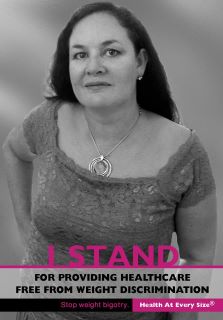
| all images from istandagainstweightbullying.tumblr.com |
As the pressure on providers to "do something" about the Obeeeesity Epidemic increases, so does the pressure for them to participate in weight bullying at appointments.
What is "weight bullying"? Weight bullying is the unrelenting, negative focus on a patient's weight during medical appointments to the detriment of all other issues.
It is the constant harassment to lose weight ─ not just work on healthy habits, but actually put the primary focus on losing weight ─ by whatever means necessary, even radical ones.
It is blaming the patient's weight for everything that is wrong with that patient, even when such a connection is dubious.
It is overlooking other possible causes because the care provider cannot see anything besides the patient's weight ("fat distraction," also known as "size profiling").
It is limiting access to tests and treatments, based only on a patient's weight (or willingness to pursue losing weight). It is denying treatment until a patient acquiesces and loses weight.
Sometimes this pressure for weight bullying comes from the insurance companies that providers have to answer to, sometimes from colleagues within the profession, sometimes from research articles that contend that care providers aren't doing enough to combat the "obesity problem," etc.
Many articles in the popular media and in the medical research claim that doctors are rarely engaging in "obesity screening" or "weight loss counseling." Funny how that doesn't seem to jibe with the experiences of most "obese" people, who report that the harassment over their weight and pressure for weight loss is unrelenting at most appointments.
Whatever the source of the pressure, care providers need to start recognizing that weight bullying is causing more harm than good for many obese people.
The Dreaded "Weight Talk"

The topic of the post, as you might guess, is weight bullying. Specifically, "the weight talk" and pressure to lose weight, often without regard to why you're really at the doctor in the first place, and usually without even asking about your habits first (because you're only going to lie about them, right?).
Jess pointed out that when a routine health check-up becomes an exercise in shame, it tends to have a chilling effect on future doctor visits.
And that is one of the most ominous effects of weight bullying at the doctor's, because putting off regular appointments can result in serious conditions going overlooked or undertreated, and thereby irreparably harming a person's health.
Here is what Jess experienced. She was at her doctor's for a regular pap smear. Here's part of what happened:
...he asked what I ate, but he didn't wait for an answer. I had to exercise more, he said, having no idea how much I was exercising. I also needed to eat less than whatever it was I was eating which I hadn't gotten a chance to tell him.
Dear god, what cutting-edge medical research! I certainly never thought of “eat less and exercise more,” especially not when I was bulimic, which incidentally is in that file of papers you’re holding which we like to call “records.”
“I’m not concerned about it,” I said tightly, “and if it comes up again I’m going to have to find another doctor.”
“Any other doctor would tell you the same,” he said, as though I hadn't been coming to him, just as fat as now, for several years.
“Well, I prefer a doctor who at least waits to hear what I eat before telling me to eat less."
He looked exasperated. “There’s no possible way you’re not eating too much.”Even though she fought back and fired this doctor, she found herself putting off her next yearly exam because she dreaded finding a new doctor who might put her through all that again.
When fat people get bullied, not believed, or made to feel like crap at the doctor's office, they tend not to not return.
What a surprise. Imagine not being keen to keep going back for repeated harassment and derision.
Worse yet, they often lose trust in being able to get reasonable health care from other providers, and so tend to put off a return to ANY provider, not just the fat-phobic one.
Then doctors whine about how obese people avoid the doctor, and gees, how can we get fat people to be compliant with the recommended doctor visits? How can we get them to improve their health? How can we get them to regularly undergo tests and see specialists as needed?
The answer is, STOP THE WEIGHT BULLYING.
Weight Bullying Repercussions
 Care providers greatly underestimate the negative impact of weight bullying. It rebounds in so many harmful ways.
Weight bullying results in people trying over and over again to lose weight, even though research clearly shows that permanent success is very unlikely. It results in weight cycling, which can increase the chances for gallstones, kidney cancer, further weight gain, and potentially many other issues.
Weight bullying results in fat people resorting to ever-escalating steps to try and lose weight. When the usual recommendation of "eat less and exercise more" doesn't do enough, most dieters try to eat even less or exercise even more. If that doesn't work, they go even further, sometimes to dangerous levels.
When that doesn't work, they try fasting, meal-replacement drinks, herbal supplements, or weight-loss drugs that have significant risks and which may do permanent harm to their systems.
When the weight loss doesn't last, many resort to surgery, maiming perfectly healthy organ systems in a desperate attempt to achieve thinness and "health," only to find other, unexpected complications instead. And still, even with stomach amputations and gut bypasses, most don't lose enough weight to achieve a "normal" BMI. Does that really sound like a purely behavioral problem? Or could something more be going on to cause their obesity?
.jpg) With such poor results, so many negative side effects, and the extreme unlikelihood of achieving a "normal" BMI, does this sound like a goal worth pursuing?
With such poor results, so many negative side effects, and the extreme unlikelihood of achieving a "normal" BMI, does this sound like a goal worth pursuing?Weight bullying also results in people (especially women) developing low self-esteem and poor body image. Some develop eating disorders because of the shame and disapproval they have internalized.
Even when a full-on eating disorder does not occur, many people have developed harmful habits like overeating or binge-eating, and have internalized toxic attitudes about food and body image.
And, as we have seen, weight bullying discourages fat people from making regular doctor visits and makes them less likely to get tests that might help prevent/diagnose various diseases early. In the end, this has far greater negative impact on fat people's health than choosing not to go on the latest diet.
In particular, fat people LOATHE:
- being lectured about weight/pressured to diet when they are at the doctor's about something completely unrelated to weight
- having every condition they experience blamed on their weight, even when it is clearly unrelated
- being told they are liars (either to others or to themselves) when they try to share that they eat normally or are already exercising
- being told that they just haven't tried "hard enough" or with the "right" program yet
- having to have The Weight Discussion over and over again, every time they visit the doctor, despite previously explaining patiently why they have reservations about weight loss/dieting and why they are exercising their right to patient autonomy by declining this treatment
- having weight loss promoted as the only treatment choice for whatever ails them, even when their condition has nothing to do with weight or there are alternative treatments to consider
- having the risks associated with obesity exaggerated in order to scare them into losing weight ("You won't live to see 40!" "You'll never see your child grow up!")
- not being given access to tests that people of "normal weight" would automatically receive with the same symptoms because the care provider has concluded that weight is the main issue
- not being allowed access to needed treatment without having to lose weight first

However, there is a difference between promoting good nutrition/exercise and browbeating someone about their weight.
Providers need a better sense of when they cross the line between encouraging health and harassing someone about weight. It's not that weight cannot ever be brought up, but rather that it should be a respectful and dynamic dialogue, not a one-sided lecture full of assumptions about what the fat person "must" or "must not" be doing, or pressure to lose weight no matter what extreme tactics must be used to do so.
Too many times, fat people try to share their concerns about the health downsides of yo-yo dieting, extreme restrictions, or the eating-disordered behaviors that dieting and weigh-ins can trigger, only to have their concerns completely dismissed or cut off.
Providers need to realize that many people who have opted out of the weight-loss paradigm have done so for very legitimate reasons, not out of laziness, gluttony, or lack of knowledge about the risks of obesity, but because it makes better sense for their body and their life and they feel healthier overall doing so.
Providers also need to understand that patient autonomy means respecting people's right to decline a recommended treatment (weight loss) and still receive respectful, considerate care.
Providers need to understand that repeatedly challenging a person's decision not to pursue weight loss and harassing them about their weight can result in the person avoiding healthcare altogether until an emergency presents, and this certainly does not improve that person's health.
 Furthermore, providers need to realize that promoting healthy habits doesn't have to involve weight loss or a weight discussion at all.
 Providers need to understand that promoting healthy habits can result in health improvements without significant weight loss, and that promoting weight loss as a goal at any cost often backfires and can result in extremely unhealthy behaviors.
By all means, promote more exercise and movement for patients...but don't tie it to weight loss as a goal. We know that exercise is beneficial, even when it doesn't lead to weight loss. But if exercise is seen only as a means to weight loss, it is rarely sustained.
Exercise should be promoted as a goal in and of itself, not just as a weight loss tool.
And don't forget to promote healthy habits for all your patients, not just the fat ones. Don't make it about weight control, make it about lowering the risk for health complications. Fitness is the best predictor of health, whatever a person's BMI, and may be the most efficient way to improve health for those who have difficulty losing weight.
 Don't assume that a fat person never exercises, or that thin ones are exercising plenty. The truth is that you can't tell how much a person exercises just by looking at them.
 ASK THEM their habits and then advise them based on what you are told. Find out what barriers there are to improvement of habits, and then help them strategize how to overcome those barriers.
Providers can and should encourage healthy behaviors ─ but it is more effective to do so without tying it to weight, without assumptions about what a person's habits "must" be (based only on their BMI), and without indulging in shaming and blaming.
As Deb Burgard says, "Listen to your public health messages with the ears of your fat loved one or colleague...Tease out the hate [speech] from the health speech."
Or as Ragen Chastain says, "People don't hate themselves healthy....We need to take weight out of the equation and make public health about public health and not public thinness."
Summary

Health care avoidance is a REAL issue for many people of size, and many have darn good reasons for doing so, based on past experiences.
One of the most important things that care providers can do for people of size is to build trust about the care they will receive ─ independent of weight ─ so that fat patients will not avoid the doctor and will utilize all the tools available to improve/monitor their health long-term.
Providers, please divorce weight loss from the promotion of health. By all means, encourage healthy habits, but don't keep tying it to weight loss.
Bringing up weight constantly, shaming patients about it, or harassing them to lose weight doesn't work. Instead, it alienates the very people it is trying to help, often discouraging them from seeking care at all. And that certainly does not improve their health.
