|
| This documentary about lipedema is free during all of June, which is Lipedema Awareness Month |
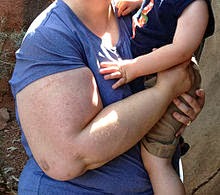
In this condition, an abnormal accumulation of fat occurs in the legs and lower trunk, sometimes also including the arms or upper body as well.
Lipedema is rarely recognized by doctors. Often it is thought to be "simple obesity," or it is confused with lymphedema, the accumulation of lymph fluid in the interstitial areas.
In Part One of the series, we discussed the symptoms and typical presentation of lipedema, and we pointed out the differences between lipedema and lymphedema. We also looked at a number of pictures that show typical features of lipedema and lymphedema.
Today, let's talk about the stages and progression of the condition.
In the next post, we will talk about fat distribution types and diagnosis of lipedema.
In future posts, we will also discuss possible causes of lipedema, associated conditions, treatment options, and how to live proactively with it.
Stages of Lipedema
 |
| Stage 1, Stage 2, and Stage 3 of Lipedema, as seen from left to right |
Different sources stage lipedema differently. Some list 2 stages, some 3, and some 4. Most sources use the 3-Stage model (like the picture shown above), but I think the 4-Stage model makes more sense.
The following summary is adapted from Dr. Herbst's article on Rare Adipose Disorders, Catherine Seo's video on her experience with lipedema, plus other resources and my own observations:
- Stage One - Disproportionate pear shape, with somewhat increased fat. Normal skin surface which feels smooth and soft. Leg still has shape but may be considered somewhat larger or thicker than average by others. There can be some swelling (edema) during the day but it usually resolves overnight or with rest and elevation
- Stage Two - Skin texture begins to change from smooth to uneven with indentations ("orange peel" or "mattress" skin). Fatty deposits start to grow around knees and thighs, and some also develop larger arms or chest. Legs begin to thicken more and lose their shape, and "cankles" start to develop. Skin is rubbery or spongy and begins to feel nodular in places, like little beans under the surface. Edema can occur but doesn't resolve as easily as it has in the past
- Stage Three - Skin texture in hips and thighs has more of an "orange peel" look, and fat nodules are easier to detect. Large masses of tissue can form folds and ridges ("lobular deformations"), especially just above and below the knees and on the thighs. Cankles get worse and may begin to "overshoulder" the ankle. Swelling becomes more consistent and does not resolve with rest and elevation. If lymphedema starts to develop, hardening of connective tissues can start to occur, and skin starts feeling tougher
- Stage Four - Lipo-lymphedema develops (lipedema with secondary lymphedema). Larger masses of skin and fat overhang, making many complex folds and ridges with consistent swelling. Large gains in weight can occur, and mobility can be affected. Skin can become harder and/or discolored. In severe cases, lymph fluid can begin to leak from lymphatic vessels
Let's look at each one of these stages a bit more closely. We will use pictures to help show the differences between stages, but be warned that some pictures may be distressing to look at. However, remember that not every woman develops every stage of lipedema, and those that develop lipo-lymphedema have treatment available to them that can help lessen its severity.
Stage One


In Stage 1, the legs and hips are just somewhat heavier than normal, what some people think of as "thunder thighs" or a distinct pear shape. The woman's behind, thighs, ankles, and legs may be a little thicker than average but not too far outside the range of normal.

Generally, women are much heavier on the bottom than the top. Some may wear quite different sizes in pants versus shirts. In the picture above, notice the size of the woman's waist compared to her hips. This is the classic "pear" shape, but a little exaggerated.

Hips and thighs are usually a bit heavier than average and may flare or bulge out a bit. If the waist is much smaller than the hips and thighs, it can be hard to buy pants that fit well. Often the waist of pants must be taken in with darts, or the woman ends up buying elastic-waist pants so there is not a large revealing gap at the waistline.

At this point, the skin still looks quite normal. It is still smooth. Underneath the skin nodules of fat are starting to form ─ but the effect is not very pronounced yet. Although the legs are a little thicker than average, "cankles" have not yet really formed, and fat pads on the insides of the knees are minimal or just starting to form. However, the woman may experience a fair amount of swelling in heat or at the end of the day, which typically resolves overnight or with rest and elevation. Generally there is no big impact on the woman's health yet, and her mobility remains very good.
Stage Two

Generally, women are much heavier on the bottom than the top. Some may wear quite different sizes in pants versus shirts. In the picture above, notice the size of the woman's waist compared to her hips. This is the classic "pear" shape, but a little exaggerated.

Hips and thighs are usually a bit heavier than average and may flare or bulge out a bit. If the waist is much smaller than the hips and thighs, it can be hard to buy pants that fit well. Often the waist of pants must be taken in with darts, or the woman ends up buying elastic-waist pants so there is not a large revealing gap at the waistline.

At this point, the skin still looks quite normal. It is still smooth. Underneath the skin nodules of fat are starting to form ─ but the effect is not very pronounced yet. Although the legs are a little thicker than average, "cankles" have not yet really formed, and fat pads on the insides of the knees are minimal or just starting to form. However, the woman may experience a fair amount of swelling in heat or at the end of the day, which typically resolves overnight or with rest and elevation. Generally there is no big impact on the woman's health yet, and her mobility remains very good.
Stage Two
 |
| Stage 1 into Stage 2 |

As a result, the skin can now start to look uneven, with indentations (called "indurations"). This is the "cottage cheese," "mattress," or "orange peel" texture. Some people have this strongly early on, while others retain a smoother skin surface longer, even as fat pads and cankles begin to form. Usually it's worst on the thighs; the lower leg is not that affected.
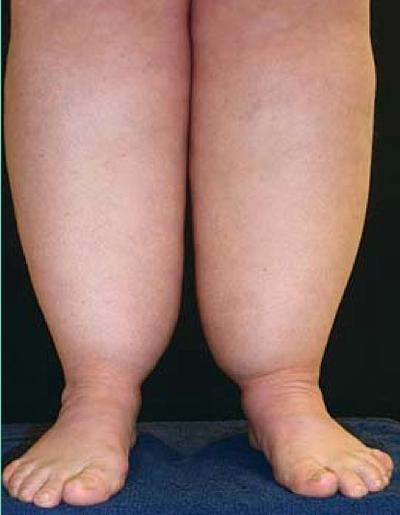
Pockets of fluid may begin to develop but are not pronounced yet. The skin begins to feel more rubbery or spongy. The leg begins to lose its shapeliness and "cankles" start to appear. A bump of fat may appear above the ankles, which is sometimes called "inverse shouldering" because it can look like upside-down shoulders.

The ankles may get thicker, and a bump of fat above the ankle becomes more noticeable. There is a "stepped" appearance, which means that a care provider trying to move their hands from the foot to the leg would get momentarily stopped at this bump of fat above the ankle.

Sometimes just under that bump of fat there is a ring that looks like too-tight socks have been worn. At this point the ankles do not tend to "overshoulder" (droop onto) the foot much. Mostly there is just a ridge where the bracelet of fat ends.

Some larger mounds or ridges of fat can start to appear. Often this starts with larger fat pads on the inside of the knees, or a bit of a fold just above the knee.

Certain types of lipedema that are more concentrated around the hips instead of the legs can start to get "saddlebags." These are bumps of fat in the behind or upper thighs that tend to overshoulder the legs.

In the picture above, the woman has some saddlebags, her hips are larger than her waist, she is beginning to get the fat pad on the inside of the knee, and the skin texture is starting to change, with just a touch of the "orange peel" look. She is in Stage 2.

However, not every woman experiences lipedema in the same way. For some, stage 2 is more about losing the shapeliness of their legs and developing "column-like" legs. The woman above does not have a pear shape, but she does have the "stove-pipe" legs, some cankles, a little bit of fat pad by the knees, some change in skin texture, and edema (swelling).
In this stage, significant leg edema is still mostly transitory and resolves somewhat with elevation, rest, or treatment. Often edema and unexplained weight gain is what brings women with lipedema to the doctor to get help, but at this stage, many women are told to just eat less and exercise more because few doctors recognize their condition as lipedema.
Stage Three

In Stage 3, more uneven fat deposits develop, and the "mattress" or "orange peel" texture becomes much more marked.

You begin to see strange folds and ridges ("lobes") of fat deposits around the thighs and knees. This fat folds over onto tissue below it, creating increased risks for skin infections.

There are often ridges of fat just over the knee, and a mound of fat just below the knee is common too. Pockets of fluid form in the lobes of fat and can deform the skin even more.

In some cases, the legs can become quite disproportionately large. This courageous woman, Claire Tickler, appeared on a TV show to raise awareness about lipedema. Notice the size of her legs compared to the host's legs, the difference in shape, as well as the bracelet of fat at the ankles. This is classic lipedema. [Bravo to Claire for raising awareness like this!]
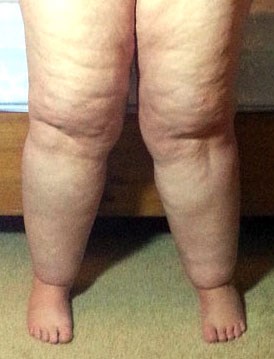
In some cases, the legs simply become more column-like and lose most of their shape. Notice the lack of curves in the leg, the orange peel texture above the knee, the fat pad on the inside and above the knee, and the fat bracelet at the ankle.

The bracelet of fat around the ankle can start to become very distinctive now. Notice how swollen the legs appear to be.

Again, there can be a big "stepped" difference in size between the foot and leg. Often the skin will start to droop down over the ankle and onto the foot (overshouldering) as lipo-lymphedema develops, but the foot remains normal-sized unless lipo-lymphedema becomes severe.

The texture of the skin can turn rougher and have extreme folds and fibrous lumps. Spider veins and varicosities can develop, especially as women age. Easy bruising is common.
Stage Four

In Stage 4 (or Stage 3b in some resources), secondary lymphedema develops, called lipo-lymphedema. At this stage, weight gains, edema, and fat folds can vary from significant to extreme. Notice the swelling, the orange peel texture of the skin, the overshouldering of the ankles, and the bruising on the skin ─ all typical lipedema symptoms, but more severe than in Stage 3.

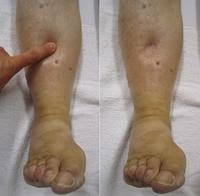
The secondary lymphedema can become so significant in a few cases that it really does look like the woman has a pantaloon fat suit on over her legs, as in the picture above. Notice the extreme difference between the legs and the feet. This swelling does not resolve without treatment anymore, but treatment can make a tremendous difference if it's received in time. The woman above got Manual Lymphatic Drainage on her legs and lost 65 lbs. in 14 days. That's a lot of swelling.

Sometimes, massive swelling adds even more folds, ridges, and lobes of fat. These can deform the leg significantly. Many "super-obese" people actually have Stage 4 lipo-lymphedema that has gone undiagnosed and untreated for years.

Although most of the time lipo-lymphedema still spares the feet, the feet can also be affected now. In addition, sometimes the lipo-lymphedema is not completely symmetrical between legs either. Both of these effects can be seen above.
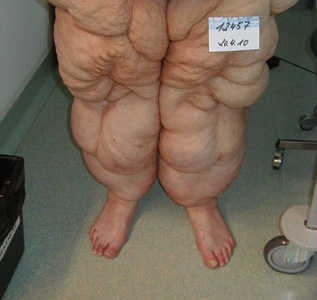
Occasionally the fat folds and ridges that develop can become quite severe and disfiguring, like the Michelin Man on steroids. As you might guess, this can make walking difficult. As a result, many women with severe lipo-lymphedema experience significant mobility issues. Many need wheelchairs and scooters, only to be shamed for using them as a fat person.
 |
| This lipedema patient has developed a secondary infection (see the redness on the lower legs) |
The lack of efficient lymph transport and pooling of lymph fluid can lead to a predisposition to infections, delayed wound healing, and other issues. Any redness in the skin on areas affected by lipedema needs to be taken seriously and treated immediately with antibiotics (with weight-based dosing, depending on the type of antibiotic).
Mosquito bites, spider bites, or minor trauma can quickly lead to significant problems and must be watched carefully in women with any stage of lipedema, but especially so in Stages 3 and 4.

Serious skin infections are mainly characterized by reddened, tender skin. Sometimes a fever, tiredness, and swollen lymph glands are present too but not severe, leading patients and caregivers to shrug them off. Nausea and vomiting may also occur, but may be mistaken for the flu. A particularly ominous symptom is red streaks extending from the infected area, as this indicates the infection is spreading via the lymph system.
The two main infections to watch for are erysipelas and cellulitis. Erysipelas ("air-eh-sip-eh-las") is a more superficial infection of the top layers of the skin and lymph system, and usually is marked by a raised rash with sharp, clear boundaries. Cellulitis, on the other hand, is an infection that goes deeper into the skin, subcutaneous fat, and underlying lymph system. The rash is usually not raised and its borders are not nearly as clear-cut.
Both infections are dangerous because if the infections go deep enough, they can spread into the underlying tissues (necrotizing fasciitis) or blood system (sepsis) and become life-threatening. If antibiotic doses are inadequate or if the infection is left untreated long enough, the person can die, which has happened to women with lipo-lymphedema.
Most women with lipedema do not progress to Stage 4 lipo-lymphedema, but for those who do, it can become severely disabling and even life-threatening. This is why lipedema must be taken more seriously by healthcare providers.
Summary
Below is a video comparing a mother-daughter pair at different stages of the disease. The daughter is in Stage 1, while the mother is in Stage 3. The doctor is Dr. Karen Herbst from Arizona, one of the leading specialists on Rare Adipose Disorders.
Conclusion
Lipedema can be a progressive condition, meaning it often gets worse as women age. In the past, women with lipedema were often counseled that the disease was progressive and that lipolymphedema and immobility were virtually inevitable.
However, more recent knowledge suggests that not everyone progresses through every stage listed above.
Doctors hope that by being aggressive in care early on, later stages and complications like cellulitis can be avoided. However, the course for each patient is different. Sometimes complications develop even when you are only in Stage 2, and some later-stage women never develop any serious complications.
Most women do not learn about their lipedema from their doctors because most doctors do not know about this condition. Many women learn about it from the internet after having googled "fat legs" or something similar, and then have to search to find a doctor that knows what lipedema is and how to confirm or rule it out.
It may be that your family doctor does not feel qualified to diagnose lipedema; in that case, you can ask to be referred to a specialist. Be sure to choose one that knows about lipedema. Check the lipedema websites to see if anyone has a recommendation for specialists in your area. A doctor who treats lymphedema might be your best bet to find someone who has heard of lipedema.
However, more recent knowledge suggests that not everyone progresses through every stage listed above.
Some resources note that many women's cases stay fairly stable over time or only progress mildly. Anecdotally, some people seem to stay at Stage 1 their whole lives; many progress to Stage 2 but never get worse. Some get to Stage 3 but never develop the lipo-lymphedema of Stage 4. It's difficult to predict what will happen to any one individual. But have courage; lipedema doesn't have to get worse.
Doctors hope that by being aggressive in care early on, later stages and complications like cellulitis can be avoided. However, the course for each patient is different. Sometimes complications develop even when you are only in Stage 2, and some later-stage women never develop any serious complications.
It may be that your family doctor does not feel qualified to diagnose lipedema; in that case, you can ask to be referred to a specialist. Be sure to choose one that knows about lipedema. Check the lipedema websites to see if anyone has a recommendation for specialists in your area. A doctor who treats lymphedema might be your best bet to find someone who has heard of lipedema.
*Next post: Types of Lipedema and Diagnostic Process
References and Resources
*Trigger Warning: Many of these sites are not size-friendly. However, because they also contain valuable information about lipedema and its treatment, they are included here.
Blogs, Websites, and Facebook Pages from Those Dealing with Lipedema
Clin Obes. 2012 Jun;2(3-4):86-95. doi: 10.1111/j.1758-8111.2012.00045.x. Epub 2012 Aug 3. Lipedema: an overview of its clinical manifestations, diagnosis and treatment of the disproportional fatty deposition syndrome - systematic review. Forner-Cordero I1, Szolnoky G, Forner-Cordero A, Kemény L. PMID: 25586162
*Trigger Warning: Many of these sites are not size-friendly. However, because they also contain valuable information about lipedema and its treatment, they are included here.
- http://www.curelipedema.org/# - Cure Lipedema
- http://www.lipomadoc.org/lipedema.html - Website of Karen L. Herbst, PhD, MD, one of the most pre-eminent researchers on lipedema. She is an endocrinologist practicing in Arizona
- http://fatdisorders.org/fat-disorders/lipedema-lipoedema-description - Website of the Fat Disorders Research Society
- http://www.lipv.nl/Lipedema%20a%20frequently%20misdiagnoseds%20and%20misunderstood%20syndrome.pdf - Educational article on lipedema for care providers, good but technical in parts. (Not size-friendly; advocates "rigorous" weight control and suggests bariatric surgery)
- http://www.ncbi.nlm.nih.gov/pmc/articles/PMC3309375/ - United States National Library of Medicine, National Institutes of Health
- http://en.wikipedia.org/wiki/Lipedema - Wikipedia article on lipedema
- http://www.nhs.uk/conditions/lipoedema/Pages/Introduction.aspx - United Kingdom's NHS website page on Lipedema
- http://www.lymphedema-therapy.com/Lipedema.htm - Lymphedema Therapy website
- http://www.hanse-klinik.de/englisch/Lipoedema.pdf - article on lipedema from one of the foremost clinics in Germany that treats lipedema
- http://www.lymphedema.com/lipedema.htm - Peninsula Medical summary of lipedema
- http://www.lipv.nl/zslnokycordero.pdf - journal article about lipedema with many pictures
- http://www.lymphedemapeople.com/wiki/doku.php?id=lipedema - Lipedema page from a website specializing in lymphedema information (Lymphedema People)
- http://www.webmd.com/women/guide/lipedema-symptoms-treatment-causes - WebMD article
- http://www.lipedemaliposuctioncenter.com/about-lipedema.html - Liposuction clinic specializing in lipedema patients
- http://www.lymphedemablog.com/2012/12/13/a-closer-look-at-lipedema-and-the-effects-on-the-lymphatic-system/ - Effect of lipedema on the lymphatic system
- Differential Diagnosis for lipedema vs. lymphedema - how to differentiate these conditions
- http://rlbatesmd.blogspot.com/2010/02/lipedema-lymphedema-lipolymphedema.html - blog entry on lipedema vs. lymphedema, written by a plastic surgeon
- http://www.obesityaction.org/educational-resources/resource-articles-2/obesity-related-diseases/lipedeam-and-obesity - article about why lipedema might occur (WLS site)
- http://www.mdjunction.com/forums/dercums-disease-discussions/articles/2888889-lipolymphedema-dercums - details about lipedema and lymphedema
- http://www.thelymphoedemacliniclondon.co.uk/pages/treatment-for-lipedema-and-lipo-lymphoedema.php - treatment options for lipedema and lymphedema
- http://lipedemaproducts.com/pages/stages - drawings illustrating the different types of lipedema as they progress through the various stages of lipedema
- http://blog.wegohealth.com/2014/09/15/the-phases-of-a-lipedema-diagnosis/ - Guide to navigating a lipedema diagnosis, written by Sarah Bramblette, a prominent lipedema activist
- http://lipedema-simplified.org/ - blog and advocacy from Catherine Seo, who is dealing with lipedema and who is the maker of the new film "Born To Be Fat" about lipedema. (Caution, weight loss and diet talk, but still a worthwhile resource for Fat-Acceptance folk)
- lipladyfab.wordpress.com - blog of woman dealing with lipedema and undergoing liposuction
- http://www.biglegwoman.com - blog of woman dealing with lipedema
- http://born2lbfat.com/category/livingwithlipedema/ - blog of woman dealing with severe lipedema, including her journey with gastric bypass
- http://lipedemagirl.tumblr.com/me - tumblr account of a woman dealing with lipedema and lymphedema, including having had lap band surgery
- Big Fat Legs http://www.bigfatlegs.com/ - blog of woman dealing with lipedema
- Lipoedema Ladies (U.K.) - http://www.lipoedemaladies.com/ - U.K. support group for lipedema
- http://www.tillysmidt.nl/LIPEDEMA_Englisch_for_Lipoedeem.html - website of Dutch woman with lipedema who was an early voice for treating lipedema (not a size-friendly resource)
- https://www.facebook.com/lilithnixroadtorecovery/posts/537379969717549 - Facebook page of a woman with lipo-lymphedema (this link takes you to her biography and lipedema story)
- http://www.thedoctorstv.com/videos/living-with-lymphedema-and-lipedema - video biography of Sarah from "The Doctors" episode (she has stage 4 lipolymphedema)
- http://www.nursevirginiablog.com/?s=lipedema - Nurse Virginia's blog (not size-friendly)
- https://mylipedemajourney.wordpress.com/ - a thin woman's journey with lipedema and tumescent liposuction to treat it
- http://www.lass.org.au/ - Lipoedema Australian Support Society (LASS)
- http://www.talklipoedema.org/ - U.K. support and information group for lipedema
- https://livingwithlipoedema.wordpress.com/ - a British woman's journey with lipedema, particularly focusing on its emotional effect and the treatments she has tried
- http://www.laurajdavis.com/blog/category/lipolymphedema - one woman's history of lipo-lymphedema, failed attempts at weight loss, and treatment difficulties
- http://lipedemanetworkcanada.com/ - lipedema support, education, and advocacy for Canada
Clin Obes. 2012 Jun;2(3-4):86-95. doi: 10.1111/j.1758-8111.2012.00045.x. Epub 2012 Aug 3. Lipedema: an overview of its clinical manifestations, diagnosis and treatment of the disproportional fatty deposition syndrome - systematic review. Forner-Cordero I1, Szolnoky G, Forner-Cordero A, Kemény L. PMID: 25586162
Lipedema is a disproportionate, symmetrical fatty swelling characterized by pain and bruising existing almost exclusively among women. We undertook a systematic review of the available literature about lipedema, given the lack of knowledge and little evidence about this disorder especially among obesity experts. Diagnosis of lipedema is usually based on clinical features. Symmetrical edema in the lower limbs with fatty deposits located to hips and thighs usually appears at puberty and often affects several members of the same family. Main disorders considered for differential diagnosis are lymphedema, obesity, lipohypertrophy and phlebedema. Treatment protocols comprise conservative (decongestive lymphatic therapy) and surgical (liposuction) approaches. Early diagnosis and treatment are mandatory for this disorder otherwise gradual enlargement of fatty deposition causes impaired mobility and further comorbidities like arthrosis and lymphatic insufficiency.Int J Low Extrem Wounds. 2014 Oct 17. pii: 1534734614554284. [Epub ahead of print] Lipedema: A Review of the Literature. Okhovat JP1, Alavi A2. PMID: 25326446
Lipedema is a disorder of adipose tissue that primarily affects females and is often misdiagnosed as obesity or lymphedema. Relatively few studies have defined the precise pathogenesis, epidemiology, and management strategies for this disorder, yet the need to successfully identify this disorder as a unique entity has important implications for proper treatment. In this review, we sought to review and identify information in the existing literature with respect to the epidemiology, pathogenesis, clinical presentation, differential diagnosis, and management strategies for lipedema. The current literature suggests that lipedema appears to be a clinical entity thought to be related to both genetic factors and fat distribution. While distinct from lymphedema and obesity, there are some existing treatments such as complex decongestive physiotherapy, liposuction, and laser-assisted lipolysis. Management of lipedema is complex and distinct from lymphedema. The role of newer randomized controlled studies to further explore the management of this clinical entity remains promising.Acta Pharmacol Sin. 2012 Feb;33(2):155-72. doi: 10.1038/aps.2011.153. Rare adipose disorders (RADs) masquerading as obesity. Herbst KL1. PMID: 22301856 Full text available here.
Rare adipose disorders (RADs) including multiple symmetric lipomatosis (MSL), lipedema and Dercum's disease (DD) may be misdiagnosed as obesity. Lifestyle changes, such as reduced caloric intake and increased physical activity are standard care for obesity. Although lifestyle changes and bariatric surgery work effectively for the obesity component of RADs, these treatments do not routinely reduce the abnormal subcutaneous adipose tissue (SAT) of RADs. RAD SAT likely results from the growth of a brown stem cell population with secondary lymphatic dysfunction in MSL, or by primary vascular and lymphatic dysfunction in lipedema and DD. People with RADs do not lose SAT from caloric limitation and increased energy expenditure alone. In order to improve recognition of RADs apart from obesity, the diagnostic criteria, histology and pathophysiology of RADs are presented and contrasted to familial partial lipodystrophies, acquired partial lipodystrophies and obesity with which they may be confused. Treatment recommendations focus on evidence-based data and include lymphatic decongestive therapy, medications and supplements that support loss of RAD SAT. Associated RAD conditions including depression, anxiety and pain will improve as healthcare providers learn to identify and adopt alternative treatment regimens for the abnormal SAT component of RADs. Effective dietary and exercise regimens are needed in RAD populations to improve quality of life and construct advanced treatment regimens for future generations.