Wednesday, June 29, 2011

Blogiversary #2: State of the Blog

♫  Happy Blogiversary to me, Happy Blogiversary to me.....!  ♫

Yes, it's been 2 years since I started this blog.  I can hardly believe it.  Feels like I've been doing it a lot longer!

So in honor of the blog's birthday, let's take a moment to do a State of the Blog assessment, eh?

Purpose of the Blog

2 years ago, I started the blog to raise awareness about the issues of "obesity" and pregnancy. 

I found little awareness or comment about pregnancy issues in the fat-acceptance world and wanted to raise the fatosphere's awareness of the discrimination and mistreatment many women of size face during their pregnancies and births.  Size discrimination often starts in the womb, yet this has been a very overlooked area in the discussion about size bias.

I particularly wanted to reach out to pregnant women of size who might be looking for information on how weight could affect their pregnancy and care.  I wanted to make sure they had in-depth information about their choices, risks, common care protocols, the pros and cons of interventions, etc., and that they had information about proactive things they could do to improve outcome.  And I wanted to make sure they had a place to share their concerns and questions, and a space where they could see other pregnant women who looked like them so they would know that they are not alone. 

I also wanted to reach out to the birth world and further its awareness of how pregnant women of size are often mistreated, ask birth workers to question the assumptions often made about women of size, to analyze the quality of the research on obesity and pregnancy, and to open a discussion of how to improve outcomes in women of size. 

Whew. That's quite a wide-ranging mission and target audience.  This means that sometimes my posts will appeal only to one segment of my readership.  Some will really want the pregnancy pictures and birth stories, others really want the nuts-and-bolts research analysis, and still others are most interested in discussions of size bias or Health At Every Size instead.  But hopefully, even when the posts don't appeal to your particular needs, they're still interesting enough to learn something new or to be diverted by for a few minutes.

Thank you to those of you who have linked to my blog or specific posts on your sites, or who have "liked" or tweeted about them on social media networks.  It really helps increase the visibility of my blog, increase the readership, and get my message out.  Keep linking, "liking" and tweeting!

My birth friends are pushing me (kicking and screaming all the way) towards the social media world, and I have been informed that I must get a Facebook page soon.  I'm no fan of social media but I recognize its importance in getting out advocacy messages, so I'll probably be looking into this soon.  Keep your eyes peeled for it.

Blog Stats

Alas, Blogger has only had stats available for my site for the last year, so I have no data on how many readers I had in the first year or what they read the most.  But now that I have these stats available, it's been fun keeping track of them.  It feeds my inner geek and my ego too, which is always nice!

Generally I average about 20,000-25,000 hits per month these days.  That's up from the beginning of the year when it was more like 17,000-20,000 per month.  So that's encouraging.

Here's the part that boggles my mind. All together, I've had nearly 275,000 hits in the last year alone.  Whoa.  Pretty amazing!

Yeah, okay, peanuts compared to some sites, but still pretty dang impressive to me!  Starting this blog has been a big boost for getting out my message, even beyond my regular website, www.plus-size-pregnancy.org.  I'm sure if I ever drag my reluctant backside over to Facebook, that would help boost readership even more.

Popularity-wise, my Top Five Posts of all time are:
 Of these, the Plus-Size Pregnancy Photo Gallery is by far the most-viewed post.  It has had nearly 70,000 views all on its own, compared to about 12,000 for the next most-viewed post. 

Apparently there is just a tremendous need out there for images of women of size in pregnancy and birth, because nearly all the search terms commonly used to find my blog involve some variation of "overweight" or "obese" or "plus-size" and "pregnancy" or "photo" or "belly."  So obviously, one of the most important things I've done is to try and meet that need for images and reassurance.

This is one reason why I hold my nose and still use the "o" words ("obesity" and "overweight") at times; I know those are the search terms used by people not familiar with fat acceptance.  Frankly, those odious "o" terms are how most people find my blog.  It helps me preach not just to the choir but to a lot of people unfamiliar with fat-acceptance and Health At Every Size.  It helps me reach more of my most-desired target audience ─ people unfamiliar with size acceptance and new to the concept, whether those are people in the birth world or are people of size themselves.

So while I've had many approaches to the terminology issue over the 16 years I've been writing about this topic, in the end I've decided that getting the message out to those who need it most takes priority. As a result, I use a mix of terms on the blog, from the repulsive "o" words at times, to "fat" (which is my preferred term but which alienates some), to euphemisms that tend to be a bit more neutral. This makes my blog more likely to be found by a variety of people, not all of whom are on board with fat-acceptance yet.  You can agree or disagree with that approach, but it's the compromise that seems to work best for me after many years of trying different ways of handling the terminology.

Geeky Stuff

I get a real charge out of my little "world" widget on the top right-hand side of my blog. It's always so much fun to look and see who's reading my blog right now and where they are from.   I love that!

Not surprisingly, most of my readership comes from English-speaking countries, especially the U.S., the U.K., Australia, Canada, and New Zealand, but I get a fair amount of hits from Germany and the Netherlands. I also get quite a few hits from places I wouldn't have expected, like India, Russia, South Africa, and Iran.  Very cool!

One thing I am working on for the future are reference pages with links to research studies....sort of a quick reference link page, as it were.  I think some of my readers might find that useful; I know I find it useful on other people's blogs. (Thank you Fat Nutritionist!)

I also have a major series planned on the risks of pregnancy in women of size coming soon.  We'll take each one of the risks, look at the research on it, dissect the quality of the research, and figure out the lessons to be learned from it (if any).  This will be a major series, and it takes a huge amount of time to research and write each risk category, so it will definitely be a periodic series over a long period of time instead of a continuous short series.  Still, even though it will be spread out over time, hopefully it will be of use to women of size as they try to sift through all the scare tactics and rhetoric around fatness and pregnancy.

Conclusion

So that's the State of the Blog─where we are right now, and some directions we plan to go in the future.

Thank you for reading the blog, for sharing links to it with others, and for spreading the message about it.  Keep doing spreading the word, please!

Thank you to the Fatosphere for being open to this unique message about pregnancy in fat women.  I know it can be hard to care about this topic if you are not personally planning to have children, but size discrimination matters, even if it doesn't personally affect you.  Thank you to those who continue to read even with no personal investment in the topic, and thanks to those of you who are affected by the topic and who share your stories and concerns.

Thanks to the many gutsy maternity care providers and birth workers who have embraced the cause of better treatment for women of size too.  It is so important that this message not be limited to this blog or to the size-acceptance world, but that it be actively discussed and pursued by those in the birth field.  Special thanks to those birth workers who have done their best to help and advocate for women of size as clients.

Finally, special SPECIAL thanks to the many brave mamas of size who have shared their pictures, their thoughts, their comments, and their stories with the blog or my other website.  Your experiences are the heart of why I do this; thank you so much for sharing.  YOU ROCK.  You'll never know what a difference you make in the lives of future women of size.

Happy Blogiversary, and I look forward to sharing many more blogiversaries with  you!

Wednesday, June 22, 2011

Because Of Your Weight, We'll Schedule Your Cesarean

Still find it hard to believe that fat women are being denied access to low-intervention care and are often railroaded into cesareans these days?

Try this story on for size, from the website, My OB Said What?!?

“Because Of Your Weight…We’re Going To …Schedule Your Cesarean.”

“Because of your weight, you’re just not a candidate for midwifery care, and we’re going to go ahead and get you to an OB to schedule your cesarean section.” – CNM to mother at 36 week appointment

Augh.  Just AUGHHHHH!!!  On sooooooo many levels.

Sunday, June 19, 2011

New Health At Every Size Resource

I'm delighted to hear that ASDAH (Association for Size Diversity and Health) has started a new, very important blog, the Health At Every Size blog.  About time!

I'm sure my size-acceptance and fatosphere readers have heard about it already, but I wanted to make sure my birth-world readers (who may not be as familiar with HAES concepts) knew about it too.

If you don't know about Health At Every Size (HAES) yet, the basic principles of HAES are:
1. Accepting and respecting the diversity of body shapes and sizes.
2. Recognizing that health and well-being are multi-dimensional and that they include physical, social, spiritual, occupational, emotional, and intellectual aspects.
3. Promoting all aspects of health and well-being for people of all sizes.
4. Promoting eating in a manner which balances individual nutritional needs, hunger, satiety, appetite, and pleasure.
5. Promoting individually appropriate, enjoyable, life-enhancing physical activity, rather than exercise that is focused on a goal of weight loss.
Here is a summary about the HAES Files from the HAES blog's first post (I've broken it up a bit):
The Health At Every SizeSM approach is about the ways that people of all sizes can maximize their health.

This approach does not mean to give up or to let everything go. It is an active process by which people work positively with their bodies and within their lifestyles to achieve a level of health which is reasonable and above all, sustainable for them.

It means managing health within a framework of a life well lived as opposed to weight centric, thin at any cost methods.

It means managing nutrition and fitness within a global health framework that would include managing stress, sleeping well, maintaining social connectedness and much, much more. This is not passive, and it is not easy. It requires a lifetime of careful work in learning which foods nourish you and which leave you feeling unwell; in learning what forms of exercise strengthen you and energize you and which forms leave you depleted and hurting; and in learning to make positive, gradual changes based on self-care rather than self-hatred.

The HAES Files will serve as a means to push for a shift in paradigm from weight centered to health centered...

We have asked each of our bloggers to challenge us on how we address weight and diet and nutrition and physical activity and stigma and discrimination and ALL that our culture has deemed to wrap in a so-called “obesity crisis.”

We are no longer content with sitting in the back of the room, listening politely as policy makers, the media, and the food, diet and health industry dictate how this is going to play out. We are done asking for a seat at the table, we are taking one.
AMEN to that!

For those who are new to the idea of HAES, here are some more resources on it.  There is also Linda Bacon's book, Health At Every Size, excerpts of which can be found here.

I look forward to many wonderful, informative, and empowering posts from this new resource.  Go ASDAH!

Wednesday, June 15, 2011

Third Post at Science and Sensibility is up!

Okay, my third and final post at Science and Sensibility is up!

You can access it here.

This one is about lowering the risks for complications in women of size, and exploring ALL the possibilities for doing that. 

It's about not relying on weight loss, restricted weight gain, and/or a high-intervention model of care as the only ways to prevent complications in women of size.  It's about the need to explore other options as well, and what some of those options might be.

Check it out!  And give it some more link love, eh?

Monday, June 13, 2011

Second Post at Science and Sensibility Now Up!

My next post, second in the series on obesity and pregnancy, is up now at the Science and Sensibility blog.  You can find it here.

This one takes a critical look at the research for confounding factors that rarely get accounted for in the research, and suggests directions for more meaningful research in the future.

Go forth and give it some link love, "likes" and tweets!

Friday, June 10, 2011

Check Out My New Post at Science and Sensibility!

On the childbirth blog, Science and Sensibility, there is currently an ongoing series about "obesity" and pregnancy.  All the usual material is there, be warned, but to its credit, it has also solicited the views of women of size, something most of these discussions never do.

So I submitted some posts on the topic and my first one is up on the blog today.  Huzzah!

Go forth and read it, link to it, "like" it, tweet it, digg it, and whatever else you can do to increase its visibility and readership. Give it some serious love, people.  Having an alternate point of view represented is a major step forward.

I do have one request, though; if you comment on my post or anyone else's, be respectful and polite as you make your points.  It's a radical thing to have our voice actually represented in these discussions and we want that voice heard and taken seriously.

There will be further follow-up posts from me there, so stay tuned to the Science and Sensibility blog for more!

A Note About Terminology

I'd also warn FA activists that I use the "o" words in the post at times.  While I strongly dislike these terms, I've found over the years that the medical establishment doesn't take you seriously if you only use alternate terms, and the word "fat" is seriously alienating to a lot of women who aren't on board with the fat-acceptance thing yet. 

Also, it's a search-engine optimization thing; the fact is that most of the terms used to search out this blog and my website involve "overweight" or "obesity" or variations thereof.  Back in the days when I scrupulously avoided these like a good NAAFA-ite, it really limited who would find my information. Often it kept the people who MOST needed to hear it (newly pregnant fat women, those facing fat-phobic treatment and misinformation, or care providers looking for information about weight and pregnancy) from finding it altogether.

So I grit my teeth and use the "o" words at times, both here and when I write about the topic elsewhere.  Here I use scare quotes around "obese" etc. to show that I GET it and I don't like those terms either.  Elsewhere I don't always, for style reasons and to be taken more seriously by medicos. But it doesn't mean that I don't agree with the objections to these words. 

In making this compromise, I am taking my cue from various researchers and authors who write about HAES topics and have also had to negotiate a compromise between ideals and practicality.  Here's a summary from Saguy and Gruys, in their article on the way that the news media frames articles on obesity vs. eating disorders (an awesome article, BTW, if you've never read it):
The definition of “overweight” and “obesity,” and even these terms themselves, are contested. Fat acceptance activists, who advocate for civil rights on the basis of body size, argue that these terms pathologize normal biological variation and reclaim the word “fat” as a neutral descriptor like “tall” or “short” (Cooper 1998; Wann 1999). Similarly, many feminist scholars have avoided the term “eating disorder” because it situates “disorder” within individuals rather than in complex social structures. We do not use “overweight,” “obesity,” or “eating disorders” because we endorse a medical or public health framing, but because we seek to establish how these particular terms have been constructed in the news media. We note that a search for articles using the term “fat” produced very few relevant articles, which is not surprising given that this word is still taboo in most social circles in the contemporary United States. An article search using the term “eating problems” was similarly unproductive. For stylistic reasons we do not place the terms “overweight,” “obesity,” or “eating disorder” in quotations throughout the article, but we wish to be clear that this is the spirit in which we use them.
So hopefully that will explain why I use these terms at times, even as I hold my nose. 

The best compromise I've found so far is to mix up my use of terms, using the "o" words mostly when discussing medical research, using "fat" as a descriptor of size or when talking about FA things, and using terms that are seen as more neutral (like "women of size") as much as possible in between.

You can agree or disagree with that compromise, just remember that I've done it for practicality reasons only. 

Ties Into Upcoming Series

This series of posts on Science and Sensibility ties well into my upcoming series on this blog on the risks of "obesity" and pregnancy, one I've been working on for a long time but have had trouble finishing because it's so research-intensive and I've been so busy. 

For that reason, it will be a periodic series.  We'll do an overview first, then take one risk at a time and dissect the research on it, and finish by overviewing what might be done to help lessen the risk for that complication. 

As I said, it will be a periodic series; other posts on other topics will get interspersed between to allow me time to work on each installment.  I'm sure it will take me a long time to finish the whole series, but bit by bit we'll get there.

This can be a difficult subject to discuss, because the last thing I want to do is scare pregnant women or those considering whether or not to have a baby. And information about risks can certainly scare anyone considering pregnancy.  But it's also a disservice to pretend there aren't any risks, or to not discuss ways in which women of size can be proactive about risks.  To me, knowledge is power, and this is an important discussion to have.  Just keep it in perspective.

Remember that risk discussion, by its very nature, tends to inflate people's perception of risk.  Add in pregnancy, when women feel most vulnerable, and risk discussions can be a bit scary. They narrowly focus on the small minority of people who have complications, rather than the large majority of those who do not.

Just keep reminding yourself that most of the time, pregnancy goes perfectly well, and many MANY women of size have had healthy pregnancies, healthy babies, and healthy births. 

Friday, June 3, 2011

Florida OBs Who Won't Take Fat Patients

A number of people have blogged about the recent story of a group of OBs in Florida who won't accept fat women as clients because they are "too high risk" and therefore they are afraid they might get sued more. 

Their cutoff for "too" fat?  200 lbs., a ridiculously low cutoff.  There is no way the risks of complications at that size justify denying these women care across the board, and there is no way that they should be denying care to an entire group of women based on complications some individuals might develop. 

Other people have covered the story just fine so I don't feel the need for extensive comments, but I do like the coverage from The Unnecesarean.  One commenter ("Mel") there, had a good summary:
I think the point of it all, the reason this is such an ugly decision, is that this group of doctors (and many others) have isolated the risks of obesity as THE ONLY risk, right off the bat, that makes people "too risky" to serve. What can account for this?

...These are OBs, who by nature of their training, are best equipped to help people with any remotely moderate to high level of risk, right up to the sorts of very high risks that are better attended to by MFM [maternal fetal medicine] specialists. I don't see them passing on caring for multiple pregnancies, or a woman who will need a 5th c-section for instance.   
Why single out obesity as a risk factor? The only plausible answer, given the scope of their practice, is bias. Prejudice. It's an excuse so they don't have to treat people they don't like and of whom they disapprove.

...I don't buy for a moment that these doctors won't treat overweight patients because it's SO risky! I could understand a person by person decision for women with really high risks that included being very obese. But that's not what they're doing here. 
The Florida doctors use the excuse that it's more difficult to get a good quality image during an ultrasound of an obese woman, and their office machines can't handle that.

The answer to that?  Train your docs and techs in techniques that improve the image for women of size, delay the scan by a few weeks, and if that isn't enough, send the woman to a specialty center with more advanced equipment....for the ULTRASOUND. No need to transfer all of her care to a high-risk maternal fetal medicine specialist just for ultrasounds!

The doctors also complain about their potential for being sued. Now, I generally have great sympathy for doctors who are sued unjustly (as does happen sometimes in obstetrics), and I do think many docs are between a rock and a hard place in terms of malpractice insurance.

But I'm sorry, many doctors face high malpractice rates and don't deny care to fat women. Other docs (and midwives) somehow manage to care for a variety of women, not all of whom are super low-risk.

Categorically denying care to "obese" women, regardless of actual complications, is the result of an inflated perception of risks around this group and sheer outright weight bias.

Another wrinkle to this story is that not only won't they see fat pregnant women, they won't see fat non-pregnant women either now.  That's new...but it's a trend that started with obesity and pregnancy and is now extending to non-pregnant fat folk as well.  So all of you in the fatosphere who read my posts about weight bias from OBs and think it doesn't apply to you because you don't plan to have children......au contraire.  Now it's spread to GYN care.  Apparently pregnancy weight bias is just the canary in the mine, warning of further dangers to come regarding equal access to care for all fat people.

Some in the birth world have commented cynically that the one bright spot in this story is that at least fat women in Florida know the worst fat-bigoted practices up front and will be able to avoid them. Too many doctors smile and nod and pretend to be size-friendly, then turn on the mom at term and tell her she "needs" a cesarean or an induction or whatever because of her size.

So, yeah, I suppose that's the one good side to all this. But I'm sorry, I just can't celebrate that.

This is just a further step along an ominous trend to segregate people of size into the care of ultra-high-risk docs, based on their size alone, regardless of whether or not they actually have poor health or develop complications, and regardless of whether such high-intervention care actually improves outcomes. 

It's another step along the path of denying people of size health care choices and life choices, "for their own good," and I find that extremely ominous.

We've discussed before in "Ghettoizing Fat Women" that there is an increasing trend to shunt all women of size, regardless of actual complications, into specialized "bariatric obstetrics" practices and regional high-risk hospitals, and denying them access to midwives and a low-intervention model of care. Sadly, I only see that practice increasing.  I've heard from women of size who have been denied care from homebirth midwives (despite prior births with them with good outcomes), from birth centers, from regular OBs, and even from some hospitals.....simply because of their size. 

No, these are not "super obese" women; these are often "mid-sized" fat women.  The idea now is that ALL "obese" women, pregnant or not (and regardless of actual health status and health habits), are being considered far too high risk for any care but the most centralized, most interventionist, most high-risk practices and centers─without actually proving that this sort of care improves outcomes.

And it's a very frightening step down the road of taking birth and healthcare choices away from a substantial group of women.  Where is the respect for patient autonomy?  For people having the right to choose the kind of care they prefer?  For people having a say in their own care?  For people being able to say no a style of care they don't want?

Each person needs to have their care individualized, based on their health status, their healthcare preferences, and their needs.  We should not have our healthcare choices taken from us, simply because we are fat.  And this latest story is just another step along the path of denying patient autonomy to people of size.

An ominous canary in the mine indeed.

Monday, May 30, 2011

Honoring Our Bellies Month: Healing Through Belly Art


As May ends, it's time for some final thoughts on "Honoring Our Bellies" month. 

My thanks to all the wonderful women who have been willing to share their thoughts and their pictures with the rest of us.  You may never know what a service you have done for future women of size contemplating pregnancy, and perhaps even in helping non plus-sized folks see the beauty and the wonder of pregnancy in women of size too. 

As we end this month, let's discuss a few final thoughts; a few more ways to honor our bellies, our selves, and our journey; and let's feature a few more pictures of pregnant bellies and related belly art.

Document Your Journey

First, if you are pregnant, please please please take the time and effort to document your pregnancy and your motherhood in pictures. 


 Too many fat women are missing in action from their family's photo albums because they are self-conscious or too embarrassed to be photographed much. What a tragedy this is!


The truth is that our pregnant bodies are beautiful. And they deserve to be seen in all their glory.


No one cares if you are not stick-thin with a bump; certainly your children don't care.  They only know that you are that most beloved of people ─ mommy ─ and if mommy isn't in the pictures of their childhood very much, what does that say to them?  Be present in your children's lives, both in the moment and in their archives.


If you don't get pictures of yourself pregnant, you will be losing such a wonderful memory.  Every pregnant woman is beautiful, and we all deserve to have our pregnancies documented in pictures. 


Sweet moments like these are so incredibly precious later on.  If you miss the chance to document it, that opportunity is gone forever.  Remember, you can always throw away or delete the really terrible shots, but you can't go back and get pictures you never took. 


Don't be the gaping black hole in your child's baby album.  Take pictures of yourself both in pregnancy and as a mother, and make sure your existence is documented, both for your child and for yourself. 

You deserve it.

Honor The Normality of Ambivalent Feelings

Remember, it's normal to feel some ambivalence about the changes happening to your body.

The truth is that your body will never be quite the same again...but that's okay. Life is change, and change is hard sometimes.  Often, we want everything to stay the same, forever, but that just doesn't happen.  Change is the norm in life, but it's not always easy. It's okay to acknowledge that.


And when that change is reflected on the body, it's normal to mourn those changes, whether they happen because of pregnancy or accidents or just plain time.  You're not a "bad" fat-acceptance person for having smidgens of dissatisfaction or body ambivalence.  It's just a normal part of dealing with changes in your body.

And few changes are bigger or more fast-acting than those wrought by pregnancy! So it's very normal to have mixed feelings about changes in your body around pregnancy. 

Just don't stay in that place of ambivalence.  Recognize its normality, recognize the challenge to your sense of self-confidence and worth, and actively find ways to work through it. 

Don't stay stuck in negativity. Do the work you need to do to get back to a place of self-acceptance and self-love.

Find a Way To Honor Your Body

Even as you process normal feelings of ambivalence about these changes, it's important to  honor your belly for all the amazing work it's doing in pregnancy, and one way to do that is through belly art.

There are many types of belly art you can do to honor your body in pregnancy.  Look around online and see which type calls to you.

[No, not all the images below are of women of size; but some are.  Others are presented just for ideas. Links to sources of some of these pictures are presented near the end.]


 We've already discussed belly henna, temporary tattoos using henna, which starts as a dark paste on your belly (like above)......


................and then turns to a reddish-brown hue like this when it rubs off, lasting for about 2 weeks or so.

Another beautiful and fun thing to do is belly bump painting.  This can run the gamut in quality and subject matter (depending on who your artist is!), from toddleresque to whimsical to seriously artistic.  It all depends on what you want.


A lot of people enjoy doing silly baby bump painting.  And what better Halloween costume can there be than a pumpkin baby bump? I've also seen baby bump paintings of watermelons, basketballs, and even a beachball!  It certainly doesn't have to be fancy.


You don't have to be a skilled artist to create some of these.  I am very artistically-challenged, but even I could probably manage a basic pumpkin or ladybug like the ones above. 


For those slightly more skilled, relatively easy themes might be butterflies or flowers.


There are a lot of whimsical ideas for belly painting, from turtles to speed bumps to Hello Kitty to the "She's Got The Whole World In Her Hands" riff above.


One of my favorites for sheer creative simplicity is this snowman.  Not very hard to do, yet it certainly brought a smile to my face!


And hey, who says you can't have fun with belly art, even if you can't paint?  Wouldn't this picture be a great conversation piece in a photo album in years to come?


Or you can have someone document your baby's position for you, late in pregnancy, with belly mapping.  This can be educational as well as fun, as you discover how fetal position can influence labor.   You can learn more about this at www.spinningbabies.com (this picture is from their site), or buy their book about it here. 


Or ditch your artistic and educational pretenses entirely and just let your kids go wild.  As I shared before, it can be a lot of fun to have your older children paint your belly, whether or not it turns out pretty or artistic.  My kids and I had a grand old time bonding over painting my belly, and it was a nice way to distract myself at the end of pregnancy number four.  If you are artistically challenged, just do it as a fun kid activity, not to turn yourself into a modern Renoir painting.

On the other hand, if you are the more artistic type, you can aspire to something more lofty. You can even hire someone well-versed in fine art to paint your belly for you.  Isn't this an amazing work?


There are a lot of fun examples out on the internet of different images women have painted onto their bellies, like some of these that I've pulled for us.  Some artists even specialize in this art form, or offer tips on how to do it.  There are even blog sites and flickr accounts to dig through for ideas. 


The possibilities for beauty and whimsy are endless. Let your imagination and your creativity run wild!

Create a Lasting Keepsake

Another way to honor your pregnancy belly is to create lasting keepsakes of it.

You can do this in many ways.  Photography is one of the best. 


Having professional or high-quality photographs of your pregnancy or family is one of the most beautiful keepsakes ever.  Almost without fail, women who have done this are glad that they did.  If you can't afford to have professional work done, try it yourself at home. Don't be afraid to experiment with it and try different things.


Pictures that use black-and-white tones, sepia tones, or that use lighting in an artful way can be some of the most striking pictures. Give that a try.


Then, be creative with your images.  Artsy them up with photoshop and see how they turn out.


Or focus on whimsical, fun shots.  Do whatever makes you happy.  The trick is to just do it. 

Remember, you are not obligated to keep every shot.  Take lots of shots so you are more likely to get a good one among them, and then discard the others.

Another fun idea is belly casting.  In this, you make a plaster cast of your belly in the latter stages of pregnancy.  This takes your memory of pregnancy from 2-D photos into 3-D sculpture. How cool is that?


This is a photo of someone having a belly cast done. You slather your belly with lubricant (like Vaseline, olive oil, or Crisco), then use quick-setting plaster strips (like Rigid Wrap), available at most big craft stores. You just wet them down in a pan of water and apply. There are kits available to buy online, or you can gather your own supplies fairly cheaply. 

You can do as much or as little of your body as you want.  You can do belly only, part of the belly, belly and breasts, or even the whole torso and upper legs.  Furthermore, you can be as demure or not as you prefer.  If you don't want your nipples to show, just wear an old bra under the casting, cover them with Saran Wrap, or put an arm over your breasts.  If you don't want any belly sags to show, don't cast that part of your belly.  It's completely up to you and there are no "right" or "wrong" ways of doing it.


When done, your belly cast can be left in its plaster state, like this one....


.......or finished and polished, but still with a plaster-like look, like this one from Molded Moments............


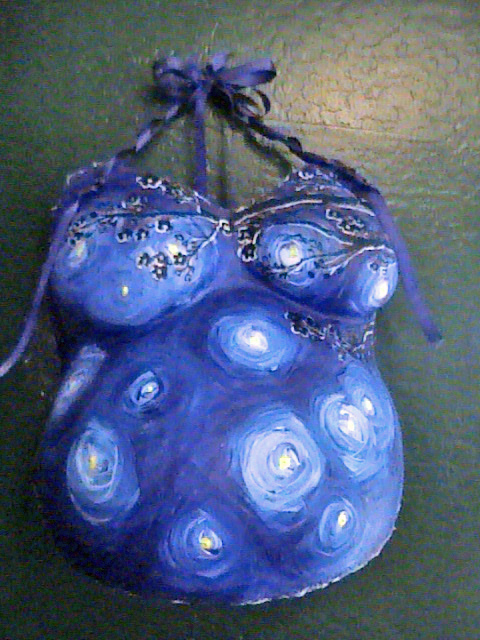
.....or it can be finished and painted for hanging on your wall, such as this one by artist Bethany Farrell....


......or personalized, like this one by artist Tina Killackey..........


........or decorated with added pieces, like this one from artist Nic Hohn.......


.......or given elaborate designs, like this one from my friend Amy Swagman of The Mandala Journey........


........or this beautiful but simpler one from Massage-ology.


You can even take a picture of your newborn nestled in the inside of the bellycast, just like they were positioned in the womb, which makes a wonderful piece of memorabilia for baby albums.  Or put paint on your baby's feet and do footprints on the inside (or outside) of the cast, to commemorate all that fetal kicking!  Or write a letter to the baby and tape it to the inside of the cast, to be given to them when they are older.


It can be as detailed or basic as you prefer ─ the possibilities are endless ─ but what a lovely keepsake to have forever.

There are any number of websites available that discuss how to make a bellycast, how to finish and display them, and which offer many images and ideas to choose from for decorating them. 

I personally did not have the nerve to do a bellycast in my first 3 pregnancies, but decided to do one in my last pregnancy. I really had to challenge myself to go through with it ─ but now I'm very glad I did. Alas, I've never found the time to actually have the cast finished ─ maybe by the time she graduates high school! ─ but what we did was sort of like the picture below. 


My husband put his hands on my belly, then I put my hands atop his.  It was difficult to differentiate between his hands and mine with plaster strips, but you can see it if you look for it.  Then later, after the cast dried a bit, we added a cast of my other children's hands too.  Doing them one at a time, later on, helped us make this work, since my kids would never have had the patience to do it otherwise.  Eventually, we will paint each person's hand a different (but complementary) color, and then finish the whole thing with beautiful uniting color and perhaps the outlines of my daughter's feet in the middle.

For now, my belly cast sits in its unfinished-but-still-inspiring-state in my office, looking down at me as I work, giving me inspiration as I write.  Even though it's not finished, I still treasure it and am immensely glad I took a chance on trying it.  I would always have regretted it had I let body self-consciousness get in the way of making this one-of-a-kind gift to myself.  Now, even if it's never formally finished, it's still a treasured memento of a very special time in my life, and of a very special child of my heart.

Conclusion

It's really not unusual for women of all sizes to experience body image issues during and after pregnancy.  There are huge changes happening to the body, and any pre-existing image issues can get magnified in uncomfortable ways as a result.

But while it's very normal to experience body ambivalence, that doesn't mean we have to stay in that murky place.  Rather, see it as an opportunity to work through and heal yourself in new and deeper ways.

One great way to work on healing pregnancy body ambivalence is through belly art. Photography, belly painting, henna, belly casts....all of these and more are good ways to honor ourselves, our bodies, and our babies.

It doesn't really matter which form you pick, but do find some way to document the experience.  It is only a brief moment out of your life, but it is such an important and memorable one.  It (and you) deserve to be honored in a special and unique way.

Don't let your size or body image keep you from memorializing this so-special moment in time in some way.  You will treasure it later, trust me!

*For more ideas and images of belly casts, belly painting, and henna tattoos, click here.

Wednesday, May 25, 2011

Nutrient Deficits in People of Size

A number of studies have found that many "obese" people have significant nutrient deficits.  As we've discussed before, contrary to the popular medical perception that fat people are overnourished, many are actually undernourished.

As one author put it:
Though commonly considered a state of “overnutrition”, obesity has increasingly been recognized as a risk factor for several nutrient deficiencies, including lower levels of antioxidants and certain fat-soluble vitamins.
Ironically, this fact went undiscovered until fat people who had had a gastric bypass started having severe nutritional deficits afterwards.  To further track the problem (and to try to blame something other than the surgery for these deficits), bariatric surgeons began documenting the nutritional status of weight loss surgery (WLS) candidates before the surgery. 

What they discovered was that many people of size actually have significant nutrient deficits, even before surgery.  

Let's be clear ─ the surgery indeed does make these deficits far worse, but many are not starting on an equal playing field before surgery even has an effect.

The $64,000 question is WHY many people of size have nutritional deficits. 

There are three main possibilities bandied about in the research to explain these deficits:
  • Nutrutional deficits are caused by years of junk food, unbalanced intake, and not enough fruits and vegetables
  • Nutritional deficits are the cumulative effect of years of dieting and limited intake common among many fat people
  • Nutritional deficits more common in people of size because they may not absorb nutrients as efficiently as others

Bad Habits?

Of course, the weight loss surgery studies usually blame junk food and a poor diet for the nutritional deficits among "obese" people.   Here's what one author (Xanthakos 2009) wrote about it:
The presence of nutritional deficiencies in overweight and obesity may seem paradoxical in light of excess caloric intake, but several micronutrient deficiencies appear to be higher in prevalence in overweight and obese adults and children. Causes are multifactorial and include decreased consumption of fruits and vegetables, increased intake of high-calorie, but nutritionally poor-quality foods, and increased adiposity, which may influence the storage and availability of some nutrients.
Weight loss surgeons like this Too-Much-Junk-Food explanation because it gives them an easy out by blaming the victim for the problem. 

And certainly there could be some truth to this possibility for some fat people.....some fat folk really do have poor nutrition, are binge eaters, and/or mostly eat junk/highly processed food, and that could certainly depress their nutritional reserves.

However, this explanation is simply too facile and convenient.  Yes, some fat people have terrible habits and this can have effects on their nutritional reserves ─ but some have normal habits and yet still have nutritional deficits. 

I hope the researchers look further than these "easy out" conclusions.  They need to dig a little deeper with the research and stop making assumptions about how "all fat people" eat and live.

Years of Dieting?

The second possibility ─ nutritional deficits are caused by years of dieting and limited calories ─ certainly seems logical.  Even the healthiest "lifestyle change" diets have difficulty providing sufficient amounts of nutrients if the caloric intake drops too far.  Given that many fat folk have been on 1200 calorie (and less) diets, are our bodies able to extract enough nutrients from that amount of calories? 

And what about those of us who have been on Very Low Calorie Diets (VLCDs); how much does that steal from our nutrient stores?

[Most of my dieting years were spent on moderate, "healthy" diets, usually 1200-1500 calories, with balanced intake of all the nutrient groups.  However, my last big dieting attempt involved a medically-supervised VLCD of about 500 calories per day.  I spent six months on that stupid VLCD; what do you think that did to my nutrient stores?]

Inadequate Nutrient Absorption?

To me the most intriguing possibility is that perhaps fat people simply do not absorb nutrients from their food as efficiently as others.  Unfortunately, this is the possibility with the least amount of research, just tantalizing mentions of this possibility in studies that I've read, but without providing documentation or proof that this does indeed occur. 

Certainly it is thought by some doctors that adipose stores can sequester fat-soluble vitamins (like vitamin D) and that this is why fat people tend to have very low Vitamin D levels.

But I've also seen some passing references in research of the possibility that fat people's gut and/or intestinal flora do not absorb certain nutrients (like folate) properly.  Some have speculated that this may be why we have lower levels of folate (and thus more birth defects) than thinner people, despite research showing no difference in folate intakes between groups.

I think this is an incredibly intriguing thought, and one that intuitively seems quite possible to me.  Now we just need research to actually really examine this question thoroughly, instead of making passing referece to the possibility without really documenting what study has been done on it.

Concluding Thoughts

It is clear that many "obese" people, rather than being overnourished, are actually undernourished instead.  They often have nutrient deficits of varying degrees of severity.

Nobody quite knows why this is; there is lots of speculation in the research about it, with many assumptions about how fat people "must" be eating (with little actual proof of these assumptions).  It may be bad habits, it may be deficits from years of dieting, or it may be decreased ability to absorb nutrients from food.  Perhaps it is a synergistic combination of some or all of these ─ or perhaps it is something else entirely.

What's needed is further study ─ study not just documenting the existence of nutrient deficits, but seeking the causes of these deficits, without making assumptions along the way. 

Compare the "obese" people with significant nutrient deficits to those without significant nutrient deficits, for example, and see if that comes up with any meaningful clues about nutrient intake, hormonal interference, or other issues.  Or compare the efficacy of nutrient absorption in the guts of average-sized people and the guts of "obese" people and see if there are any differences.

There are many ways to start investigating this finding further; it's time to create some more meaningful research on the topic, research that might actually lead to some breakthroughs in fixing the problem.

The ironic and maddening thing to me is that the undernourished status of so many fat people would have gone largely undiscovered had it not been for weight loss surgery (WLS).  This is important knowledge to have, but how terrible that it comes at such a price.

Not that I hate people who have had WLS or anything; it's their body and they get to choose what they do with it.  If they make an educated choice for it, who am I to begrudge them that?  I understand what drives them to that choice; I have several dear friends who have had WLS, and while I don't agree with all their reasons, I wish them well. 

But my gripe with research and publicity about WLS is that its long-term benefits are being oversold by selective reporting, complications are being hidden and minimized, and long-term risks are really greatly underemphasized. 

There are a lot of people out there who are sick from side effects of WLS, and that story is conveniently not making the news.  Only the stories of people in the "honeymoon" period of the first few years after WLS are being reported, not the nightmare stories of those who develop long-term problems from the procedure.  That's not fair and balanced reporting.

And how frustrating it is that doctors only start to notice and care about the nourishment status of very fat people in order to explain away the complications associated with their risky weight-loss interventions. 

Why was this undernourishment only discovered when doctors were trying to explain away the severity of nutrient deficits in fat people who had had WLS?  Why didn't doctors notice, test for, or care about these nutrient deficits in fat people before?  Why was it only important when it affected their bottom line?

In addition, it's important to remind health professionals that nutrient deficits in people who have had WLS are made far worse by the surgeries, even among many who are fully "compliant" with their vitamins.  The fact that many have nutrient deficits before the surgery certainly adds to the problem, but surgeries that worsen their intestinal tracts' abilities to absorb nutrients definitely worsen the problem to levels far beyond what it was in the first place.  Don't blame it all on pre-surgery status or lack of vitamin compliance; the surgery definitely is part of the problem.

It's time for doctors and researchers to stop stereotyping and blaming, and it's time for them to start examining WHY people of size tend to have higher rates of nutrient deficits, what causes these deficits, and how they can be treated effectively.


References

Aasheim ET, Hofsø D, Hjelmesaeth J, Birkeland KI, Bøhmer T.  Vitamin status in morbidly obese patients: a cross-sectional study.  Am J Clin Nutr. 2008 Feb;87(2):362-9. PMID: 18258626
Study from Norway that prospectively examined 110 consecutive "morbidly obese" patients and 58 healthy controls not taking multivitamin supplements. The fat patients had "significantly lower concentrations of vitamin B-6, vitamin C, 25-hydroxyvitamin D, and lipid-standardized vitamin E than did the healthy controls...The status of these vitamins was inadequate in a substantial proportion of the patients (11-38%)."
Carlin AM, Rao DS, Meslemani AM, Genaw JA, Parikh NJ, Levy S, Bhan A, Talpos GB. Prevalence of vitamin D depletion among morbidly obese patients seeking gastric bypass surgery. Surg Obes Relat Dis. 2006 Mar-Apr;2(2):98-103.  PMID: 16925330
Prospectively studied vitamin D levels before surgery in 279 "morbidly obese" patients in Michigan seeking gastric bypass surgery. Vitamin D depletion, defined as serum 25-hydroxyvitamin D level less than or= 20 ng/mL, was found in 166 patients (60%)...Vitamin D depletion was significantly more prevalent in the African-American patients than in the white patients (91% vs 48%; P less than .001)...Before gastric bypass surgery, a majority of morbidly obese patients have vitamin D depletion and secondary hyperparathyroidism. Studies evaluating the effects of gastric bypass on vitamin D metabolism must consider preoperative vitamin D nutritional status.
Xanthakos SA. Nutritional deficiencies in obesity and after bariatric surgery.  Pediatr Clin North Am. 2009 Oct;56(5):1105-21.  PMID: 19931066
"The presence of nutritional deficiencies in overweight and obesity may seem paradoxical in light of excess caloric intake, but several micronutrient deficiencies appear to be higher in prevalence in overweight and obese adults and children. Causes are multifactorial and include decreased consumption of fruits and vegetables, increased intake of high-calorie, but nutritionally poor-quality foods, and increased adiposity, which may influence the storage and availability of some nutrients. As the obesity epidemic continues unabated and the popularity of bariatric surgery rises for severely obese adults and adolescents, medical practitioners must be aware of pre-existing nutritional deficiencies in overweight and obese patients and appropriately recognize and treat common and rare nutritional deficiencies that may arise or worsen following bariatric surgery. This article reviews current knowledge of nutritional deficits in obese and overweight individuals and those that commonly present after bariatric surgery and summarizes current recommendations for screening and supplementation."
Ammor N, Berthoud L, Gerber A, Giusti V. [Nutritional deficiencies in candidates for bariatric surgery] Rev Med Suisse. 2009 Mar 25;5(196):676-9. PMID: 19462611
[Article in French]

"98% of patients who have undergone a gastric bypass for treating severe obesity develop multiple micronutrient deficits. However, prior to surgery, it isn't rare to find nutrient deficiencies. Indeed, the dietary intakes of surgery candidates are often unbalanced, lacking in variety especially in high vitamin and mineral nutrients. We present the preliminary results concerning the qualitative and quantitative analysis in a group of patients waiting for a gastric bypass. The recommended daily amounts in vitamin B9, vitamin D and iron are insufficient in the majority of the patients. The correction of nutritional intakes is advisable, even before the surgery, in order to reduce the risks of developing biological deficiencies."
Kaidar-Person O, Rosenthal RJ. Malnutrition in morbidly obese patients: fact or fiction?  Minerva Chir. 2009 Jun;64(3):297-302.  PMID: 19536055

"Reports of nutritional deficiencies after Bariatric surgery have lead investigators to inquire about the preoperative nutritional status of morbidly obese patients. Interestingly, numerous reports demonstrated a pattern of low levels of various micronutrients among overweight and obese patients, even in comparison with normal weight population. In this article we reviewed the literature for micronutrient deficiencies in obese patients prior to weight reduction surgery."
Kaidar-Person O, Person B, Szomstein S, Rosenthal RJ. Nutritional deficiencies in morbidly obese patients: a new form of malnutrition? Part A: vitamins. Obes Surg. 2008 Jul;18(7):870-6. PMID: 18465178   See also: Kaidar-Person O, Person B, Szomstein S, Rosenthal RJ. Nutritional deficiencies in morbidly obese patients: a new form of malnutrition? Part B: minerals. Obes Surg. 2008 Aug;18(8):1028-34. PMID: 18461424
"It is a common belief that clinical vitamin or mineral deficiencies are rare in Western countries because of the low cost and unlimited diversity of food supply. However, many people consume food that is either unhealthy or of poor nutritional value that lacks proteins, vitamins, minerals, and fiber. In this, article we reviewed the literature and highlighted the vitamin deficiencies in obese patients before bariatric surgery. Deficiency of dietary minerals is described in the accompanying manuscript. The prevalence of vitamin deficiencies in the morbidly obese population prior to bariatric surgery is higher and more significant than previously believed."
Schweiger C, Weiss R, Berry E, Keidar A. Nutritional deficiencies in bariatric surgery candidates. Obes Surg. 2010 Feb;20(2):193-7.  PMID: 19876694
"Preoperative blood tests of 114 patients (83 women and 31 men) were collected...The prevalence of pre-operative nutritional deficiencies were: 35% for iron, 24% for folic acid, 24% for ferritin, 3.6% for vitamin B12, 2% for phosphorous, and 0.9% for calcium, Hb and MCV level was low in 19%. High levels of PTH were found among 39% of the patients...Patients with BMI greater than or = 50 kg/m(2) were at greater risk for low folic acid (OR = 14.57, 95% CI:1.4-151.34). Patients with high income were less likely to have iron deficiency (OR = 0.19, 95% CI:0.038-0.971). A high prevalence of nutritional deficiencies was found amongst bariatric surgery candidates suffering from morbid obesity."

Friday, May 20, 2011

Welcome, Maceo: Newborn Video


In our last post, we shared pictures of pregnant women of size to show the diversity of bodies and belly shapes for Honoring Our Bellies Month and for our Plus-Sized Pregnancy Photo Gallery. 

I'm happy to report that one of those women who shared belly pictures, Theresa, gave birth exactly one week ago to her son, Maceo.  She sent us a video of Maceo's first moments in the world, just after he was born.

The video is about 3 minutes long, doesn't have any graphic birth footage, and is mostly just sweet sweet pictures of baby Maceo with his mommy and daddy.

Beautiful, just beautiful. Thank you for sharing, Theresa.

Here is an abbreviated version of her birth story.  To me, it illustrates the importance of maternal mobility in labor as a way to deal with the pain without drugs, and probably as a way to help correct any position issues with the baby (in this case, possibly a hand by the baby's head). 

Can you imagine how hard it would have been for her to deal with the pain if she was tied down to a bed, flat on her back, not permitted to move around much, like most women (and especially women of size) are in hospitals?  This is why the epidural rate is so high in hospitals, even among women who want to go without drugs.  Such restricted movement just makes it incredibly hard to deal with the pain; free range of motion and unlimited mobility makes it at least doable for many.

Notice how much Theresa moves around in her birth story, and notice how many positions she uses for labor and pushing.  Notice also how she switches positions at the last minute.  This frequent movement and re-positioning was probably very important in helping the baby out, yet it's something that's rare in many hospitals.  How many problems could be avoided if women were just encouraged to have free range of motion like this?

Here, then, is Theresa's birth story.

"Suddenly instead of five people in our bedroom, there were six."

Okay, so Thursday I started having what I can only describe as gas pains..It wasn't painful, more like the kind of sensation that makes you want to wrinkle up your nose. Also I noticed when I was in the "library" that I had started to let go of the mucus plug.  I had an appointment to go see the midwives that morning and luckily I had asked [my husband] Moonie to start his leave a few days early because I didn't want to drive to the midwife's by myself (good thing, too!)

Everyone agreed my gas was likely early labor but it could be really early and start and stop or maybe it WAS just gas. Anywho, the appointment went well, my BP was great, my urine was fine and about an hour later the sensations subsided.  [I took] an afternoon nap (good thing, too). 

Moonie made us some dinner about 6pm and we watched a movie and my "gas pains" started to return.  I finished eating and felt like I really needed to go take a leak and Moonie helped me up off the sofa and followed me to the "library" but I was to do no reading here for a while!  As soon as I got in I got an EARTH SHATTERING contraction that made me grab the over toilet towel rack and moan, "Ohhhhhh AHHHHHHH"   We had been discussing that maybe I wasn't in labor and we didn't want to go getting excited over nothing especially since first labors are usually long.  Moonie just said, "Yeah, kid I think you really are in labor!"  and called the midwives to put them on alert and I tried to go back to watching the movie but all you moms probably can figure how well THAT worked out! 

By 8pm I was seriously in first stage. The midwifery student came over an hour later and I was just dealing with each contraction as it came. [I was] sitting on the exercise ball, using the sock warmers (socks filled with rice and warmed in the microwave), and Moonie was timing my contractions as we played my "Relaxing" playlist on iTunes and tried to veg out to the visualizer. 

Soon after the student came she started inflating the baby pool and I could no longer sit and deal with contractions I was walking around moaning and chanting OM while doing belly dance moves and pelvic stretches.  Walking it off was really the only way I could deal with these harder contractions, the thought of laying down was uncomfortable. I did try to lay down through one and it felt all wrong so I scrapped that idea.  

For me the contractions weren't painful per se, they were more like the most intensely uncomfortable sensations ever mostly because I couldn't lay down, I couldn't sit and standing and walking all felt crappy.  Then one thing that only one mom ever mentioned to me was the flu-like sick feeling you can get. Boy did I EVER get it!  I threw up that dinner like nobody's business and I felt like was gonna hurl up everything I had eaten since I was 2 years old. I felt really sick to my stomach between contractions and that continued until the end pretty much.

Later that night...the midwives came.  The midwifery student had been helping me through the contractions because the sensations were so STRONG that they scared me at first and I would [think], "Oh another one! What do I do???" I couldn't believe how close they were and she just hugged me and let me lean on her and reminded me to breathe and helped me through it.

I tried to sit in the pool which was filled by a hose hooked up to the shower head.  The water seemed too hot and there wasn't enough of it. Also it was on my hard living room floor so kneeling in the pool sucked. I couldn't SIT for love or money and leaning on the side just made it sink down and overflow.  I tried a second time during the labor but it just felt wrong and so I scrapped it. 

We all ended up in the bedroom and to be honest, I'm surprised my neighbors didn't call the police. I was told that I wasn't so very loud because I was moaning instead of screaming.  I was on all fours on our bed and it seemed like forever! I was getting these MASSIVE pushing contractions one at a time and felt sick as dog in between along with the front of my hips hurting like Satan was cracking my bones so in between loud moans I just yelled "SICK SICK! I'm not gonna be sick I FEEL sick!" and "DAMN IT MY HIPS HURT LIKE HELL!"

My midwife wanted me lay on my back to try and examine me but there was no WAY I could lay on my back!  I just instinctively knew that would make everything worse. She thinks Maceo's hand was up by his head because I had been pushing for a bit and the head would come out and go back. So she did a clear of my cervix which I  was told I complained about loudly (I have no memory of this) and then switched positions.  They suggested I try the birth stool. I got up off the bed and then another massive contraction came (they were now two or three pushing urges in a row then a break), and I just grabbed my rickety bedside table and got into a squat and yelled. I got into the birth stool and pushed there for a bit. Got back on the bed and pushed there, yelling about how my hips hurt in between while they kept repeating, "Push it out and it'll all be over!"  I remember being covered in sweat and seeing Moonie's face and holding his hand and crying.

"This is taking so long!!!" I yelled and they said something and I remember saying, " I just want to get the baby OUT!!!" I slid off the bed to the birth stool and  had the most massive contractions ever and pushed with all my might with every ounce of strength I had in my entire being and the midwife said, "It's coming!" and Moonie dove to the floor to help her catch baby and he said "I see the head, baby! I can see it, it's almost here!" I said "You do?!" and then pushed Maceo out into the world and suddenly instead of five people in our bedroom there were six.  The midwife and Moonie both caught baby.

"Is it a girl?" I asked and she said, "It's a boy!"  and I said "Oh it's Maceo!" and I just repeated his name over and over again.  The cord was around his neck but she just slipped it off and handed him up to me.  We waited what seemed to me like five seconds but was an hour we clamped the cord and the student cut it. 

Then we waited for the placenta to come out but it had stage fright I guess. I tried coughing and pushing but to no avail. I took a few doses of Angelica tincture  and still nothing. The midwife suggested we move to the toilet because it might come out easier. I sat there and sat there and nothing and finally the midwife said, "You know if you can't get it out we'll have to go someplace where they can take it out."  Then before I could even say "Oh" I had another contraction and this was actually a little painful or maybe it was just that it was stronger than I expected and it was over before I even knew what happened and out it came.  I looked at it when they put it in a specimen bowl and was like "uh-huh" and thought about how tired I was.

I went back to the bedroom and Maceo was in his Poppi's arms and the student took some photos. Then I had him again and we took some more photos.  Then the midwives started cleaning everything up and sump pumping the pool and deflating it, loudly.  Finally that crap was over and we had quiet time. I just laid in bed with Maceo and Moonie was totally enraptured with us both.

Our midwives examined me and I had  no rips but something called a skidmark which is like a little scrape on the taint and they were all so happy (so the hell was I).

I think I just laid in bed and dozed with Maceo and Moonie just laid diagonally at the foot of the bed, completely dressed with glasses and everything and slept for the next four hours until his parents got there and brought us breakfast.