Just a quick alert and follow-up on the thread about Joan of Arcadia.
SciFi channel is apparently doing a Joan of Arcadia marathon on Thursday, February 5th, starting early in the morning. If you don't already own the series and want to check it out (or see it again), set your recorders!!
Alas, it doesn't look like they are going to do the episodes in order, but I only did a quick glance so I could be wrong. Even so, it's worth watching.
If you have not yet seen this series, please check it out. It really is worth a look. Really thoughtful and engaging, especially if you watch more than one episode.
Thursday, January 29, 2009

Wednesday, January 28, 2009
Timing of Planned Cesareans
 As we have discussed before, cesareans are at epidemic level among "obese" women. Although rates vary from study to study, on average up to one-half of all "morbidly obese" women today give birth by cesarean, many of them planned (done before labor). In some areas and hospitals, the rate approaches three-quarters.
[Of course, the c-section rate does NOT need to be that high in women of size, but because of current practice patterns, it is skyrocketing. For more on this topic, read this.]
This is a travesty because surgery is riskier on larger people; more problems with anesthesia, more risk of infection, hemorrhage, blood clots, and wound complications. And cesareans have long-term health implications for women of all sizes, both for future pregnancies and the woman's own health.
But let's leave that for another rant and talk instead about the timing of planned cesareans, and why this is such an important issue, particularly for women of size.
Timing Is Everything
A woman's "due date" is about 40 weeks, and a "full-term" pregnancy is anywhere from 37 to 42 weeks. If, for whatever reason, an "elective" cesarean is planned, what is the most favorable time for scheduling that surgery?
Many doctors in recent years have been scheduling cesareans early. A repeat c-section at 38 weeks is routine in many communities, and 37 is not unheard of. Sometimes, women themselves advocate for a little early because they are uncomfortable and "tired of being pregnant."
Doctors, too, often want to "just get things over with" and get that patient off their books. Scheduling a c-section at 38 weeks means two less appointments cluttering up their busy schedules. They also have talked themselves into believing that scheduling a little early might prevent a few unexpected stillbirths at term (even though that risk is extremely low and outweighed by the risks of being born early).
So, over time, doctors decided that "term is term" and a few more days doesn't make an appreciable difference in the baby's condition.
However, new research shows that planned cesareans should not be performed prior to 39 weeks at the earliest.
The Benefits of Waiting
Before 39 weeks, the risk of breathing difficulties in the baby is quite a bit higher. The older the baby is, the more ready they are to breathe on their own.
In addition, younger babies have more difficulties regulating their blood sugar, have more jaundice, and have more difficulties learning to breastfeed. But it's the breathing difficulties that puts the babies most at risk.
In particular, cesareans without labor put babies at much higher risk for breathing difficulties. Babies born by cesareans after labor has begun have less trouble breathing, and vaginally-born babies have the least difficulty breathing of all. The baby that has the most difficulty breathing on its own is the baby born by planned cesarean before 39 weeks.
Why is this? Labor contractions help squeeze the baby's chest and expel the fluid there. Hormones that are produced during labor help the baby's body be ready to breathe independently. In addition, the umbilical cord gets cut very quickly at a cesarean, cutting off a significant portion of the placental blood meant to perfuse the baby's lungs and help them get ready to start working.
Gestational age also influences a baby's readiness to breathe independently. Preemies have a much harder time initiating breathing and maintaining it without apnea or oxygen saturation issues. Until recently, gestational age was not thought to be that important once babies reached "term" (at least 37 weeks), but now we know differently.
For some time now, research has shown that babies born before 39 weeks have higher rates of Transient Tachypnea of the Newborn (TTN), Respiratory Distress Syndrome (RDS), and Persistent Pulmonary Hypertension (PPH). These babies then need to go to neonatal intensive care (NICU), experience many interventive procedures, and accrue significant costs. Some experience long-term effects.
Because of this, many hospitals have begun strongly encouraging doctors to schedule cesareans no earlier than 39 weeks, and ACOG (American College of Obstetricians and Gynecologists) has recommended that planned cesareans be delayed until at least 39 weeks. Unfortunately, not all doctors follow this recommendation, and many many cesareans are still being done at 38 weeks.
New Evidence for Waiting
A new study, recently published in the New England Journal of Medicine, once again highlights the importance of delaying planned cesareans until at least 39 weeks. Here are some excerpts from the press release:
NEW YORK – Babies do better after a scheduled Caesarean section if they're born no sooner than seven days before their due date, a new large study of U.S. births shows. Those delivered earlier had more complications, including breathing problems, even though they were full term, the researchers reported in [the] New England Journal of Medicine. Even just a few days made a difference, they said....
The study supports recommendations that elective C-sections be scheduled after 39 weeks unless tests show the infant's lungs are fully mature....
In the new study, the researchers, led by Dr. Alan Tita of the University of Alabama at Birmingham, examined a C-section registry from 19 academic medical centers to see how many of the surgeries were being done before the recommended 39 weeks and if the timing made a difference in the risk of complications.
They focused on 13,258 women who had a single child at a planned Caesarean and who had previously given birth the same way. Excluded were cases where medical issues warranted an early or immediate delivery. The infants were followed until they left the hospital or for four months.
More than a third of the C-sections were performed before 39 weeks, the researchers found. Those delivered at 37 weeks were twice as likely to have health problems, including breathing troubles, infections, low blood sugar or the need for intensive care. Fifteen percent of those born at 37 weeks and 11 percent born at 38 weeks had complications, compared to 8 percent of the babies delivered at 39 weeks.
Note that one-third of the planned c-sections in the study were done at 38 weeks, despite years of prior evidence that delaying till 39 weeks improves outcomes.
It is simply unconscionable that despite considerable, long-standing evidence to the contrary, one-third of contemporary elective cesareans were still carried out so early. When will doctors finally align their practice patterns with the evidence?
Some of the press releases also implied that it was mostly maternal request that was driving this trend towards 38-week cesareans, but in fact, the push for early cesareans is usually physician-driven. This is another recent trend in research and press releases: blame the mothers for problems instead of physician mismanagement.
One might also ask, why not delay a planned cesarean until at least 40 weeks? Even at 39 weeks, about 1 in 12 babies still had breathing difficulties. Although the difference did not reach statistical difference, the rate of complications was lower at 40 weeks than at 39.
There is no good reason for an arbitrary dictate to have planned cesarean done at 39 weeks, before a woman's due date. Unless there is a compelling medical reason, delay until the due date or until after spontaneous labor begins and outcomes will improve even more.
Second, I wish the medical journals would also press doctors to stop doing so many planned cesareans. The most optimal timing of cesareans is a red herring issue. Research is VERY clear that vaginally-born babies do better overall in so many ways, a point conveniently left out of the report.
The cesarean rate in the whole country is unconscionably high (over 30%), with cesarean rates in some hospitals exceeding 40 or even 50%. There is NO need for a cesarean rate this high. Most mothers and babies do better if they are given a chance at a vaginal birth.
A cesarean is an excellent thing for true emergencies, and there are also times when a planned cesarean is justified. But the overuse of cesareans today is putting a whole generation of babies, future babies, and mothers at risk unnecessarily.
Debating the timing of cesareans is not the real issue here; the overuse of unnecessary cesareans is.
Cesarean Timing and "Obesity"
Finally, timing of a planned cesarean may be particularly critical for women of size. Research shows that women of size tend to have longer menstrual cycles, which should delay their due dates, yet cycle length is rarely adjusted for by most doctors.
If a woman's cycle is 35 days, that means her "due date" by Last Menstrual Period (LMP) will be too early by a week. This is a critical point, especially when discussing planned cesareans.
Even if doctors follow the latest recommendations and schedule an "obese" woman's elective cesarean at 39 weeks, in reality this may well mean the baby is only 38 weeks, and subject to the higher risk of breathing issues noted above.
If the cesarean is scheduled at 38 weeks instead (as 1/3 of cesareans were in the report above), her baby will actually be born at 37 weeks, raising the risk for problems even more.
Of the women of size I know who have had elective cesareans, many of them had them at 38 weeks. This is putting these babies at risk unnecessarily; putting off the surgery just a little more really improves outcomes and helps babies in so many ways.
But even better in most cases would be to give those babies and mothers the benefits of labor.
If a woman's cycle is 35 days, that means her "due date" by Last Menstrual Period (LMP) will be too early by a week. This is a critical point, especially when discussing planned cesareans.
Even if doctors follow the latest recommendations and schedule an "obese" woman's elective cesarean at 39 weeks, in reality this may well mean the baby is only 38 weeks, and subject to the higher risk of breathing issues noted above.
If the cesarean is scheduled at 38 weeks instead (as 1/3 of cesareans were in the report above), her baby will actually be born at 37 weeks, raising the risk for problems even more.
Of the women of size I know who have had elective cesareans, many of them had them at 38 weeks. This is putting these babies at risk unnecessarily; putting off the surgery just a little more really improves outcomes and helps babies in so many ways.
But even better in most cases would be to give those babies and mothers the benefits of labor.
*Image from Wikimedia Commons.
Thursday, January 22, 2009
Cause You're Just Not Trying Hard Enough
So, I went to an orthopedist for the first time this week. I was in a car accident last spring...a guy rear-ended my car at a high speed, and my car was totaled. Did a number on my body too, including my knees.
I have been concerned about a distinct decline in the function of my knees (and increase in pain level) since the accident. I've been seeing a chiropractor and acupuncturist regularly for most of this time, which have helped my other problem spots dramatically. There's still some residual issues, mind, but I've had a lot of improvement in those areas. Not so much in my knees. So my chiropractor suggested that perhaps it was time to see an orthopedist to check things out further.
I was surprised by how anxious I was about this visit. I'm usually a good advocate for myself and my size with doctors and I generally don't take crap from anyone, so I was surprised to have so many nerves about this visit.
On the other hand, I know orthopedists can be very fat-phobic, and I was worried that I'd be severely lectured or even yelled at about the need for weight loss, yadda yadda. I knew I'd have to have my youngest child with me at the appointment and I was worried about getting into this kind of crap in front of her, I think. She's young, but she's old enough now to "get" a lot more of what she hears, and I didn't want her to pick up on this kind of crap.
Also, I looked up the bios on the practice I was seeing and saw that they were all mega-athletes; the particular doc I was seeing went on and on about his training for the Iron Man Triathlon during medical school and residency. Great, someone who judges everyone else's exercising by his own quasi-compulsive standards. I knew I'd never measure up there either, even though one of the reasons I was there was because the knee issues were keeping me from getting back into exercising. Crap.
Well, the appointment was both better and worse than I expected. The doctor was nice, at least. That always counts for a lot with me. They didn't weigh me (which I was prepared to battle over). There was no yelling, no nasty over-the-top lecturing, none of the really hard-sell tactics you often see. So that was refreshing, and frankly, quite a relief. But that doesn't mean there wasn't size bias, just that it was couched more nicely. Sigh.
They did have me do an x-ray, and while they did have a pair of shorts in my size for me to wear for the x-ray and exam, they were pretty tight and not comfortable. If I'd known, I would have brought a pair of my own shorts so I could at least be comfortable. [Hint: If you ever think you might need knee/leg x-rays, bring your own shorts. I wore pants that easily pull up above the knee but that wasn't enough. Next time, I'll bring my own shorts.]
The x-ray showed arthritic changes, which I expected. I'm well into my 40s and we knew a little of this had started. My concern was that something else must be going on too, because my knee function had gone down so quickly. Well, the arthritis has certainly progressed (how depressing to write that, ugh) and the x-rays showed that. However, what was upsetting was that he wouldn't consider that something ELSE might be going on too.
When doctors see fat people with body pain, arthritis is their automatic assumption, to the extent that they get tunnel vision about it....as if nothing else could be going on too. How often do fat people get misdiagnosed or underdiagnosed for non-fat-related issues because their doctors have this kind of tunnel vision?
He mentioned in passing that I "might" have a small tear in my meniscus, but that I wasn't a great candidate for surgery because of the arthritis' narrowing of the gaps. Okay, I understand I may not be the best candidate for surgery (I didn't go there wanting surgery anyhow) but the meniscus idea deserves a little more exploration, doesn't it? But it was mentioned so briefly, in passing, that I really didn't pick up on it until after the appointment was over. Now I'm kicking myself for not pressing him more on that possibility.
Of course, at one point, weight loss was mentioned. I knew it would be. I tried to fend it off ahead of time by telling him my main concern was feeling better and getting back to exercising (and mentioned prominently that I didn't do exercise for weight loss but simply to improve fitness).
Of course, then he brought up later that even though I don't exercise for weight loss, losing weight would reduce the pressure on those arthritic knees. Well, okay, that's a legit point, and I don't think it's improper for docs to mention that.....extra weight is harder on your joints. But that doesn't alter the grim statistics on losing weight and keeping it off. Chances are losing weight would be my best ticket to actually worsening the situation because of the rebound afterwards, so I mentioned that as why I wasn't interested in losing weight.
His response was to question whether I'd really tried to lose weight....not in a mean way, mind, but still, clearly dubious about whether anyone could do it "right" and not lose permanently. He asked whether I'd ever really worked with a nutritionist or worked with an exercise specialist, and started to go off about how he could set me up for that. I shut that line of discussion down fast, laughingly noting how I'd DEFINITELY worked with specialists like that before, rolling my eyes, and noting I wasn't going down that path again.
At that point he dropped it, not because he was convinced but because the appointment clock was ticking and this clearly wasn't going anywhere with me. In the end we agreed I would give Physical Therapy a try (which is fine with me; it's why I was there) and he offered me a cortisone shot for the pain, which I declined because acupuncture has been pretty successful at helping with the worst of the pain.
After the appointment was over, I was mostly relieved that it didn't turn into some giant lecture fest (especially in front of my daughter), and disappointed in myself that I didn't more aggressively question him about the possibility of a meniscus tear. I'll be looking into that further later.
But later, after I'd had time to really think about the experience, two things about it really struck me. First, the doctors are SO focused on your weight and the possibility of arthritis that they literally cannot see any other possibilities for your joint issues, even when something like a car accident is on board. Hello?!!?? Fat people get trauma-related injuries too!
And second, there was this big underlying assumption that if I hadn't lost weight up till now, it HAD to be because I hadn't REALLY tried. I might have dieted, sure, but not hard enough, not intelligently enough, not with the "right" experts, the right program, yadda yadda.
Cause, ya know, we're all just not trying hard enough.
I have been concerned about a distinct decline in the function of my knees (and increase in pain level) since the accident. I've been seeing a chiropractor and acupuncturist regularly for most of this time, which have helped my other problem spots dramatically. There's still some residual issues, mind, but I've had a lot of improvement in those areas. Not so much in my knees. So my chiropractor suggested that perhaps it was time to see an orthopedist to check things out further.
I was surprised by how anxious I was about this visit. I'm usually a good advocate for myself and my size with doctors and I generally don't take crap from anyone, so I was surprised to have so many nerves about this visit.
On the other hand, I know orthopedists can be very fat-phobic, and I was worried that I'd be severely lectured or even yelled at about the need for weight loss, yadda yadda. I knew I'd have to have my youngest child with me at the appointment and I was worried about getting into this kind of crap in front of her, I think. She's young, but she's old enough now to "get" a lot more of what she hears, and I didn't want her to pick up on this kind of crap.
Also, I looked up the bios on the practice I was seeing and saw that they were all mega-athletes; the particular doc I was seeing went on and on about his training for the Iron Man Triathlon during medical school and residency. Great, someone who judges everyone else's exercising by his own quasi-compulsive standards. I knew I'd never measure up there either, even though one of the reasons I was there was because the knee issues were keeping me from getting back into exercising. Crap.
Well, the appointment was both better and worse than I expected. The doctor was nice, at least. That always counts for a lot with me. They didn't weigh me (which I was prepared to battle over). There was no yelling, no nasty over-the-top lecturing, none of the really hard-sell tactics you often see. So that was refreshing, and frankly, quite a relief. But that doesn't mean there wasn't size bias, just that it was couched more nicely. Sigh.
They did have me do an x-ray, and while they did have a pair of shorts in my size for me to wear for the x-ray and exam, they were pretty tight and not comfortable. If I'd known, I would have brought a pair of my own shorts so I could at least be comfortable. [Hint: If you ever think you might need knee/leg x-rays, bring your own shorts. I wore pants that easily pull up above the knee but that wasn't enough. Next time, I'll bring my own shorts.]
The x-ray showed arthritic changes, which I expected. I'm well into my 40s and we knew a little of this had started. My concern was that something else must be going on too, because my knee function had gone down so quickly. Well, the arthritis has certainly progressed (how depressing to write that, ugh) and the x-rays showed that. However, what was upsetting was that he wouldn't consider that something ELSE might be going on too.
When doctors see fat people with body pain, arthritis is their automatic assumption, to the extent that they get tunnel vision about it....as if nothing else could be going on too. How often do fat people get misdiagnosed or underdiagnosed for non-fat-related issues because their doctors have this kind of tunnel vision?
He mentioned in passing that I "might" have a small tear in my meniscus, but that I wasn't a great candidate for surgery because of the arthritis' narrowing of the gaps. Okay, I understand I may not be the best candidate for surgery (I didn't go there wanting surgery anyhow) but the meniscus idea deserves a little more exploration, doesn't it? But it was mentioned so briefly, in passing, that I really didn't pick up on it until after the appointment was over. Now I'm kicking myself for not pressing him more on that possibility.
Of course, at one point, weight loss was mentioned. I knew it would be. I tried to fend it off ahead of time by telling him my main concern was feeling better and getting back to exercising (and mentioned prominently that I didn't do exercise for weight loss but simply to improve fitness).
Of course, then he brought up later that even though I don't exercise for weight loss, losing weight would reduce the pressure on those arthritic knees. Well, okay, that's a legit point, and I don't think it's improper for docs to mention that.....extra weight is harder on your joints. But that doesn't alter the grim statistics on losing weight and keeping it off. Chances are losing weight would be my best ticket to actually worsening the situation because of the rebound afterwards, so I mentioned that as why I wasn't interested in losing weight.
His response was to question whether I'd really tried to lose weight....not in a mean way, mind, but still, clearly dubious about whether anyone could do it "right" and not lose permanently. He asked whether I'd ever really worked with a nutritionist or worked with an exercise specialist, and started to go off about how he could set me up for that. I shut that line of discussion down fast, laughingly noting how I'd DEFINITELY worked with specialists like that before, rolling my eyes, and noting I wasn't going down that path again.
At that point he dropped it, not because he was convinced but because the appointment clock was ticking and this clearly wasn't going anywhere with me. In the end we agreed I would give Physical Therapy a try (which is fine with me; it's why I was there) and he offered me a cortisone shot for the pain, which I declined because acupuncture has been pretty successful at helping with the worst of the pain.
After the appointment was over, I was mostly relieved that it didn't turn into some giant lecture fest (especially in front of my daughter), and disappointed in myself that I didn't more aggressively question him about the possibility of a meniscus tear. I'll be looking into that further later.
But later, after I'd had time to really think about the experience, two things about it really struck me. First, the doctors are SO focused on your weight and the possibility of arthritis that they literally cannot see any other possibilities for your joint issues, even when something like a car accident is on board. Hello?!!?? Fat people get trauma-related injuries too!
And second, there was this big underlying assumption that if I hadn't lost weight up till now, it HAD to be because I hadn't REALLY tried. I might have dieted, sure, but not hard enough, not intelligently enough, not with the "right" experts, the right program, yadda yadda.
Cause, ya know, we're all just not trying hard enough.
Monday, January 19, 2009
Adoption and People of Size
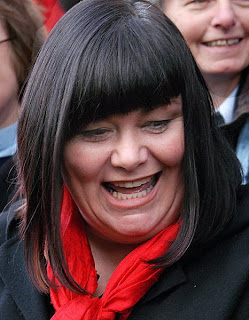 Not only do authorities want to discourage people of size from pregnancy, in some places they routinely discriminate against them in adoption too.
A fat man in Leeds, England, has been denied the right to adopt a child because he is "morbidly obese," i.e., his BMI is over 40. He has been told to lose weight and get his BMI under 40 and then demonstrate the ability to maintain that loss over time, which as we know, is very unlikely.
England has done this before. The very talented comedian and writer seen here, Dawn French,(The Vicar of Dibley, and Gryffyndor's Fat Lady portrait in Harry Potter) experienced similar size discrimination.
She tried to adopt a child a number of years ago and was told she had to lose weight first. She lost weight on a crash diet, they adopted the child, and then, as she stopped dieting, slowly regained the weight. (She has been frank about that in the press, so this may account for the new requirement to demonstrate the ability to maintain the weight loss over time.)
Nor is this requirement unique to England. Not long ago, a fat woman with PCOS from Australia was told something similar. She weighed 277 lbs. and was told she had to lose about 110 lbs. in order to be considered for adoption.
Furthermore, some countries (like Korea and China) have put official weight limits on adults wanting to adopt children from their countries. Other countries (like England and Australia) don't seem to have official national policies on weight limits but a number of news stories in the last few years suggests that it is becoming more common.
Here in the United States, weight limits on adoption seem to be much less common, although stories do exist. I personally know several fat women who have successfully adopted without their weight being made an issue; Rosie O'Donnell is an example of a fat celebrity who was able to adopt several times without weight becoming an issue.
Unfortunately, in other countries, obesity seems to be seen as a "legitimate" reason for denying adoption.
Why Keep Fat People From Adopting?
Oftentimes, size bias in adoption is disguised under the dubious cover of being concerned "about the future of the child." Authorities are afraid that:
- Fat people won't live long enough to raise the adopted child to adulthood
- Fat parents will teach bad habits and make the adopted child fat and unhealthy too
- Fat parents are emotionally unhealthy and will make the child unhappy or emotionally unstable too
First and foremost, adoption weight restrictions are based on the assumption that fat people are about to keel over at any moment and so will not live long enough to raise a child to adulthood, further scarring a child who has already suffered the loss of biological parents.
Sandy from Junkfood Science addresses the fallacies in this argument well; most fat people live plenty long enough to raise a child. Look around you; there are plenty of adults who have fat parents, and there are plenty of middle-aged and older fat people in our society. That alone should tell you that fat people live plenty long enough to raise a child to adulthood.
Amazingly, there are people who believe that fat people shouldn't adopt because they might make the adoptive child fat too. From an ABC news story:
Medical experts told ABC News that obesity — and the associated health risks — may be something that adoption agencies should consider more often when finding a permanent home for a child.This is completely contrary to what we know about the biology of obesity. Adoption studies clearly show that body size is most strongly influenced by genetics, not environment. Chances are that a child with a biological predisposition to "normal" weight would stay in the "normal" range, whether or not they are adopted by fat parents.
"Kids learn what they see and parents, whether they like it or not, are role models for our kids," said Keith Ayoob, an associate professor of pediatrics at Albert Einstein College of Medicine in New York, who argues that the environment in which a child is raised plays an important role in reducing their risk of obesity.
What about the idea that fat people are emotionally unhealthy (warning: major Sanity Watchers points!) and will cause the adopted child to grow up emotionally unhealthy too? Dr. David Katz spoke to this concern in an ABC editorial on the change in Chinese adoption guidelines. He wrote:
China announced plans...to tighten restrictions on adoptions by foreigners...Stated bluntly, if you are too fat, you can't adopt a Chinese baby.The Chinese presumably could, if they wanted to, require that applicants be able to juggle or knit or play the piano. If their intent is to create arbitrary barriers so that the mismatch between supply and demand is resolved, these would work just fine. If their intent is to ensure babies a nurturing and loving home, however, these restrictions would be ridiculous.
The laundry list of new restrictions on adoptions by foreigners is ostensibly aimed at assuring the babies a stable home conducive to good physical, mental and financial health...This policy is misguided, discriminatory and shameful.
Preventing adoption based on weight, no matter what weight, only makes sense if there is evidence that parental BMI is legitimately linked to the quality of a child's life and health or the kind of parenting he or she receives. To my knowledge, that link doesn't exist.
I've searched the medical literature for studies that link parental weight or BMI with quality of life in children and found nothing. I could find no studies that demonstrate a link between the BMI and the capacity to love. I found no system that correlates weight, waist circumference or any other measure of body size with the quality of parenting.
As for a link between parental weight and weight in their biological children, that's a well established fact in the medical literature: heavy parents are more likely to have heavy children. You barely even need to search the medical literature to make this case —just look around. Kids tend to look like their parents...
The science clearly and consistently indicates that body shape and size in children resembles that of their biological parents for the same reason that eye color does — because of genes.
There is no link — repeat none — between the weight of adults who were adopted as children and the weights of their adoptive parents, as has been confirmed by the famous decades-long Danish Adoption Study. More than 20 years of scientific studies have shown that nature, not nurture, explains the weight outcomes of adopted children.
Adopted children don't take on the body type or body weights of their adoptive parents. The science that supports that fact is not only persuasive, it is almost shocking. Virtually none of the variation in the BMI of adults who were adopted as children is explained by the weight of their adoptive parents, according to the research...
The biggest reason China is imposing restrictions on adoption is because it can, I suppose. A lot of foreigners are trying to adopt Chinese babies, and the government can afford to set limits. There are far more non-Chinese adults wanting to adopt than there are Chinese babies available. In the crudest of terms, it is a seller's market.
So is the notion that you can measure the quality of a parent on a bathroom scale.Denying adoption rights to obese people because of a concern over life expectancy or because of a fear that the fat parent might make the child fat or emotionally unstable is an example of cultural bias against fatness. It has no basis in reality and it should have no basis in the law either.
Size should have nothing to do with adoption. What really matters most is a parent's ability to love and take care of a child, period.
For those interested in adopting, there is an article about adoption and people of size on my website, including hints on dealing proactively with size bias.
*Picture of Dawn French from Wikimedia Commons.

Sunday, January 11, 2009
Love Your Cervix, Learn Your Body
 Do you know what a cervix looks like? Do you know how it changes during a woman's monthly menstrual cycle? Have you ever seen a cervix in real-life pictures, up close? If you are a woman, have you ever seen your own cervix?
 Do you know the subtle fertility signs a woman's body puts out that can help you determine when you are most likely to get pregnant and when you are not? Do you know about the Fertility Awareness Method of birth control? (No, it's not the rhythm method.)
Do you know why the fluids your body gives off "down there" (yes, from your vagina) change from day to day? Why sometimes they are copious and slippery, why sometimes they are tacky and kind of dry, why sometimes they are in-between----and what these changes indicate?
There is a new and very cool website out there that records--in pictures--the changes in one woman's cervix over one menstrual cycle. If you answered "no" to any of the above questions, you should definitely check out this woman's site. Even if you answered yes to all of the above questions, you'd probably find the site fascinating, as it documents everything you've already learned but in more detail than you've probably seen.
The site is called "My Beautiful Cervix" and an explanation about it can be found at http://beautifulcervix.com/about/.The actual daily pictures of her cervix can be found at http://beautifulcervix.com/photos-of-cervix/.
Be aware that these pictures are very detailed, and that the first pictures start during her menstrual flow, so proceed at your own "squick" factor. But unless you are extremely upset by these sorts of things, I highly recommend this site to you, male or female. It's important to expand our knowledge about the human body, and in this case, it's so helpful in learning about fertility, menstruation, and how best to achieve....or avoid....pregnancy.
Some Basic Information About Fertility
Unfortunately, very few women in our patriarchal society really understand how their body changes over their menstrual cycle, know their own fertility signs, have really seen their own genitals, or know how to control their own fertility without having to rely on artificial drugs, barriers, or chemicals.
If you have never read the book, Taking Charge of Your Fertility, by Toni Weschler, you really should check it out. It is an amazing book, and so educational. It is particularly helpful for women with PCOS and for women whose cycles last longer or shorter than the usual 28-day cycle doctors consider "typical." It's also very helpful if you want to find a less chemical form of birth control, or conversely, if you plan to try and conceive soon.
In Fertility Awareness, you track your body's fertility by keeping track of 2 or 3 primary fertility signs, usually Basal Body Temperature (BBT, a temp taken first thing in the morning on a special thermometer), cervical mucus, and cervical position.
You are not equally fertile on all days of your cycle. Your cervical mucus gets more slippery and copious as you get more fertile, and on your days of highest fertility it has more of an "egg-white" quality, looking like you have egg whites stretched between your fingers when you check it. (The picture above shows one example of fertile mucus.)
Similarly, your cervix will change position too, getting higher or lower, softer or harder, less or more open, depending on where you are in your cycle.
Your BBT will spike once ovulation has taken place, because the body has upped its production of progesterone in order to support a pregnancy if fertilization were to occur. This jump in temperature will stay elevated until just before your period starts; once your menses begins, your temperature will decrease significantly as progesterone production drops off.
However, if you are pregnant, your temperature will remain elevated. This is often the first sign of pregnancy and can tell you that you are pregnant well before any pregnancy test will.
Utility of Fertility Awareness
I can't tell you how useful this information is, in so many ways, even if you don't use it as a form of birth control (or to help you conceive).
So many women see the increased/changing fluids during their cycles and wonder if they have some sort yeast infection. You have to wonder how much unnecessary over-the-counter yeast medicine is being bought each year, simply because women have not been taught about their natural variations in cervical mucus!
Also, if you have unusual-length or highly variable cycles, knowing the signs of fertility and ovulation can help you know when to expect your period. If your cycles vary a lot, this can be a god-send!
The time from ovulation to the start of your period is pretty uniform in most women. It varies from woman to woman, averaging anywhere from 12-16 days or so, but within the same woman, this "luteal phase" length stays pretty consistent. So if you recognize the signs of ovulation, you can predict with pretty good accuracy about when your period will arrive afterwards.
It can also keep you from panicking too much about whether or not you are pregnant! When I was first married, I had many scares wondering whether I could be pregnant because my period simply didn't show up when the doctors said it should. Even once I knew my cycles were longer than "typical," I was never sure when I should start worrying, always wondering if our birth control method had failed somehow. Fertility Awareness would have saved a lot of money on unnecessary pregnancy tests!
Fertility Awareness can also help prevent unwanted pregnancies. Many women have a mistaken idea of when they are fertile and when they are not. I know I had a lot of incorrect ideas about this, and it helped to lead to my first child! It was a welcome surprise, mind, at a time in life when we were ready for it, but not everyone is ready to be so welcoming. Looking back with FA knowledge, I could understand exactly why we goofed, and I was able to prevent any repeat of this surprise until I was ready for more kids.
Once you decide you are ready for children, Fertility Awareness is great at helping you achieve that. Once my first pregnancy was done, a friend of mine taught me about Fertility Awareness. When my husband and I were ready to try for #2, we used Fertility Awareness and were able to achieve pregnancy the first month we tried. Same for my later children, despite being an old geezer by obstetric standards.
Turns out I ovulate much later than most women (thus the longer cycles). Trying to conceive during the usual times recommended would not have worked for us....too far away from my normal ovulation times. Learning my cycles made the process so much easier and less stressful.
It was also fantastic to know really early on from my temperature charts that I was pregnant. Helped remind me to take my prenatals plus extra folic acid religiously, and to be extra careful of my nutrition and exercise.
Despite having PCOS, I was able to get pregnant without any problems. I am fortunate in that my case is fairly mild on the PCOS spectrum. But in many women, PCOS prevents them from ovulating, or they ovulate only irregularly. Fertility Awareness is helpful in establishing whether or not they are really ovulating, and at what point in their cycle this is taking place. If they ovulate irregularly, Fertility Awareness can help them clue in on the signs that ovulation may be about to occur so they can take advantage of it.
Like any birth control method, Fertility Awareness has its pros and cons. It's not for everyone, at least as a birth control method. And using it as a conception aid won't guarantee you'll get pregnant. But even so, it's a great idea to learn about your body and its natural cycles, to learn what your cervix really looks like up close, and to understand exactly how your body works.
I highly recommend visiting the Beautiful Cervix website, and reading up more about Fertility Awareness.
*Image from Wikimedia Commons.

Saturday, January 10, 2009
Twin Pregnancy - Day by Day Video
This is just the coolest video. It's of a woman of size, pregnant with twins, who was kind enough to share her journey with us.
Her partner took a picture of her just about EVERY DAY in the same place, same pose, throughout her pregnancy, ending with the twins in carseats on the floor beside her. Then he made a stop-motion video of how her body changed, and they generously shared it.
Now, this video has already been shared on the fatosphere, over at Body Impolitic. Normally I'd just send y'all over there to see it instead of reposting it here.
However, one of my goals for this site is to share more pictures of women of size in pregnancy, birth, and breastfeeding. We see so few pictures of this in the media that I believe it's vitally important to have these pictures available; I get requests for it frequently on my website.
Women of size are so curious to know what they will look like when pregnant and giving birth. These pictures help answer that question for them.
Of course, what we look like pregnant and birthing is as different as what we look like non-pregnant. Not all women of size carry the same way; pregnant "apples" don't look quite the same as pregnant "pears" or "hourglasses," etc. So what this mom looks like may or may not be what you would look like in pregnancy.
Still, many women of size do look a lot like this in pregnancy. And how wonderful of her to show us this journey in the nude!
What a great thing to have more images to add to my plus-sized pregnancy photo gallery. And so cool to have these images of a twin pregnancy!
Thank you so much to this family for sharing. (I have their permission to embed the video here so there is a permanent entry in the blog for other well-rounded mamas to look at.)
You may never realize how many lives you touch because of this. Bless you, and bless your sweet little babies.
Video by Guy Gayle.
p.s. Random Factoid: Did you know that women of size have higher rates of twins?
Edited to note that this video was taken by a partner, not a husband. Thank you for the correction.
Her partner took a picture of her just about EVERY DAY in the same place, same pose, throughout her pregnancy, ending with the twins in carseats on the floor beside her. Then he made a stop-motion video of how her body changed, and they generously shared it.
Now, this video has already been shared on the fatosphere, over at Body Impolitic. Normally I'd just send y'all over there to see it instead of reposting it here.
However, one of my goals for this site is to share more pictures of women of size in pregnancy, birth, and breastfeeding. We see so few pictures of this in the media that I believe it's vitally important to have these pictures available; I get requests for it frequently on my website.
Women of size are so curious to know what they will look like when pregnant and giving birth. These pictures help answer that question for them.
Of course, what we look like pregnant and birthing is as different as what we look like non-pregnant. Not all women of size carry the same way; pregnant "apples" don't look quite the same as pregnant "pears" or "hourglasses," etc. So what this mom looks like may or may not be what you would look like in pregnancy.
Still, many women of size do look a lot like this in pregnancy. And how wonderful of her to show us this journey in the nude!
What a great thing to have more images to add to my plus-sized pregnancy photo gallery. And so cool to have these images of a twin pregnancy!
Thank you so much to this family for sharing. (I have their permission to embed the video here so there is a permanent entry in the blog for other well-rounded mamas to look at.)
You may never realize how many lives you touch because of this. Bless you, and bless your sweet little babies.
Video by Guy Gayle.
p.s. Random Factoid: Did you know that women of size have higher rates of twins?
Edited to note that this video was taken by a partner, not a husband. Thank you for the correction.
Tuesday, January 6, 2009
Thoughts about breast reduction surgery
So, discussion about breast reduction surgery was all over the fatosphere a few weeks ago. I debated whether to get involved in those discussions because things got a little heated. After thinking it over for some time, though, I decided to weigh in with my own thought process on the topic because I went down this road too.
[Please keep in mind that in no way is this post meant to criticize the decisions of anyone else, either in having or not having the surgery, nor in any parenting/breastfeeding decisions either. I'm just sharing my own experience with reduction surgery, why I've made the decisions I've made so far, and reflecting back on those decisions. I'm not judging anyone else or telling them what they should or shouldn't do. It would probably be easy to read judgment into what I'm going to say, but I sincerely don't mean it that way.]
My Story
I came within a day or two of having breast reduction surgery when I was in my 20s. I did all the consults, got all the information, did all the required paperwork and pictures (ugh), got insurance approval, and was ready to go. Then at the last minute, the insurance company balked at paying for a significant part of it and there was no way at that point we could realistically afford it, and so the surgery got put off.
We wrangled with the insurance company but couldn't resolve it. In the end, we just decided to cancel the surgery rather than risk being stuck with huge medical bills. I was relieved in some ways, but incredibly bummed and angry too. I had desperately wanted to be rid of the problems associated with being so well-endowed.
Yet now, in my 40s, I have to say I'm incredibly glad I didn't do it.
Background
I chose to consider breast reduction surgery because of all the usual reasons. I'm extremely well-endowed (anywhere from an F to a J cup, depending on brand) and it's been a tremendous burden in many ways, both physically and emotionally. The shoulder pain, the back pain, the difficulty with exercising comfortably, the difficulty in getting clothes that fit properly, the difficulty in finding comfortable bras in your size, the difficulty in getting guys to look you in the eye when speaking to you, the ordeal of being harassed by strangers, etc. etc. You know the reasons usually cited, and they were absolutely all true for me too. It most certainly was a very real burden at times.
Weight loss didn't help; I stayed proportionately large. So I decided to consider a breast reduction. The doctor explained to me in graphic detail what would be involved, and emphasized that because of the extensive changes required for my particular case, I might very well lose most sensation, and I might very well never be able to breastfeed.
The idea of losing sensation really bothered me, but the idea of not being able to breastfeed didn't seem like a big deal to me, honestly. I was formula-fed and I was okay, no one I really knew had breastfed their kids, and the whole idea of breastfeeding seemed more than a little squicky to me. Even then I knew breastfeeding was the "healthy" thing to do, so I hoped that my ability to breastfeed would not be too compromised, but frankly, I was not particularly concerned about it. Other concerns were higher on my list of drawbacks.
But then the surgery fell through, so I decided to postpone a decision about it. Then I became unexpectedly pregnant and it was too late, at least for a while.
Looking Back in Hindsight
Now I look back, many years later, and am incredibly glad the insurance company got in the way of that surgery. Because had I had that surgery, I likely would never have known the incredible joy and healing I got from breastfeeding my children.
I know, I know. A lot of folks will read that and roll their eyes. I know how strange it sounds to some; how weird it would have sounded to me back in my 20s. But really, it was life-changing and I'm incredibly grateful I got to experience it.
[I should probably clarify here that I know that not everyone finds breastfeeding as amazing and life-changing as I did. That's okay; people experience pregnancy, childbirth and breastfeeding in an amazing diversity of ways, which is to be expected.]
I should probably also point out that I had a HECK of a time breastfeeding at first----it certainly wasn't easy sailing right away. It took about 4-5 months before things really smoothed out and got easy; the hospital did a lot of things that made breastfeeding nearly fail for us, and I didn't always have the information and support I needed. So breastfeeding certainly had a rough start for us and I wasn't all that enamored of it.....at first.
Actually, I never intended to breastfeed long-term at all, regardless. I just felt I "should" do it at least that long for the health benefits for the baby, and honestly, because I wanted to be seen as a "good" mother in the eyes of my in-laws. So I determined to "tough it out" for at least 3 months. And believe me, it was tough at first.
But then something changed. The harder I fought to make breastfeeding work and the more I realized what I was missing, the more I came to value it. The more I read, trying to figure out how to make breastfeeding work, the more I really realized how very beneficial it was in so many ways I hadn't realized before, especially immunologically. And the longer I breastfed my daughter, the more I fell in love with the process....and with my daughter.
Surprisingly, in time, breastfeeding became a tremendous force of healing in my life. My first child's birth went so badly that I actually developed post-traumatic stress from it. Breastfeeding was a big part of what helped me come back "into" my body and to really connect with my baby afterwards, despite the PTSD. It was something that only *I* could do for my baby, and those hormones released during breastfeeding really made a huge difference in helping me over the difficult bumps of early motherhood...like the four months of terrible colic she had at first.
The one time when I didn't have to deal with her crying? When she was nursing, and right afterwards, when she'd been stunned by the "happy milk" hormones. It was the one time she was happy. It was the one time we could just sit and connect and really bond. It was the one time I could get her to interact, smile, and look around. It saved us; it totally saved us.....thank goodness for breastfeeding.
So when my 3-month deadline was up, I extended it for another month. Then for another month, and then another. Soon I realized I loved nursing so much I didn't want to give it up until both my child and I were ready to stop. And we didn't.
That breastfeeding relationship with my babies was one of the best experiences of my life and I wouldn't trade it for anything.
Emotional Healing
Somewhere along the line, I realized that not only did breastfeeding help me bond with my children, but it was also helping to heal my self-esteem issues around my breasts.
This part of myself that I was so ashamed of when I was younger somehow transformed into one of the most important parts of me. In my children's eyes, my breasts became the most beautiful part of my body. They became the very symbol of mother-love to them. How could I continue to hate my breasts when they were so very beautiful, so very essential to my children? I began to see my breasts through the eyes of my children and they were transformed for me.
It's so incredibly difficult to explain this to someone who has not experienced it. I would not have understood it before I had children. I would not have thought I was giving up that much. How can you miss what you do not know, what you do not value except in the most abstract of ways?
And yet, I found breastfeeding my children to be one of the most profoundly moving experiences of my life, and one of the most profoundly healing.
If I had had that breast reduction surgery, I might never have known that experience, and that makes me truly sad. Of course, if I'd had the surgery, I'd never have known what I missed and it wouldn't have been a big deal to me. But now, on the other side, knowing what I would have missed, it almost makes me weep to think that I might have missed that experience. It's that powerful and that vital to me.
So when women decide to have a breast reduction surgery before they have children, I have ambivalent feelings. Part of me wants to say, "Way to go! You do what you need to to feel better physically and emotionally." I know how hard it is to deal with being well-endowed, and I am all for women empowering themselves and doing what they need to do. And yet, part of me weeps to think of what they may miss if their surgery leaves them unable to breastfeed.
In the end, of course, it has to be their decision, and we have to respect their judgment about the relative strength of the pros and cons to them. I wouldn't tell anyone not to do it, but I do want to point out just how powerful some women find the breastfeeding experience, about how breast reduction surgery really can interfere with breastfeeding. I also want to inform women of the resources out there on breastfeeding after reduction for those who decide to go through with surgery first.
Caveats and Resources
Of course, there have been many advances since I nearly had this surgery ~20 years ago. Surgeons now can preserve a lot more function to the breasts than they could then. Many more women are able to breastfeed now after reduction than in the past. Still, a lot depends on how much reduction is needed, on the skill of the surgeon, on the techniques used, and sometimes on just plain luck. You just don't know for sure how things will turn out.
I know of women who have had breast reductions and gone on to breastfeed, so it can be done. Sometimes it doesn't work with the first child but is more successful with the second child because the milk ducts are able to re-connect. But most women I know who have had breast reductions struggle to some degree with supply issues, and many must supplement with formula. And that does come with a price, both financial and emotional.
Low milk supply issues are much more physically difficult and emotionally painful than most people realize, and few people who have not been through it understand just how devastating it can be. With enormous admiration, I salute the women who so value the immense benefits of breastfeeding that they work so hard to get their babies every drop of breastmilk possible.
But while partial breastfeeding is possible after reduction, full breastfeeding often is not. Now, some might think....so what? You give the baby what you can and you supplement when you need to, big deal. And for some it really isn't a big deal. But for others it is, and you never know which camp you're going to fall into ahead of time.
It's hard to understand until you are in that situation just how stressful and disappointing low milk supply and breastfeeding difficulties are, especially for women who never anticipated that it would be important to them at all. For some, the struggle ends up being far more devastating than they ever realized it might be.
Some women regret having had reductions because of this; some do not. Some wish that they had waited until after they had their children to have the reduction.....and yet others do not. People's reactions to this are very individual, but no reaction is "right" or "wrong." People feel how they feel.
But it's also important not to shrug off too easily the impact that reductions can have on breastfeeding and women's ambivalent feelings and experiences with that.
For those who are looking into this surgery seriously before having children, I highly recommend the website, Breastfeeding After Reduction, http://www.bfar.org/. It has excellent, non-judgmental information for those considering the choice, and great resources and support for those who have had the surgery and are looking for breastfeeding information and help afterwards.
It also has an excellent, thoughtful discussion on the pros and cons of delaying the surgery until after childbearing, with women weighing in on both sides of that question and offering a full range of perspectives. It is truly an outstanding resource.
Now what?
As for me, my pregnancy and breastfeeding days are basically over. So how do I feel about a breast reduction now?
In one word.......ambivalent. On the one hand, all the reasons that were there before (back and shoulder pain, bra issues, comfort while exercising etc.) are still there. Even while breastfeeding, those negatives certainly didn't go away; they were always a pain. And these issues will only get worse with time. The thought of dealing with this into my 60s and 70s and 80s.....well, the thought of reduction becomes quite attractive again when I look at it that way.
And yet. It's still major surgery, especially for someone like me. That's a lot of re-arranging and chopping out and reconnecting, you know? A lot of chances for things to go wrong, a lot of chances for infection to take hold, a lot of chances for painful scar tissue to form.
And having gone through a very bad surgery with my first cesarean, I will never take surgery lightly again. I know women as well-endowed as me who have had the reduction surgery and were totally unprepared for how much pain and recovery there was afterwards. Even though most felt it was worth it, they generally had months of recovery, not just a few weeks, and most had far more pain than they had anticipated beforehand. I know firsthand how much surgical recovery can suck, and I really have no wish to go there again.
Also, I've forced myself to watch videos of breast reduction surgery on cable TV, on the surgery/medical channels. Now, I like medical stuff; surgery rarely bothers me. I find it really fascinating, frankly. So I thought that perhaps if I could watch the procedure, really understand exactly what would be done, then I'd be more okay with the idea of it.
But actually, I found myself incredibly repulsed by it, unlike most surgeries. It seemed to me like they treated the body with such disrespect, pushing and pulling it around, jiggling it, mashing it, cutting it up, treating it like a slab of meat. It literally made me ill to watch it. I realize that that's the nature of surgery, but the thought of subjecting my own beloved body to such meat-cleavering made me want to throw up.
Honestly, I'm not sure why. I speculate now that perhaps it's because it takes a certain degree of emotional or physical disconnect from your body to consider doing something so radical to it, and pregnancy and breastfeeding helped me live so intensely in my body that I came to love and respect it and be connected to it in a way that would make altering it like that seem like a disfigurement, a sacrilege.
That doesn't mean that someone else choosing to do that is wrong or disfiguring; I can see how it can be helpful and even a good choice for many women. I'm not criticizing anyone for making that choice. I like the idea...in the abstract. But when I think of it for me, I get a profound sense of disquiet, of self-disrespect inside. And I need to listen to that feeling and honor it.
Yes, I have days when I am bothered by back pain, days when I see a picture and I see how very much my appearance is dominated by this feature....and I have moments when I absolutely want to consider a breast reduction again.
So I do not rule it out for the future; I might, at some point, consider having one......but at this point, it just seems wrong, almost sacrilegious to do it to my body. I honestly don't know if I'll change my mind on this, so I leave room for flexibility and for reversing the decision. I also leave room for choosing to leave my body intact. At this point, I have decided not to decide.
Either way I choose in the future, I can't escape the profound gratitude that my surgery was unable to go forward in the past, that I was able to experience the wonderful and profound healing that I found through breastfeeding my children, and that I was able to give them (and me) the amazing health benefits of breastfeeding.
I understand and respect that not everyone feels that way, and I understand and respect that some people will move forward with their surgeries regardless, feeling that a reduced ability to breastfeed is more than enough of a trade-off for the benefits they will get. That's their right, and I truly wish them well. I just felt that it was important to represent a variety of thoughts and experiences on the subject, and I wanted to share my own process with the community.
*I welcome comments to this post, but please use sensitivity and consideration. This is an emotional topic for many people. The post is meant to encourage dialogue, not condemnation.
[Please keep in mind that in no way is this post meant to criticize the decisions of anyone else, either in having or not having the surgery, nor in any parenting/breastfeeding decisions either. I'm just sharing my own experience with reduction surgery, why I've made the decisions I've made so far, and reflecting back on those decisions. I'm not judging anyone else or telling them what they should or shouldn't do. It would probably be easy to read judgment into what I'm going to say, but I sincerely don't mean it that way.]
My Story
I came within a day or two of having breast reduction surgery when I was in my 20s. I did all the consults, got all the information, did all the required paperwork and pictures (ugh), got insurance approval, and was ready to go. Then at the last minute, the insurance company balked at paying for a significant part of it and there was no way at that point we could realistically afford it, and so the surgery got put off.
We wrangled with the insurance company but couldn't resolve it. In the end, we just decided to cancel the surgery rather than risk being stuck with huge medical bills. I was relieved in some ways, but incredibly bummed and angry too. I had desperately wanted to be rid of the problems associated with being so well-endowed.
Yet now, in my 40s, I have to say I'm incredibly glad I didn't do it.
Background
I chose to consider breast reduction surgery because of all the usual reasons. I'm extremely well-endowed (anywhere from an F to a J cup, depending on brand) and it's been a tremendous burden in many ways, both physically and emotionally. The shoulder pain, the back pain, the difficulty with exercising comfortably, the difficulty in getting clothes that fit properly, the difficulty in finding comfortable bras in your size, the difficulty in getting guys to look you in the eye when speaking to you, the ordeal of being harassed by strangers, etc. etc. You know the reasons usually cited, and they were absolutely all true for me too. It most certainly was a very real burden at times.
Weight loss didn't help; I stayed proportionately large. So I decided to consider a breast reduction. The doctor explained to me in graphic detail what would be involved, and emphasized that because of the extensive changes required for my particular case, I might very well lose most sensation, and I might very well never be able to breastfeed.
The idea of losing sensation really bothered me, but the idea of not being able to breastfeed didn't seem like a big deal to me, honestly. I was formula-fed and I was okay, no one I really knew had breastfed their kids, and the whole idea of breastfeeding seemed more than a little squicky to me. Even then I knew breastfeeding was the "healthy" thing to do, so I hoped that my ability to breastfeed would not be too compromised, but frankly, I was not particularly concerned about it. Other concerns were higher on my list of drawbacks.
But then the surgery fell through, so I decided to postpone a decision about it. Then I became unexpectedly pregnant and it was too late, at least for a while.
Looking Back in Hindsight
Now I look back, many years later, and am incredibly glad the insurance company got in the way of that surgery. Because had I had that surgery, I likely would never have known the incredible joy and healing I got from breastfeeding my children.
I know, I know. A lot of folks will read that and roll their eyes. I know how strange it sounds to some; how weird it would have sounded to me back in my 20s. But really, it was life-changing and I'm incredibly grateful I got to experience it.
[I should probably clarify here that I know that not everyone finds breastfeeding as amazing and life-changing as I did. That's okay; people experience pregnancy, childbirth and breastfeeding in an amazing diversity of ways, which is to be expected.]
I should probably also point out that I had a HECK of a time breastfeeding at first----it certainly wasn't easy sailing right away. It took about 4-5 months before things really smoothed out and got easy; the hospital did a lot of things that made breastfeeding nearly fail for us, and I didn't always have the information and support I needed. So breastfeeding certainly had a rough start for us and I wasn't all that enamored of it.....at first.
Actually, I never intended to breastfeed long-term at all, regardless. I just felt I "should" do it at least that long for the health benefits for the baby, and honestly, because I wanted to be seen as a "good" mother in the eyes of my in-laws. So I determined to "tough it out" for at least 3 months. And believe me, it was tough at first.
But then something changed. The harder I fought to make breastfeeding work and the more I realized what I was missing, the more I came to value it. The more I read, trying to figure out how to make breastfeeding work, the more I really realized how very beneficial it was in so many ways I hadn't realized before, especially immunologically. And the longer I breastfed my daughter, the more I fell in love with the process....and with my daughter.
Surprisingly, in time, breastfeeding became a tremendous force of healing in my life. My first child's birth went so badly that I actually developed post-traumatic stress from it. Breastfeeding was a big part of what helped me come back "into" my body and to really connect with my baby afterwards, despite the PTSD. It was something that only *I* could do for my baby, and those hormones released during breastfeeding really made a huge difference in helping me over the difficult bumps of early motherhood...like the four months of terrible colic she had at first.
The one time when I didn't have to deal with her crying? When she was nursing, and right afterwards, when she'd been stunned by the "happy milk" hormones. It was the one time she was happy. It was the one time we could just sit and connect and really bond. It was the one time I could get her to interact, smile, and look around. It saved us; it totally saved us.....thank goodness for breastfeeding.
So when my 3-month deadline was up, I extended it for another month. Then for another month, and then another. Soon I realized I loved nursing so much I didn't want to give it up until both my child and I were ready to stop. And we didn't.
That breastfeeding relationship with my babies was one of the best experiences of my life and I wouldn't trade it for anything.
Emotional Healing
Somewhere along the line, I realized that not only did breastfeeding help me bond with my children, but it was also helping to heal my self-esteem issues around my breasts.
This part of myself that I was so ashamed of when I was younger somehow transformed into one of the most important parts of me. In my children's eyes, my breasts became the most beautiful part of my body. They became the very symbol of mother-love to them. How could I continue to hate my breasts when they were so very beautiful, so very essential to my children? I began to see my breasts through the eyes of my children and they were transformed for me.
It's so incredibly difficult to explain this to someone who has not experienced it. I would not have understood it before I had children. I would not have thought I was giving up that much. How can you miss what you do not know, what you do not value except in the most abstract of ways?
And yet, I found breastfeeding my children to be one of the most profoundly moving experiences of my life, and one of the most profoundly healing.
If I had had that breast reduction surgery, I might never have known that experience, and that makes me truly sad. Of course, if I'd had the surgery, I'd never have known what I missed and it wouldn't have been a big deal to me. But now, on the other side, knowing what I would have missed, it almost makes me weep to think that I might have missed that experience. It's that powerful and that vital to me.
So when women decide to have a breast reduction surgery before they have children, I have ambivalent feelings. Part of me wants to say, "Way to go! You do what you need to to feel better physically and emotionally." I know how hard it is to deal with being well-endowed, and I am all for women empowering themselves and doing what they need to do. And yet, part of me weeps to think of what they may miss if their surgery leaves them unable to breastfeed.
In the end, of course, it has to be their decision, and we have to respect their judgment about the relative strength of the pros and cons to them. I wouldn't tell anyone not to do it, but I do want to point out just how powerful some women find the breastfeeding experience, about how breast reduction surgery really can interfere with breastfeeding. I also want to inform women of the resources out there on breastfeeding after reduction for those who decide to go through with surgery first.
Caveats and Resources
Of course, there have been many advances since I nearly had this surgery ~20 years ago. Surgeons now can preserve a lot more function to the breasts than they could then. Many more women are able to breastfeed now after reduction than in the past. Still, a lot depends on how much reduction is needed, on the skill of the surgeon, on the techniques used, and sometimes on just plain luck. You just don't know for sure how things will turn out.
I know of women who have had breast reductions and gone on to breastfeed, so it can be done. Sometimes it doesn't work with the first child but is more successful with the second child because the milk ducts are able to re-connect. But most women I know who have had breast reductions struggle to some degree with supply issues, and many must supplement with formula. And that does come with a price, both financial and emotional.
Low milk supply issues are much more physically difficult and emotionally painful than most people realize, and few people who have not been through it understand just how devastating it can be. With enormous admiration, I salute the women who so value the immense benefits of breastfeeding that they work so hard to get their babies every drop of breastmilk possible.
But while partial breastfeeding is possible after reduction, full breastfeeding often is not. Now, some might think....so what? You give the baby what you can and you supplement when you need to, big deal. And for some it really isn't a big deal. But for others it is, and you never know which camp you're going to fall into ahead of time.
It's hard to understand until you are in that situation just how stressful and disappointing low milk supply and breastfeeding difficulties are, especially for women who never anticipated that it would be important to them at all. For some, the struggle ends up being far more devastating than they ever realized it might be.
Some women regret having had reductions because of this; some do not. Some wish that they had waited until after they had their children to have the reduction.....and yet others do not. People's reactions to this are very individual, but no reaction is "right" or "wrong." People feel how they feel.
But it's also important not to shrug off too easily the impact that reductions can have on breastfeeding and women's ambivalent feelings and experiences with that.
For those who are looking into this surgery seriously before having children, I highly recommend the website, Breastfeeding After Reduction, http://www.bfar.org/. It has excellent, non-judgmental information for those considering the choice, and great resources and support for those who have had the surgery and are looking for breastfeeding information and help afterwards.
It also has an excellent, thoughtful discussion on the pros and cons of delaying the surgery until after childbearing, with women weighing in on both sides of that question and offering a full range of perspectives. It is truly an outstanding resource.
Now what?
As for me, my pregnancy and breastfeeding days are basically over. So how do I feel about a breast reduction now?
In one word.......ambivalent. On the one hand, all the reasons that were there before (back and shoulder pain, bra issues, comfort while exercising etc.) are still there. Even while breastfeeding, those negatives certainly didn't go away; they were always a pain. And these issues will only get worse with time. The thought of dealing with this into my 60s and 70s and 80s.....well, the thought of reduction becomes quite attractive again when I look at it that way.
And yet. It's still major surgery, especially for someone like me. That's a lot of re-arranging and chopping out and reconnecting, you know? A lot of chances for things to go wrong, a lot of chances for infection to take hold, a lot of chances for painful scar tissue to form.
And having gone through a very bad surgery with my first cesarean, I will never take surgery lightly again. I know women as well-endowed as me who have had the reduction surgery and were totally unprepared for how much pain and recovery there was afterwards. Even though most felt it was worth it, they generally had months of recovery, not just a few weeks, and most had far more pain than they had anticipated beforehand. I know firsthand how much surgical recovery can suck, and I really have no wish to go there again.
Also, I've forced myself to watch videos of breast reduction surgery on cable TV, on the surgery/medical channels. Now, I like medical stuff; surgery rarely bothers me. I find it really fascinating, frankly. So I thought that perhaps if I could watch the procedure, really understand exactly what would be done, then I'd be more okay with the idea of it.
But actually, I found myself incredibly repulsed by it, unlike most surgeries. It seemed to me like they treated the body with such disrespect, pushing and pulling it around, jiggling it, mashing it, cutting it up, treating it like a slab of meat. It literally made me ill to watch it. I realize that that's the nature of surgery, but the thought of subjecting my own beloved body to such meat-cleavering made me want to throw up.
Honestly, I'm not sure why. I speculate now that perhaps it's because it takes a certain degree of emotional or physical disconnect from your body to consider doing something so radical to it, and pregnancy and breastfeeding helped me live so intensely in my body that I came to love and respect it and be connected to it in a way that would make altering it like that seem like a disfigurement, a sacrilege.
That doesn't mean that someone else choosing to do that is wrong or disfiguring; I can see how it can be helpful and even a good choice for many women. I'm not criticizing anyone for making that choice. I like the idea...in the abstract. But when I think of it for me, I get a profound sense of disquiet, of self-disrespect inside. And I need to listen to that feeling and honor it.
Yes, I have days when I am bothered by back pain, days when I see a picture and I see how very much my appearance is dominated by this feature....and I have moments when I absolutely want to consider a breast reduction again.
So I do not rule it out for the future; I might, at some point, consider having one......but at this point, it just seems wrong, almost sacrilegious to do it to my body. I honestly don't know if I'll change my mind on this, so I leave room for flexibility and for reversing the decision. I also leave room for choosing to leave my body intact. At this point, I have decided not to decide.
Either way I choose in the future, I can't escape the profound gratitude that my surgery was unable to go forward in the past, that I was able to experience the wonderful and profound healing that I found through breastfeeding my children, and that I was able to give them (and me) the amazing health benefits of breastfeeding.
I understand and respect that not everyone feels that way, and I understand and respect that some people will move forward with their surgeries regardless, feeling that a reduced ability to breastfeed is more than enough of a trade-off for the benefits they will get. That's their right, and I truly wish them well. I just felt that it was important to represent a variety of thoughts and experiences on the subject, and I wanted to share my own process with the community.
*I welcome comments to this post, but please use sensitivity and consideration. This is an emotional topic for many people. The post is meant to encourage dialogue, not condemnation.
Monday, December 29, 2008
Joan of Arcadia
 We've been enjoying a new TV indulgence at our house, Joan of Arcadia.
 This was a TV series that aired on CBS from 2003-2005. It was nominated for an Emmy for Best Dramatic Series and won the Humanitas Prize.
I didn't watch it when it was on originally; I only found it recently, on the SciFi channel. Alas, I find a lot of great series after they are canceled. Joan of Arcadia is one of them. But even though it was canceled after only 2 seasons, it's still worth watching.
It's about a teen-aged girl who suddenly starts getting visited by God. God appears to Joan in various ordinary-people guises and gives her various "homework" assignments, usually something that seems ridiculous or trivial at first, but which often turns out to have major effects on those around her. The storyline follows Joan as she fulfills (or doesn't fulfill) the assignment, and all the "ripples" that come from those assignments. It also follows the various members of her family as they face their own challenges and concerns too.
That 'visited-by-God' premise might be off-putting to some people, but it's really quite a good series. Sassy, moving, thought-provoking, laugh-out-loud funny---it really covers many bases all at once. And it's not saccharin-sweet like so many "religious" shows---it has an edge to it, and it's not afraid to ask hard questions or pose difficult dilemmas.
Now, you don't have to be religious to watch it. Even people who are not religious at all have found it thought-provoking and compelling at times. The writers made a point not to represent any religion specifically, but to explore spirituality in general. They avoided sanctimonious characters and simplistic solutions, and they included characters who struggle with spiritual questions without necessarily finding the answers.
I particularly liked that they included a character who doesn't believe in God/religion but who was portrayed intelligently and with respect for his views, too. He doesn't get converted or "fixed" either; he remains a skeptic, while also trying to respect his wife's changing spiritual beliefs.
I also love how Joan---being a sassy, smart-alecky teenager---gets to say a lot of the things people think about God and faith but don't actually dare to say out loud often. She pulls no punches in criticizing God, complaining and whining and accusing with gusto. She is so bitchy to God, it's really funny...and it's good to hear someone verbalize all the negatives people often think but feel guilty over even thinking. Person of faith or not, if you've ever had doubts about God, you'll probably hear them verbalized here, yet treated with respect. How refreshing.
A Few of My Favorite Things
There are so many other great things about this show, it's hard to know where to start in listing them all. I guess first, you'd have to acknowledge the really talented acting on the show. Amber Tamblyn is so amazing as Joan. She can turn from humor to pathos, insecurity to bitchiness on a dime, and she really carries the show. She is so genuine in the part. You really root for this character, even as she makes mistakes and gets off-track. She may be young, but this girl is a major talent.
Joe Mantegna and Mary Steenburgen are very believable as the parents. They ground the show, acting as sounding boards for the younger characters, yet also portraying depth and realistic complexity as a married couple struggling with their own dilemmas too. So often middle-aged parents are portrayed only minimally on TV; not so here. It's so refreshing to see the storyline focus on all the family, not just the younger segment of it.
Joan's friends are portrayed by some pretty amazing actors too, like Chris Marquette as "Adam" and Becky Wahlstrom as "Grace." Both brought me to tears several times with their performances, yet they both do comedy well too. Even many small recurring roles (like the science teacher, the gym teacher, and Joan's nerdy friends "Friedman" and "Glynis") have memorable acting in them. The talent pool on this show is deep.
I also love the gimmick of God appearing in different guises each time. There's Little Girl God, TV Anchor God, Cute Guy God, Lunch Lady God, Custodian God, Dog Walker God, School Mascot God, Mrs. Landingham God, Goth Kid God, etc. I love that. God even calls Joan on her cell phone at one point, showing up as---who else?---"God" on caller ID.
Another good point is the realistic character development on the show. Joan's family acts like a real family. They argue and complain about each other constantly, yet you also feel like they love each other deeply. They go through some very hard times, but they find a way to keep it together. This is one of the more realistic family relationships I've ever seen portrayed on a traditional TV series. Bravo.
Joan's teenage friends are fun too. The writers overdo the school cliques thing a bit, but it does make for good comedy at times, and it does serve to remind us of our own adolescent "outsider" moments. Joan's "geek" friends are very funny, definitely played for "geek factor" laughs, yet they are also real people. They are in turn awkward, smart, funny, vulnerable, obnoxious, insecure, egotistical, and nerdy....basically just like regular teenagers, but exaggerated a bit for TV purposes.
A Few Nit-Picks
Of course, the series isn't perfect. Despite loving it, even on first viewing I recognized a few clunkers here and there. There are things that are culturally insensitive, awkwardly written, or which seemed out of character.
And the second season, while it had some terrific moments, also had a couple of character missteps that really brought down the believability factor. There was definitely a bit of a second-season slump at points, yet I could see how some of it was because they were setting up conflict and story for the third season. Alas, they never got to do a third season, so we don't know if it would have paid off later on or not. But the second season was certainly a bit uneven in quality.
[I should also add a caution that sometimes the series deals with mature subject matter. At times there is frank talk about drugs, sex, homosexuality, death, and suicide, and there are a few tense scenes with guns and violence. These things may or may not bother you, but I think it's worth mentioning them so you can preview the series first, then decide whether it's appropriate for your particular child or not.]
So I don't want to over-inflate anyone's expectations.....the series had bumps along the way, and a couple of major missteps here and there. It's not perfect. And there may be some parents who feel that some of the subject matter is too mature even for teens.
But on the whole, it is SO head and shoulders above the usual stuff on network TV, it's not even in the same ballpark. At times, it is that good. Really.
Fat-Friendly Too!
One of the things that made points with me early on about Joan of Arcadia is that it was relatively fat-friendly, at least by Hollywood standards. Not every minute of every episode---there were a couple of fat jabs here and there, which were made all the more wince-worthy by the intelligent writing elsewhere---but for the most part, it was much more fat-friendly than most TV shows.
For example, the main characters actually eat on the show, even comfort food for emotional reasons, without it being made into a big neurotic crisis. It's wonderful to see a family actually eat normally on TV without it being a big deal.
Also, the main character, Joan, looks like a normal teen-aged girl. She's not fat by any means, but she's a bit pear-shaped, unlike most TV actresses today. Yet they don't try to hide her shape or tart her up for the sake of ratings, nor do they have her fixate on her body as a focus of her insecurity. They just let her be simple and cute and ordinary, like the girl next door. Refreshing.
One of the best and most noticeable ways in which this series is fat-friendly is the fact that you actually see fat people on the show. Not just as an occasional guest star, but fairly often, especially as the series goes on. Fat actors are seen all over....in the background, as extras with a couple of lines, in small roles, and sometimes even with major lines as God.
It's always been one of my pet peeves that in a country in which so many people are supposedly "overweight" or "obese," you'd never know it by watching television. Fat people are mostly invisible on TV and in the movies, except for an occasional scapegoat for mockery by others or as literary shorthand for "evil" or "stupid/foolish" or "low self-esteem."
But not on Joan of Arcadia. Quite a few times, they had fat actors playing different versions of God (including Lindsay Hollister, the dancing fat lady in Get Smart). Some of the fat God actors were even recurring. And not just fat men, either, who tend to get far more work on TV than fat women.....they actually hired both fat women and fat men multiple times over the course of two seasons.
And the size of these actors usually had nothing to do with the plot line, nor did it get commented on. They were just fat. It was all just a part of achieving a wide variety of ordinary looks for God, from the typical good-looking Hollywood star to folks who looked like your very average-looking neighbor.....and everything in between.
Joan used a wider variety of ages, sizes, ethnicities, and "looks" than just about any show I've seen recently. It was one of my favorite things about the show. The people on it just looked so.....ordinary, so slice-of-life, so like the variety of people you see on the street every day. Sure, I could nit-pick and ask for even more diversity (which would have been even better), but really, it was far ahead of the usual Hollywood game. And I thought it really added to the look and feel of the show.
Truly, Joan of Arcadia is an exceptional show. I could just kill CBS for putting it on Friday nights (which guaranteed low ratings from its targeted audience, young people), and for canceling it after only 2 seasons. What a loss, but I guess that's what you get from Network TV. If only it had been developed through one of the cable channels! I would love to have seen where they would have gone with the show. Alas, that's something we'll never know now. Still, what we do have is well worth checking out, even in truncated form.
Go Find It!
If you're interested, Joan of Arcadia is available on Amazon.com now, both Season One and Season Two. Or if you aren't sure about whether you'd like it, you can check and see if your local library has it (or can get it through a lending program).
I got interested in the show this summer when I saw it on the Scifi channel, which unfortunately now seems to have dropped it. So then I checked it out of the public library so I could finish watching the whole thing. Now, because I think it's so good, I'm buying it on DVD.
I'm slowly watching it with my two older children, and we are using it as a springboard for discussion of the deeper issues brought up in the series. However, we also watch it simply because it makes us laugh out loud.....a lot. How often do you find such a combination on TV?
What a great series. Go check it out.
Thursday, December 25, 2008
The 12 Days of Gift Opening
 I'm writing simply as a parent today. I want to talk about gift giving.
 I want to write about helping our children be more grateful for their gifts, to be more present with each gift as they get it, about spreading out the joy of Christmas over a longer period. I want to talk about our family tradition of the 12 Days of Gift Opening.
What I see is that many kids get an awful lot of "stuff" all at once, under the tree. When I watch these gifts get opened, I notice that while they love the thrill of ripping through the paper and opening a bunch of stuff all at once, they don't always appreciate each present fully when they do this. They go off and play with one or two things intensely and leave a pile of "stuff" under the tree that gets neglected or ignored for some time.
I also noticed that when my eldest kids were very young, they'd want to stop after the first couple of gifts and just play with those gifts; they totally lost interest in opening the rest of their gifts because they had stuff they were already interested in. Little kids live in the moment; it's hard for them to open something really neat and then put it aside so they can open up the rest of the stuff for Grandma and Grandpa's benefit. Yet we routinely make them do just that.
When my big kids were very young, we started the tradition of letting them open ONE gift on Xmas Eve, and the rest on Xmas Day. Oh, this made them SO excited!! They loved it so much. They were almost more excited for the Xmas Eve gift than for the big pile on Xmas Day.
And I noticed that they really engaged so much more deeply with their Xmas Eve gift than with all their Xmas Day gifts. They really played with it, they really spent more time with it, and they really seemed to appreciate it more. Yes, the big Xmas Day present-fest was fun, but they really seemed to be more in the true spirit of Xmas during the Xmas Eve present-opening.
After a few years of making them open all their gifts at once so the Grandparents could see it all, we began to space out the gifts a bit more. We did open quite a few of them on Xmas Day (especially the ones from the Grandparents so they could watch), but we also watched the kids' attention span and called it quits when they were done emotionally. Then we would open one present per child every day after Xmas till all the presents were gone.
And you know what? It was amazing to watch! They loved doing presents that way, because the excitement of Xmas and of present-opening was spread out so much longer. Even if one child ran out of presents sooner than another child, they still got a thrill out of watching the other child finishing up their stash. It emphasized the surprise and the joy of giving and receiving so much more than the actual getting of some particular "thing." It became more about the spirit of Xmas and fun than the spirit of consumerism.
And I just saw them engage in and appreciate their presents more when they were spread out over time. They'd stop everything to really play without whatever the gift was, and there was a lot less whining about "less cool" presents like socks and whatnot. Even if you only got socks that day, someone else had something cool to look at or play with.
It reminded me of "The 12 Days of Xmas" song, and in time, we began deliberately pursuing spacing out presents over several days. Sometimes it was over 12 days, sometimes only over a few days; we don't follow any particular "rules" except going with the flow.
Now, as my older kids have gotten closer to teenage-hood, they'd rather do it all at once instead of spread it out more, but even so, I notice that they still have a better appreciation for their gifts when we talk them into spreading things out longer "for the little ones' sake."
I don't know how long this tradition will last; I only have one really little one left to emphasize "spreading things out for." But I'm hoping to talk my kids into continuing to extend the gift-opening season at least a little bit because it really seems to cut down on the hyper-consumerism of the season, the overemphasis on "stuff, stuff, stuff," and the underemphasis on gratitude for and engagement with what we do have.
Does anyone else do something like this at all?
Sunday, December 21, 2008
Greenish Wrapping Dilemmas
With all the weather going on lately, I stayed home, nice and warm, and worked on my Christmas giftwrapping. And that got me thinking about one of my annual debates, green giftwrapping.
Now, mind you, I'm no purist. I try to be "greenish" about some things, but I'm by no means "perfect" by the green crowd's standards. And that's okay by me; sometimes they get a little too politically correct, impractical, and inflexible for my tastes. Still, I don't like to be wasteful either.
And giftwrapping is nothing if not wasteful. All those trees, cut down, just so we can have 5 minutes of tearing off the paper? All the energy it takes to cut down the trees, transport them, make them into wrap, and then transport it all over the country? And then afterwards, all the paper that goes in the trash instead of into recycling?
But......I have little kids. They love to tear off wrapping paper. It's one of the biggest parts of the joy of opening their gifts. Heck, at certain ages, they like the tearing of the paper better than the gift itself. Then as they age, they love the brightly-colored papers under the tree, the ritual of wrapping and unwrapping, the garish over-the-topness of it all. Take that away from them, and they really miss it....and so do I.
So for a long time, we just went ahead and did wrapping paper. We did what we could to re-use as much as possible year to year, but little kids tearing off wrapping paper means there's not a lot of re-using, and I'm not going to deprive them of that ripping, tearing joy they love so much. As they get older I show them how to slow down and preserve things a bit more, but basically there's a lot of wrapping paper in the recycling bin each year.
We have considered some of the other "green" ideas for wrapping paper. My SIL and BIL are extremely "green" so they have wrapped with comics or newspaper for many years, or have used butcher paper with kid-made paintings and prints on it. My reaction has always been lukewarm to that. I mean, hey it's nice if you want to do that, but it's really not the same at all. It's not very attractive, it's not fun, and it's just a big PC downer, frankly. Doesn't feel like Xmas at all. At least not to us.
We have saved gift bags (the kind you get in Hallmark stores) and we often re-use those for big or awkwardly-shaped presents, but I'm not that fond of these kinds of bags. Too gaudy for me, not always recyclable, too easy for kids to peek in even with a gazillion pieces of tape on them. And just no "fun" factor for the kids.
Last year, I won some cloth gift bags at a birth conference, and I've been liking those. They look prettier than the foofy store paper ones, they use up scraps of fabric, they're really practical, and they hold up really well year to year. I like mine with drawstrings at the top, and I really like the ones with beautiful and/or soft, lovely fabrics. Again, good for big or awkwardly-shaped presents, and good for the adults....but not so good for the littles, who want the actual opening of the gift to be something special too. Opening a drawstring is just not that exciting, you know?
My favorite solution ever, though, is specialized gift boxes. A few years ago Mr. Well-Rounded invested in nesting, folding Xmas gift boxes. At first I thought these were the stupidest things ever, just something to take up my precious little closet space from year to year. But now, I have to admit.....these were a GREAT idea. We have re-used them many times over in the last five years or so. And once they get too tattered to re-use anymore, they can be recycled.
They are printed with terrific, cute patterns so they look festive and nice under the tree, like wrapping paper. You can put bows on them so they look like wrapped packages. And although not quite as fun as ripping open paper-wrapped gifts, even the littles really get a charge out of taking off all the tape and opening the box. Furthermore, if you get the nesting kind, they will fold flat and nest into each other so they don't take up much space during the rest of the year. Very important if you've got limited storage space!
So now what we do is a mix of all of these. Under my tree now I have some presents in re-usable cloth gift bags, I have some in traditional wrapping paper to satisfy that ripping frenzy need in the littles, and I have a lot of them in these re-usable Xmas boxes. That seems to be the compromise that best suits our family-----as green as we can manage without being too dogmatic about it, practical and pretty without being dull and boring.
Do you have any better solutions to the green wrapping dilemma? I'm sure many other parents struggle with this too and would love to have more ideas. What does your family do for wrapping presents for whatever holidays you celebrate?
Now, mind you, I'm no purist. I try to be "greenish" about some things, but I'm by no means "perfect" by the green crowd's standards. And that's okay by me; sometimes they get a little too politically correct, impractical, and inflexible for my tastes. Still, I don't like to be wasteful either.
And giftwrapping is nothing if not wasteful. All those trees, cut down, just so we can have 5 minutes of tearing off the paper? All the energy it takes to cut down the trees, transport them, make them into wrap, and then transport it all over the country? And then afterwards, all the paper that goes in the trash instead of into recycling?
But......I have little kids. They love to tear off wrapping paper. It's one of the biggest parts of the joy of opening their gifts. Heck, at certain ages, they like the tearing of the paper better than the gift itself. Then as they age, they love the brightly-colored papers under the tree, the ritual of wrapping and unwrapping, the garish over-the-topness of it all. Take that away from them, and they really miss it....and so do I.
So for a long time, we just went ahead and did wrapping paper. We did what we could to re-use as much as possible year to year, but little kids tearing off wrapping paper means there's not a lot of re-using, and I'm not going to deprive them of that ripping, tearing joy they love so much. As they get older I show them how to slow down and preserve things a bit more, but basically there's a lot of wrapping paper in the recycling bin each year.
We have considered some of the other "green" ideas for wrapping paper. My SIL and BIL are extremely "green" so they have wrapped with comics or newspaper for many years, or have used butcher paper with kid-made paintings and prints on it. My reaction has always been lukewarm to that. I mean, hey it's nice if you want to do that, but it's really not the same at all. It's not very attractive, it's not fun, and it's just a big PC downer, frankly. Doesn't feel like Xmas at all. At least not to us.
We have saved gift bags (the kind you get in Hallmark stores) and we often re-use those for big or awkwardly-shaped presents, but I'm not that fond of these kinds of bags. Too gaudy for me, not always recyclable, too easy for kids to peek in even with a gazillion pieces of tape on them. And just no "fun" factor for the kids.
Last year, I won some cloth gift bags at a birth conference, and I've been liking those. They look prettier than the foofy store paper ones, they use up scraps of fabric, they're really practical, and they hold up really well year to year. I like mine with drawstrings at the top, and I really like the ones with beautiful and/or soft, lovely fabrics. Again, good for big or awkwardly-shaped presents, and good for the adults....but not so good for the littles, who want the actual opening of the gift to be something special too. Opening a drawstring is just not that exciting, you know?
My favorite solution ever, though, is specialized gift boxes. A few years ago Mr. Well-Rounded invested in nesting, folding Xmas gift boxes. At first I thought these were the stupidest things ever, just something to take up my precious little closet space from year to year. But now, I have to admit.....these were a GREAT idea. We have re-used them many times over in the last five years or so. And once they get too tattered to re-use anymore, they can be recycled.
They are printed with terrific, cute patterns so they look festive and nice under the tree, like wrapping paper. You can put bows on them so they look like wrapped packages. And although not quite as fun as ripping open paper-wrapped gifts, even the littles really get a charge out of taking off all the tape and opening the box. Furthermore, if you get the nesting kind, they will fold flat and nest into each other so they don't take up much space during the rest of the year. Very important if you've got limited storage space!
So now what we do is a mix of all of these. Under my tree now I have some presents in re-usable cloth gift bags, I have some in traditional wrapping paper to satisfy that ripping frenzy need in the littles, and I have a lot of them in these re-usable Xmas boxes. That seems to be the compromise that best suits our family-----as green as we can manage without being too dogmatic about it, practical and pretty without being dull and boring.
Do you have any better solutions to the green wrapping dilemma? I'm sure many other parents struggle with this too and would love to have more ideas. What does your family do for wrapping presents for whatever holidays you celebrate?
Monday, December 15, 2008
Pregnancy After Weight Loss Surgery
I had already planned an entry on pregnancy after Weight Loss Surgery (WLS) to address the recent study purporting to show that WLS made pregnancy in fat women safer.
However, Sandy from Junkfood Science beat me to it. And really, there's no need to re-invent the wheel when someone else has already done it far more completely than I'd ever have time for. So if you want to read about the weaknesses of this study and how there really are still significant concerns about pregnancy after WLS, be sure and go read Sandy's entry.
But while Sandy has done the heavy lifting on this one, let me just add some comments.
First of all, let's not vilify people who have had this surgery. I am strongly against WLS but I also understand what drives many people to do it. Several friends of mine have done it, despite my strongly expressed concerns over the potential consequences. I empathize with their reasons, even while I disagree with how they are going about addressing their concerns.....but ultimately it is their body and they have the final say about what they do with it. I just pray now that the nutritional repercussions are not too severe because I truly love my friends and I want the best for them.
To be fair, let's also point out that many women have had seemingly successful pregnancies after WLS. Their babies seem to have been born healthy and fine, with no major obvious issues. For their sake, I am glad their babies seem to be fine, and I genuinely rejoice with them for their new little ones.
I have to be honest, though, and say that I fear what impact this might have on the baby long-term that we are not able to see now. Just because a baby is born with no obvious problems does not mean that it was not affected. The doctors seem far too content to say, 'Look, no obvious birth defects or problems at birth; see, pregnancy after WLS is perfectly safe!!' Actually, we know no such thing.
In fact, one of the important points this review missed was that there is an increased rate of small-for-gestational-age (SGA) and/or IUGR (intra-uterine growth retardation) babies in some of the research. I've seen studies where the abstract proudly announces that outcomes were more "normalized" among the women with WLS, that no bad outcomes resulted from the pregnancies after WLS in the study.
Yet, when you look closer, hidden in the full text is the finding, carefully shrugged off, that there was a higher rate of SGA and/or IUGR babies in the women who'd had WLS before pregnancy. And we know that these babies have higher rates of all kinds of health problems. Yet this issue gets hardly any press.
Another problem is whether or not the outcomes of pregnancies after WLS are being selectively reported. I have heard anecdotal reports of poor outcomes from women who are on WLS support boards, as well as from doulas and midwives who have worked with pregnancies after WLS. While many women have seemingly done well, there are also quite a few miscarriages happening, as well as some babies with birth defects.....yet few if any of these stories are being documented in the research that I've read.
That certainly suggests the possibility that poor outcomes of pregnancies after WLS are being under-reported. What kind of accountability is there for making sure that all outcomes of pregnancy after WLS are being recorded and reported? Is it simply a matter of poor tracking after WLS? Or is that women who have poor outcomes are not reporting them to their WLS surgeons? Or could it be that some WLS surgeons are selectively reporting to feature only the best outcomes?
One of my biggest concerns about this whole issue is that the people who are responsible for doing the research and reporting about it are the ones with the biggest economic interest in it. It's like asking the tobacco industry to be the sole group investigating and reporting on the effects of cigarettes. Or asking the pharmaceutical industry to sponser all the research about a certain drug and report these findings without any oversight or independent investigation to confirm or repudiate their findings.
Research on WLS is mostly done by WLS doctors. On the surface, this is logical, as they are the ones in the trenches every day, seeing patients, and the ones with the data in their files to pull from. But WLS is a profoundly profitable industry these days; greed (and prejudice about "saving" fat people from themselves) makes it easy for data to get distorted or selectively reported.
Frankly, in WLS research, far too much data conveniently gets "lost" to follow-up, and there is little or no accountability from outside, independent agencies. There needs to be far more independent oversight and investigation from people outside both the weight loss and the weight loss surgery industries.
Another thing that really bothers me about WLS (especially Gastric Bypass) is the aggressive marketing of it to childbearing-aged women, as if no fat woman on earth could possibly have a healthy pregnancy or baby without losing weight first. While it's true that there are risks associated with 'obesity' and pregnancy, it's also true that the MAJORITY of fat women have healthy babies just fine, and that prevention of complications in this group does not have to involve weight loss or dietary restriction.
It's not an either/or proposition....but you'd never know that from the marketing on some WLS websites. A lot of fat women are having WLS because they have been convinced that WLS may be their only way to have a pregnancy or a healthy baby, and that's simply not true.
Furthermore, aggressively marketing WLS to childbearing-aged women as the "best" way to ensure a healthy pregnancy and baby while we still know so little about the long-term effects of malabsorptive procedures on the baby seems horribly unethical to me. The long-term nutritional effects of WLS can be so devastating for the mother; how do we really KNOW it's going to affect a baby, both short-term and long-term?
Malabsorptive procedures bypass parts of the digestive system that absorb certain nutrients. At first, the woman's own body reserves are enough to sustain her, and the massive amounts of supplements taken after WLS help make up the difference. For some, that's enough.....but for many it is not. Most women of childbearing age face significant nutrient deficits after several years, once their own reserves are used up and they stop absorbing the supplements as well.
If a woman is not able to absorb enough iron, B12, calcium, vitamin D, folic acid, etc. after WLS to keep up her own levels long-term, how in the world is she going to be able to lay down sufficient quantities of this for a growing, developing baby? What are the possible long-term effects this could have on babies?
I realize that most women who have babies after WLS get pregnant within 1-3 years or so, while they still have some nutritional reserves. And this is probably what has saved the babies of these pregnancies so far....they are able to draw on the mother's nutritional reserves to absorb sufficient stores for their own development....but are they really receiving optimal amounts of these nutrients?
For example, after WLS, many women have so much trouble absorbing enough calcium and vitamin D that osteoporosis and/or rickets is a real risk later on. It takes years for most people to get to this kind of deficit, but it's a process of malabsorption that takes place gradually over time. So even if pregnancy takes place within a couple of years after WLS, are babies in these pregnancies truly absorbing enough during a pregnancy for their bones to be fully mineralized properly? Will they pay a price later on in life? Frankly, I have yet to see anyone properly examine that question in research but it certainly is one of my concerns.
Yes, vitamin supplements help compensate for the gut's decreased ability to absorb these nutrients, but many women become nutritionally compromised, even while taking supplements. If they can't support their own bodies' needs over time, even while on supplements, are they really able to fully support a baby's needs? What kind of long-term effects will there be from compromised access to B12, iron, vitamin D, calcium, vitamin A, etc.? I just don't think we know this yet.....and no one seems to be asking the question at all.
I wonder if what we've got here is akin to babies born during times of famine. Yes, even on a famine diet of significantly reduced calories and nutrients, many babies are born "okay" and seem like they are fine. It's a tribute to the remarkable adaptability of the fetus in utero that babies survive even under the least desirable of conditions, like famine. And yet, research clearly shows that babies born during times of famine are affected by that lack of nutrients; more develop diabetes, hypertension, obesity, and a host of other issues.
Of course, pregnancy after WLS is not exactly the same as pregnancy during a true famine. Women after WLS get more calories and probably more variety of foods than women during a famine. On the other hand, women in famine still have their full digestive and absorption capabilities, so they can at least make better use of the calories and nutrients they are getting. So, obviously, pregnancy during famine and pregnancy after WLS are not exactly the same thing, and it's difficult to draw too many broad conclusions.
Yet it's also clear that pregnancy during famine is not entirely a benign thing, and animal models clearly show that deprivation during pregnancy can have long-term consequences for offspring. Doesn't pregnancy after WLS have the potential for similar consequences? Seems like a logical concern, yet the WLS industry is completely shrugging these potential concerns off.
As far as I know, there are NO long-term studies of the offspring of WLS pregnancies. They can hardly manage to document decent percentages of WLS pregnancies for study as it is now (see Sandy's piece); there doesn't seem to be anything in place for long-term foll0w-up of the children of these WLS pregnancies years later.
So the question remains.....are we creating more long-term problems than we are solving? Will we face an epidemic of other health problems in these children 30, 40, or 50 years down the road? Is ANYONE even trying to investigate this? And who is overseeing the surgeons with their hands in the monetary goody jars?
I have great empathy for people considering WLS. Although I sincerely believe they are making a choice that often worsens health over the long run, I understand some of the reasons why many of them consider it. Although it's a choice I'd never make, it's their body, their choice.
However, I do not believe that a "safer pregnancy" or a "healthier baby" should be one of those reasons. The research on this topic is far too spotty in quality, too subject to selective reporting, too lacking in long-term follow-up, and too prone to bias because it's done by those with a vested economic interest in promoting it.
However, Sandy from Junkfood Science beat me to it. And really, there's no need to re-invent the wheel when someone else has already done it far more completely than I'd ever have time for. So if you want to read about the weaknesses of this study and how there really are still significant concerns about pregnancy after WLS, be sure and go read Sandy's entry.
But while Sandy has done the heavy lifting on this one, let me just add some comments.
First of all, let's not vilify people who have had this surgery. I am strongly against WLS but I also understand what drives many people to do it. Several friends of mine have done it, despite my strongly expressed concerns over the potential consequences. I empathize with their reasons, even while I disagree with how they are going about addressing their concerns.....but ultimately it is their body and they have the final say about what they do with it. I just pray now that the nutritional repercussions are not too severe because I truly love my friends and I want the best for them.
To be fair, let's also point out that many women have had seemingly successful pregnancies after WLS. Their babies seem to have been born healthy and fine, with no major obvious issues. For their sake, I am glad their babies seem to be fine, and I genuinely rejoice with them for their new little ones.
I have to be honest, though, and say that I fear what impact this might have on the baby long-term that we are not able to see now. Just because a baby is born with no obvious problems does not mean that it was not affected. The doctors seem far too content to say, 'Look, no obvious birth defects or problems at birth; see, pregnancy after WLS is perfectly safe!!' Actually, we know no such thing.
In fact, one of the important points this review missed was that there is an increased rate of small-for-gestational-age (SGA) and/or IUGR (intra-uterine growth retardation) babies in some of the research. I've seen studies where the abstract proudly announces that outcomes were more "normalized" among the women with WLS, that no bad outcomes resulted from the pregnancies after WLS in the study.
Yet, when you look closer, hidden in the full text is the finding, carefully shrugged off, that there was a higher rate of SGA and/or IUGR babies in the women who'd had WLS before pregnancy. And we know that these babies have higher rates of all kinds of health problems. Yet this issue gets hardly any press.
Another problem is whether or not the outcomes of pregnancies after WLS are being selectively reported. I have heard anecdotal reports of poor outcomes from women who are on WLS support boards, as well as from doulas and midwives who have worked with pregnancies after WLS. While many women have seemingly done well, there are also quite a few miscarriages happening, as well as some babies with birth defects.....yet few if any of these stories are being documented in the research that I've read.
That certainly suggests the possibility that poor outcomes of pregnancies after WLS are being under-reported. What kind of accountability is there for making sure that all outcomes of pregnancy after WLS are being recorded and reported? Is it simply a matter of poor tracking after WLS? Or is that women who have poor outcomes are not reporting them to their WLS surgeons? Or could it be that some WLS surgeons are selectively reporting to feature only the best outcomes?
One of my biggest concerns about this whole issue is that the people who are responsible for doing the research and reporting about it are the ones with the biggest economic interest in it. It's like asking the tobacco industry to be the sole group investigating and reporting on the effects of cigarettes. Or asking the pharmaceutical industry to sponser all the research about a certain drug and report these findings without any oversight or independent investigation to confirm or repudiate their findings.
Research on WLS is mostly done by WLS doctors. On the surface, this is logical, as they are the ones in the trenches every day, seeing patients, and the ones with the data in their files to pull from. But WLS is a profoundly profitable industry these days; greed (and prejudice about "saving" fat people from themselves) makes it easy for data to get distorted or selectively reported.
Frankly, in WLS research, far too much data conveniently gets "lost" to follow-up, and there is little or no accountability from outside, independent agencies. There needs to be far more independent oversight and investigation from people outside both the weight loss and the weight loss surgery industries.
Another thing that really bothers me about WLS (especially Gastric Bypass) is the aggressive marketing of it to childbearing-aged women, as if no fat woman on earth could possibly have a healthy pregnancy or baby without losing weight first. While it's true that there are risks associated with 'obesity' and pregnancy, it's also true that the MAJORITY of fat women have healthy babies just fine, and that prevention of complications in this group does not have to involve weight loss or dietary restriction.
It's not an either/or proposition....but you'd never know that from the marketing on some WLS websites. A lot of fat women are having WLS because they have been convinced that WLS may be their only way to have a pregnancy or a healthy baby, and that's simply not true.
Furthermore, aggressively marketing WLS to childbearing-aged women as the "best" way to ensure a healthy pregnancy and baby while we still know so little about the long-term effects of malabsorptive procedures on the baby seems horribly unethical to me. The long-term nutritional effects of WLS can be so devastating for the mother; how do we really KNOW it's going to affect a baby, both short-term and long-term?
Malabsorptive procedures bypass parts of the digestive system that absorb certain nutrients. At first, the woman's own body reserves are enough to sustain her, and the massive amounts of supplements taken after WLS help make up the difference. For some, that's enough.....but for many it is not. Most women of childbearing age face significant nutrient deficits after several years, once their own reserves are used up and they stop absorbing the supplements as well.
If a woman is not able to absorb enough iron, B12, calcium, vitamin D, folic acid, etc. after WLS to keep up her own levels long-term, how in the world is she going to be able to lay down sufficient quantities of this for a growing, developing baby? What are the possible long-term effects this could have on babies?
I realize that most women who have babies after WLS get pregnant within 1-3 years or so, while they still have some nutritional reserves. And this is probably what has saved the babies of these pregnancies so far....they are able to draw on the mother's nutritional reserves to absorb sufficient stores for their own development....but are they really receiving optimal amounts of these nutrients?
For example, after WLS, many women have so much trouble absorbing enough calcium and vitamin D that osteoporosis and/or rickets is a real risk later on. It takes years for most people to get to this kind of deficit, but it's a process of malabsorption that takes place gradually over time. So even if pregnancy takes place within a couple of years after WLS, are babies in these pregnancies truly absorbing enough during a pregnancy for their bones to be fully mineralized properly? Will they pay a price later on in life? Frankly, I have yet to see anyone properly examine that question in research but it certainly is one of my concerns.
Yes, vitamin supplements help compensate for the gut's decreased ability to absorb these nutrients, but many women become nutritionally compromised, even while taking supplements. If they can't support their own bodies' needs over time, even while on supplements, are they really able to fully support a baby's needs? What kind of long-term effects will there be from compromised access to B12, iron, vitamin D, calcium, vitamin A, etc.? I just don't think we know this yet.....and no one seems to be asking the question at all.
I wonder if what we've got here is akin to babies born during times of famine. Yes, even on a famine diet of significantly reduced calories and nutrients, many babies are born "okay" and seem like they are fine. It's a tribute to the remarkable adaptability of the fetus in utero that babies survive even under the least desirable of conditions, like famine. And yet, research clearly shows that babies born during times of famine are affected by that lack of nutrients; more develop diabetes, hypertension, obesity, and a host of other issues.
Of course, pregnancy after WLS is not exactly the same as pregnancy during a true famine. Women after WLS get more calories and probably more variety of foods than women during a famine. On the other hand, women in famine still have their full digestive and absorption capabilities, so they can at least make better use of the calories and nutrients they are getting. So, obviously, pregnancy during famine and pregnancy after WLS are not exactly the same thing, and it's difficult to draw too many broad conclusions.
Yet it's also clear that pregnancy during famine is not entirely a benign thing, and animal models clearly show that deprivation during pregnancy can have long-term consequences for offspring. Doesn't pregnancy after WLS have the potential for similar consequences? Seems like a logical concern, yet the WLS industry is completely shrugging these potential concerns off.
As far as I know, there are NO long-term studies of the offspring of WLS pregnancies. They can hardly manage to document decent percentages of WLS pregnancies for study as it is now (see Sandy's piece); there doesn't seem to be anything in place for long-term foll0w-up of the children of these WLS pregnancies years later.
So the question remains.....are we creating more long-term problems than we are solving? Will we face an epidemic of other health problems in these children 30, 40, or 50 years down the road? Is ANYONE even trying to investigate this? And who is overseeing the surgeons with their hands in the monetary goody jars?
I have great empathy for people considering WLS. Although I sincerely believe they are making a choice that often worsens health over the long run, I understand some of the reasons why many of them consider it. Although it's a choice I'd never make, it's their body, their choice.
However, I do not believe that a "safer pregnancy" or a "healthier baby" should be one of those reasons. The research on this topic is far too spotty in quality, too subject to selective reporting, too lacking in long-term follow-up, and too prone to bias because it's done by those with a vested economic interest in promoting it.
Subscribe to:
Posts (Atom)